
After the conclusion of the first round of World Cup group games, Between the Lines reveals the numbers behind how teams and players have handled the hot conditions so far.
How did Michael Olise beat the heat in France's 3-1 win over Senegal? Can England maintain the intensity of their 4-2 win over Croatia in tournament venues without air conditioning? And which players have clocked the highest top speeds?
- World Cup day-by-day schedule | Latest: World Cup
- Follow our World Cup coverage in the Sky Sports App
Which games have been hottest?
The hottest game so far was the 1-1 draw between Saudi Arabia and Uruguay in Group H, where the temperature outside Miami Stadium hit a maximum of 32.9 degrees as Marcelo Bielsa's side needed a late Maxi Araujo goal to avoid an embarrassing defeat.
Excluding the games played in Houston, Dallas and Atlanta, where the air-conditioned venues provide respite from outside temperatures, the second-highest maximum temperature was 31 degrees for Belgium's meeting with Egypt in Group G, during which Rudi Garcia's men laboured to a 1-1 draw.
Five-time winners Brazil struggled in similar conditions against Morocco in Group C, playing out a 1-1 draw at the New York New Jersey Stadium, where the temperature reached 30.9 degrees.
Ivory Coast's 1-0 win over Ecuador was next-hottest with a maximum temperature of 29.4 degrees outside Philadelphia Stadium, meaning the four hottest fixtures have all featured under three goals scored, with the weather conditions a likely factor.
Temperatures are regularly reaching the high 20s or even topping 30 degrees but, at the other end of the scale, the lowest maximum temperature was the 16.2 degrees recorded in Austria's 3-1 win over Jordan at the San Francisco Bay Area Stadium, a huge drop from the highest totals elsewhere which underlines the variability of the conditions.
France among teams to beat the heat
So, how have teams coped with hot temperatures?
Premier League research by Sky Sports shows that distance covered and sprints tend to fall as temperatures rise. For the most part, the same trend has been apparent at the World Cup.
Consider the fact that the game with the highest combined distance covered in the opening round of group fixtures was the one with the lowest maximum temperature at the tournament between Austria and Jordan, who ran a cumulative total of 239.6km.
The game with the lowest distance covered was the tournament opener between Mexico and South Africa, which took place in a relatively average temperature in Mexico City but featured three red cards, skewing the numbers for running.
Generally, teams have run less in higher temperatures so far but the graph above shows some notable exceptions.
France were able to run the second-highest distance by any side at the tournament so far despite playing in above average heat in New Jersey, where the maximum temperature was nearly 10 degrees higher than in San Francisco at just under 26 degrees.

Their intensity helped blow Senegal away in the second half of that 3-1 win in Group I, while Morocco also clocked impressive numbers in terms of distance covered in their 1-1 draw against Brazil despite the temperature reaching 30.9 degrees at the same venue.
The trend line in the graph above suggests USA also overperformed expectations for distance run relative to temperature with their total of 119.9km in their 4-1 win over Paraguay in Los Angeles.
Olise's intensity stands out
What about individual players?
Michael Olise earned praise for the quality he showed in France's win over Senegal, during which his brilliant through-ball set up Kylian Mbappe's opening goal, but his physical intensity stood out too.

As shown below, the Bayern Munich winger, formerly of Crystal Palace, covered 12.6km, the third-highest distance by a player at the tournament after Jordan's Noor Alrawabdeh and Ghana's Caleb Yirenkyi who were playing in considerably cooler conditions in San Francisco and Toronto respectively.
Olise wasn't the only France player to push himself during their victory. He is joined among the top 15 players for distance covered at the tournament so far by two team-mates in Adrien Rabiot and Aurelien Tchouameni who also ran over 12km.
Olise also registered an impressive number of sprints. His total of 79, according to FIFA, was the second-highest by any player in the first round of group games, behind only Barcelona's Raphinha, who hit 80 in even hotter conditions for Brazil against Morocco.
Morocco winger Ismael Saibari, who is joining Bayern Munich from PSV Eindhoven, registered the third-most sprints in the first round of group fixtures in the same game at 76.
Haaland beats Mbappe's top speed
FIFA's data for the first round of games suggests that, unlike distance covered and sprints, top speeds are not negatively impacted by higher temperatures, with the trend line in the graph below actually showing a marginal increase in hotter conditions.
There are some familiar names among the players to have clocked the highest top speeds so far. Manchester City's Erling Haaland ranks second having reached 36.5km/h during his two-goal performance for Norway against Iraq.
France's two-goal hero Kylian Mbappe has to settle for seventh place having hit a top speed of 35.1km/h against Senegal, just below former Spurs player Heung-Min Son, who reached 35.2 km/h even at the age of 33 for South Korea against Czech Republic.

Australia full-back Jordan Bos ranks as the quickest player at the tournament so far having hit a top speed of 36.7km/h, while Haaland's Manchester City team-mate Abdukodir Khusanov, who represents Uzbekistan, is third on 36.5km/h.
Players who played in air-conditioned stadiums are excluded from the graph above but tracking data shows Djed Spence lived up to his billing by Thomas Tuchel as England's fastest player with a top speed of 35.2km/h during his cameo as a substitute against Croatia, putting him just above Mbappe.
Will England keep up their intensity?
Spence wasn't the only player to catch the eye in England's barnstorming display against Croatia. They showed defensive vulnerability in the first half but overwhelmed their opponents after the interval, going man for man and raising their intensity.
Factoring all 48 teams in the opening round of games, England ranked ninth for distance covered and fifth for sprints.
Their efforts were, however, facilitated by the comfortable conditions inside the air-conditioned Dallas Stadium, which brought the temperature down to around 22 degrees.
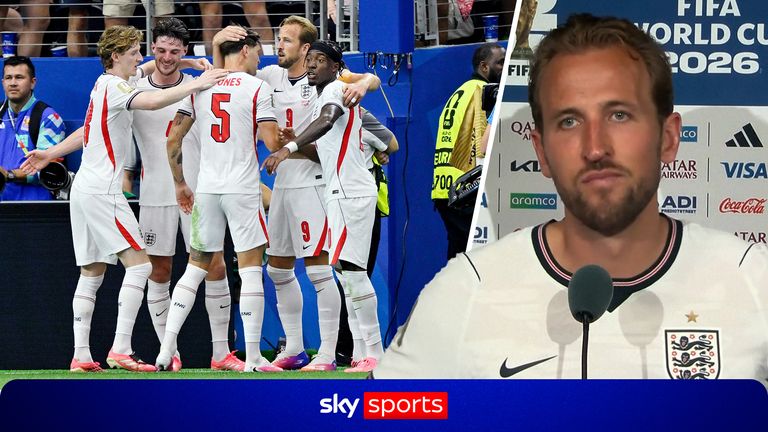
Tuchel is adamant he won't adapt England's playing style for the heat. He said: "I'm just not ready to adapt into a different style of football because of circumstances that we cannot influence. I think we would just give up our strengths."
But keeping up the same intensity against Ghana and Panama in Boston and New Jersey respectively, and indeed further ahead in the tournament, may test his resolve, with temperatures likely to be in the high 20s at their remaining group games.
Tuchel can at least look at France's efforts against Senegal for an example of how the heat can be beaten.