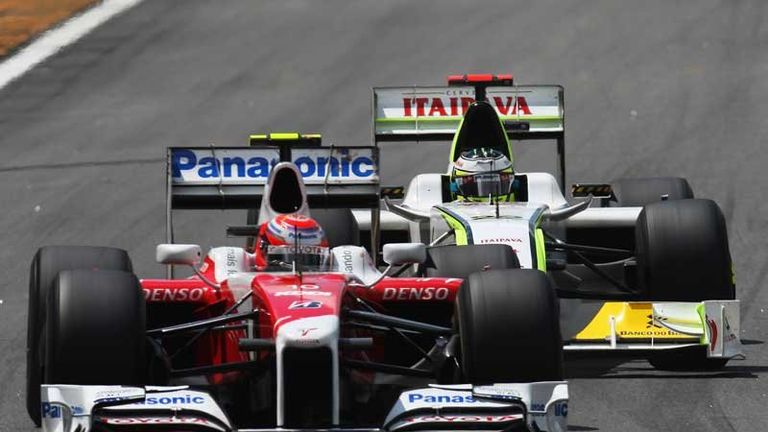
skysports.com asks whether this year's shake-up in the F1 rulebook was in fact successful.
skysports.com takes a look at the biggest shake-up in the Formula One rulebook in 25 years and asks whether it has achieved its stated aim
This year's Brazilian Grand Prix summed up everything that is great about Formula One. The race itself saw Jenson Button clinch the World Championship after coming through the field, pulling off a series of dashing overtaking manoeuvres along the way. Admittedly, his path was eased by a number of crashes on the opening lap but these too characterised the danger and excitement inherent within the sport. Pull the strands together and you were left with a thrilling piece of sporting theatre.
And yet Formula One has a problem, one on which casual viewers are always quick to pounce and one for whom those more committed have almost come to accept with a shrug of the shoulders. Namely: the cars don't actually overtake each other that often do they?
Button did it when it really mattered at Interlagos, but the number of passes he made in the race - four - equalled the sum total of all manoeuvres made by all 20 runners during the Singapore Grand Prix three weeks earlier. That night race perhaps sums up Formula One's problem: as a spectacle it was breathtaking. However, the red lights then went out and the race got underway.
With his mania for races to be held in places like Manhattan and Eurodisney, the sport's commercial rights controller, Bernie Ecclestone, doesn't give the impression of a man altogether concerned with the need for great racing; presumably as long as the TV companies and race promoters continue to cough up then everything else will take care of itself. But what of us lot at the bottom of the pyramid? Although this year's Turkish Grand Prix was notable for its empty grandstands we still keep turning out in our droves, happy to pay good money in difficult times for a product that can be frustratingly indifferent. The ability of sport to keep an irrational grip on otherwise rational people never ceases to amaze.
Ecclestone and the FIA sometimes appear joined at the hip but the governing body has at least recognised and tried to tackle the problem. Formed at the start of 2007, its Overtaking Working Group (OWG), a collective of senior engineers from leading teams, was handed the task of identifying why current F1 cars find it so difficult to pass each other and, more importantly, to try and come up with a solution.
So what is it that prevents these phenomenally skilled sportsmen doing what most people assume is the fundamental point of the exercise? In short, the cars have increasingly relied on sophisticated aerodynamics to generate the majority of their grip. However, when one car is shaping up to pass another, the air disturbance created by the one in front causes that behind to lose grip - meaning the driver has to back off. A side effect of this is a reduction in braking distances - a modern F1 car can decelerate from 200km/h to zero within 65 feet - which hardly helps matters.
Solution
The OWG's solution was to cut aerodynamic grip for the 2009 season, with 50 per cent the reduction initially hoped for. (A figure of 90 per cent was first suggested but quickly shelved so as not to make Formula One cars slower than those in junior formulae.) To do this, the FIA mandated a lower, wider front wing with an adjustable element (in order for the driver to try and improve grip when moving to pass another car), as well as a smaller, higher rear wing