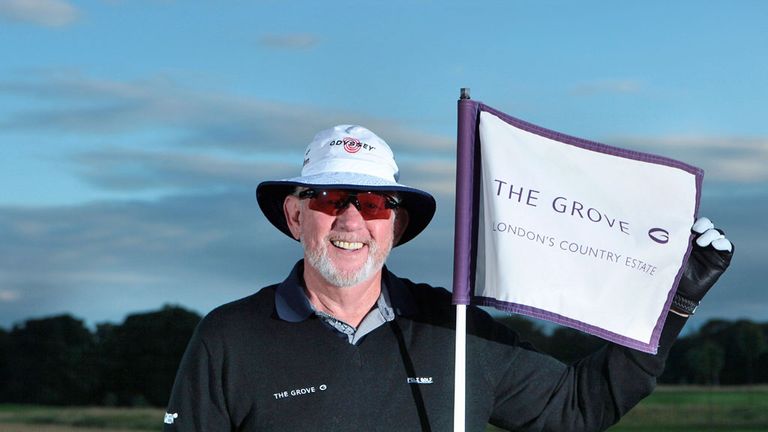
Sky Sports talks with short-game guru Dave Pelz about his early life at NASA and the keys to better scoring.
Sky Sports talks with short-game guru Dave Pelz about his early life at NASA and the keys to better scoring
Sky Sports: Dave, you have been playing golf your whole life. By the time you went to University in Indiana, it was supposed to be a four-year golfing scholarship that prepared you for the European Tour. By the time you came out of it, you had decided Physics was your game and you would be more successful in the lab - tell us about this decision?
Dave Pelz: My intent was to go to school on a golf scholarship. I played my first tournament as a seven-year-old, I played a 77-year-old man. It was a key experience, I thought it was magic, I thought I was a golfer, destined to be the greatest. I played junior golf relatively well, not good enough to get a scholarship. By the time I got out of college I knew there were college players I couldn't beat. I played against Nicklaus and Weiskopf, and I thought if I can't beat these guys, what's going to happen against the real pros? Of course, at the time I had no idea how good they were, they just beat me pretty badly, and I thought I better go earn an honest living. I was very fortunate - I got a job at Goddard space flight centre for NASA. I worked 14-and-a-half years doing space research, really applying my Major in Physics. I had learned the principles of 'Pure Research,' where you change one variable at a time and do all the analysis, but it wasn't until I got to NASA that I was able to apply this. When you send a probe from Earth to Venus, it's got to be right; the measurements have to be very accurate. I enjoyed NASA tremendously, sitting at my console, looking at satellite data, and conducting research. But I realized that every year when the Majors came round, I was taking vacation to watch the tournaments. I am a golf nut. I realized I am a golfer that loves physics rather than a physicist that loves golf. So, having heard life lessons such as 'it will never be work if you love' and 'do what you have passion for,' I decided to try golf. My boss at NASA, my division chief, happened to be a golfer. He said to me, "We have an advanced education programme, a leave of absence for a year, I can either send you for an advanced degree of physics, or I can send you out in the business world, and you can try golf." By then I had several patents in golf, as I had been doing research of my own, throughout the time I was at NASA, and I had found a couple of things and patented them. I thought, I could make a living in golf, and that maybe it would be even more fun than NASA. So, I got into golf, and lost everything, because I am not a businessman, I am very poor at business. If it wasn't for my wife I would still be in the poorhouse now! I lost everything I had in the first four years. I re-mortgaged my house and cars, borrowed or was given money by tour players. I made my money in golf finally when I got out of producing golf equipment and into teaching when I started using my research to help golfers improve their games. I recently built a new home, pooling 30 years worth of earnings into one home. The Wall Street Journal recently called It the greatest back yard ever built. I have eight greens in my back yard. I can hit every shot imaginable within 100 yards, 30 seconds from my living room. I can be hitting any short game shot in golf within one minute of whenever I want to, I can practice at any time of day or night. I still work for a living, but I am really getting excited about my own game for the first time in a long time. I'm also helping to design different people's backyards. I have been developing a grass, with a company called SYNlawn, that is really a good replication of a fairway lie. It carries directly to the golf course, unlike the old synthetic grasses that were not really any good. Now we have developed a good fairway, a good rough, a good fringe, and wonderful putting surfaces that are as good as bentgrass or Bermuda greens and they hold shots. I can practice my honest to god golf game in my own backyard, then I can go to the golf course and apply it and it carries over.
Sky Sports: You've spoken about your research, take us back to when you first started to do that research, how you gathered statistics?
Dave Pelz: Fifteen years after joining the NASA centre, I realized, I have enough information to make better golf equipment, so I'm going to spend a year doing golf business and see if I love it. I loved it, I loved it when I was losing money, so I started to wonder what it would be like once I started to make money. I had three kids at the time, so I took a chance. I started making a living, and I said this is the greatest thing I have ever done, as I'm enjoying every day, doing the research, and yet I still can't work golf out. As much as I've played, I don't understand how a man like Gay Brewer, who had a terrible golf swing, won the Masters. I said 'Pelz, you have to study how players like Brewer, Palmer and others who have awful golf swings mechanically', can beat players like Gene Littler who has a wonderful mechanical golf swing. So I started measuring every shot in the game, and I found that the short game is the key to scoring. It's not how you hit the ball off the tee, you have to hit it reasonably well, but what matters is if you can hit your wedge shots close enough to one putt rather than two putt. That's the main difference in the game. That's why Lee Westwood is a great player, who will win a major, but he hasn't yet because of his short game. If he had Phil Mickelson's short game he would have won 10 majors, as good a player as he is. Thirty years ago people didn't understand this. Every Tour player now works on his short game, every club is building short game practice areas. When I was younger, if I was caught hitting a wedge onto a putting green at my club I was fined, and threatened to be kicked out. Right now, the biggest thing I could do for amateurs, and one of the things I do at my school, is teach them to hit 8,12,14 yard pitch shots. When you miss a green, the most popular pitch shot is a 14 yard carry, you want to carry it 14 yards and make it bite and roll to the pin. If you can't do that accurately, you can't be a good player. Everybody misses greens, even the pros, pros miss five, six greens a round, amateurs often miss them all, so they are hitting greens with wedge shots, not 4 irons, you have to learn the wedge game.
Sky Sports: Give us the golden eight - from two feet to 10 feet is the crucial putt. Tell us the numbers, as some viewers may be surprised by them.
Dave Pelz: The numbers are cold, hard facts, there is no arguing this. The most important real estate in golf is the distance from two feet around the hole. At two feet the conversion rate is 100%, at three feet, it is down to 95%. At four feet, we are down to 70% and at six feet, for amateurs, we are down to 50% and from 10ft they miss 80% of them. So you go from 100% to 20% in eight feet, so every inch that you chip closer to the hole helps your scoring significantly. So, as soon as you improve your chipping to within 10 feet, the scoring gets better and better, and if I get you inside of six feet, wow! You have really started to become a player. When I was working with Ian Baker-Finch, he had a wonderful season, he won the British Open, and he had the best year of his career. What he had done was spend a whole year improving his chipping from 6ft to 4.5ft. He was a wonderful putter, he holed 100% from four feet, he holed a lot from six feet but he was better from four. That changed his career, but in some ways ruined it as well. He came to me and said, "I'm going to take a year off my short game as I don't hit it far enough." He was number two in the world but with Greg Norman ranked one he said "I've got to hit it farther." He changed swing coaches to hit it further, then again and again. Even if you go to 10 great teachers, your game is not necessarily going to get better. Take Tiger Woods, the best player in the last 20 years, he is on his third great teacher now. If you have so many swing thoughts going on in your head, it may not be beneficial for your game. He has not quite got it back yet, but we all hope he will. I admire his game, but I want Phil to beat Tiger at his best. If there is confusion in his mind he can't play, he has to get his old swing out of his game and relax on his new one.
Sky Sports: Dave, you have carried out an incredible amount of research into putting. 17" past the hole - you have determined that as the optimum speed. Tell us why?
Dave Pelz: Well, it's the optimum speed of the ball at the arrival of the hole. As the ball approaches the hole, it needs to have enough speed to carry all the spike marks and footprints that are around the hole. If you carry enough speed through the footprints to the hole that is great, but the more you increase the speed, the more you are likely to get lip outs. There is an optimum between being too slow to get into the hole and too fast that you start to get lip outs, and that is 17" past the cup. You don't miss 17" coming back, so you need to carry your putts at the optimum speed for whatever stroke you may have. I've measured it, it's true, and so I teach all my pupils, amateur or pro, to putt, on average, 17" past the cup. I penalise my students if they putt more than 34" past the hole, or if they are short of the hole, so I subconsciously train them to hit it 17" past the cup.
Sky Sports: Let's talk about pitching. I know when you first researched pitching you found that players were missing short and long rather than side to side. They were relatively satisfied to hit the ball to 25ft from 100 yards, but you thought they could get closer. Tell me how you control their distance judgment better than they did?
Dave Pelz: There are things in life, things pile on and pile on until the straw that breaks the camel's back. The piece of data that changed my career was realizing that a pro could take a wedge from 60 yards and if he hit it seven yards (20ft) left, he would be mad at himself. If he hit it right at the pin, but long by seven yards he was happy. As a scientist, I'm saying he is pleased and disgusted with the same 20 yard putt. I realized in the whole of golf the misses are left and right, the problem with the power game is direction. As soon as you get into partial swing shots, less than a full swing with wedges, direction is good as it is a shorter more upright swing, but your distance is wrong as you are not using a 60-yard club for a 60-yard shot, but a 110-yard club that is reliant on how hard you swing. Distance control is the issue due to having to swing half or three quarters. If you just think about the length of your swing you will hit better wedges. I formulated a theory that is based around how far you hit your wedges from specific lengths of swing, based around a clock system. If I learn how far I hit my 60 degree wedge from 9 o'clock downwards, it's a shot I now have in the bag. I hit this shot 71 yards, so now I have a 71-yard club in the bag. Phil Mickelson has five wedges and several different distances for each he knows, he can hit them with his eyes shut, which is an advantage over other guys.
Sky Sports: Tell us about your work with Phil Mickelson. A lot of people see him as a feel player and you as a scientist, so how does this team work?
Dave Pelz: I am a scientist and I teach mechanics in my school, as no matter how good your touch is if you have a bad mechanical swing you are going to be a bad player. If you have a bad putting stroke, it doesn't matter how good your feel is. If you can't repeat your putting stroke mechanics, feel doesn't matter. But, once you get good mechanics, you build feel on top of that. Feel is a learned, experiential thing that happens, once you find out through repetition how far a stroke will go, you can find out how to fit that into the situation that you are presented with. In my world of teaching, it is mechanics first, feel second. If you can't learn a reasonably well repeating swing, don't even bother trying to learn touch, as it's never going to happen. Once you have a mechanic and layer on top feel, the mechanics soon become second nature and feel becomes the sole thought. Phil is not mechanical, I have been working with him nine years now and he has solid mechanics, and now can focus on feel when he practises.
Sky Sports: When you first worked with Phil is it true to say that he could play the elaborate shots but the simple shots were not as good?
Dave Pelz: That is the first result I ever measured on Phil. He was great if he had to hit over or round a tree, or into a bank and check it and bounce, he was not so good with 10 yards to the green without any obstacles. Phil would not engage mentally, there was no difficulty in his mind so he would just hit the shot and view it as no challenge. He was brilliant at difficult shots, but ordinary at normal shots. I started challenging him by saying 'you have to make this shot to make the cut.' As soon as he tried to hole the easier short game shots, the less challenging shots went from ordinary to extraordinary.
Sky Sports: One of Phil's extraordinary shots was in the final round of the 2010 Masters when he played from the trees, knocking it onto the green. Were you screaming at the television saying 'knock it out and hit a wedge shot to the green, you're the best wedge player around'?
Dave Pelz: I wasn't screaming at the television, but I couldn't watch. When we starting working nine years ago he has a philosophy that he loves to challenge things, he is so competitive that he tries to do anything. I am from a world where this is a problem, as I teach people that if you can't do something nine out of 10 times, then don't try it, especially if there is a one-stroke penalty if you are a foot short! Phil thinks 'if I can do it I'm going to try it, if one out of 10 it works I'm going to try it', versus me saying only try it if you can do it nine out of 10 times. In nine years he now thinks if I can do it half the time, 50%, I'm going to try it. Of course, when the heat is on, he tends to think he can do anything. He thought he could hit his last drive on the fairway at Wingfoot, and he hit it into the tent. He was driving very poorly and he should have hit a four wood off the tee, and he would have won the US Open. He didn't, and we are still looking for our US Open... hopefully next year. He's a great player, I love working with him. I don't change Phil Mickelson, he takes what he wants from my research. He is doing pretty well, he has won four majors, and hopefully he is going to win four more.
Sky Sports: You've spoken about Lee Westwood, and how his quest to better his short game should win him a major. If you were going to work with him, which aspect would you most like to help him improve?
Dave Pelz: Well, I really can't answer that definitively, I know Lee, I see him at Augusta every year when I'm preparing with Phil. He knows he can win a major, he's been close, he's been working on his short game. I would have to measure his game and learn where his short game weaknesses are, I really don't know what they are until I measure them. The fact he is just working on his short game is good news to me, I wish him luck every time I see him. His power game is great, but if he had Phil's short game he would have won 10 majors. He may not have time in his lifetime to get to Phil's short game level, but he doesn't have to, he has been close so many times without a good short game. So with a reasonably good one he won't struggle to win majors.
* To book a place on one of Dave Pelz's Scoring Game Schools at The Grove, click here