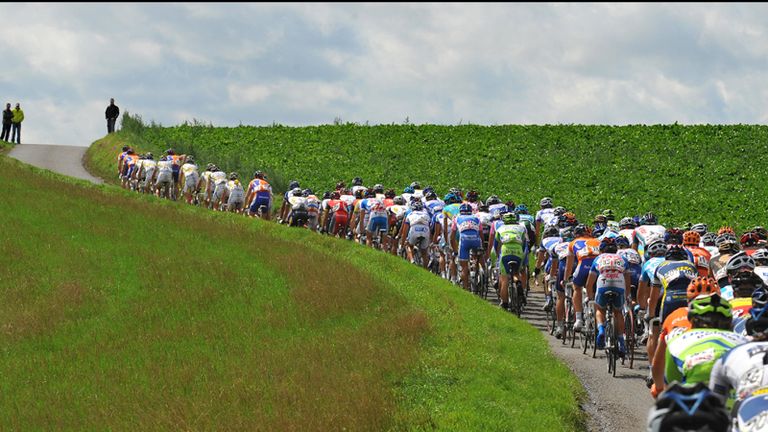
We take a closer look at each day’s action for the tough multi-national stage race the Eneco Tour.
Preview of the seventh edition
The Eneco Tour – also known as Tour of the Benelux – is a demanding seven-day stage race that takes in some of the most famous and testing roads in Europe.
Despite the Low Countries being renowned for their largely flat roads, the race organisers routinely seek out the most testing bergs in the region in a bid to test out the world’s elite.
Run in equal parts across Holland and Belgium, the race has often rewarded the strong men in the bunch, and with precious WorldTour points up for grabs there will be no quarter given once again.
2011 sees the often decisive time trial moved further towards the middle of the race, likely setting up a number of do-or-die attacks over the remaining two hilly stages, including an important run over the 2012 World Championship circuit on the final day.
Team Sky rock up in the Benelux with a strong team of riders including last year’s third placed man and former winner Edvald Boasson Hagen, as well as 2010 stage winner Greg Henderson. The duo are joined by Michael Barry, Juan Antonio Flecha, Mathew Hayman, Christian Knees, Ben Swift and Geraint Thomas.
Monday 8 August – Prologue: Amersfoort – 5.7km
The race begins in Holland with a short prologue blast around the streets of Amersfoort. The technical opening salvo in the Vathorst district should ensure that a few seconds separate the favourites going into the first stage. The course is short enough for powerful sprinters to mix it up among the time trial experts while conditions could also play their part should the road surface become slick.
TV coverage: Live on British Eurosport between 1400-1530 with highlights on British Eurosport 2 from 1800-1900 & 2030-2100.
Tuesday 9 August – Stage one: Oosterhout to Sint. Willibrord – 192.1km
The race heads south for stage one which should play into the hands of the sprinters on a second consecutive day in Holland. The peloton rolls out of Oosterhout, winding its way out of the city centre before heading south-west, with constant direction changes increasing the danger of cross-winds. A break will likely head up the road to contest the first sprint point of the day at Roosendaal (49.4km) before continuing to Bergen op Zoom. A brief glimpse of the North Sea is followed by a swift direction change as the stage closes in on Sint. Willibrord. The riders cross the finish line and take in an anti-clockwise easterly loop before re-entering the 15km finishing circuit.
TV coverage: Live on British Eurosport between 1400-1530 with highlights on British Eurosport 2 from 1915-2000 & 2145-2300.
Wednesday 10 August – Stage two: Aalter to Ardooie – 174km
A stage run on roads steeped in plenty of cycling history, day three sees the race enter Belgium and the Flemish Ardennes. Classics country shouldn’t throw too much of a spanner in the works for the sprinters despite a few tough, punchy mid-stage climbs. The day begins with a clockwise loop around Aalter, culminating in a sprint point before the route heads south. Ascents of the Edelareberg (81.7km), Berg ter Stene (87.7km) and the Tiegemberg (112.6km) should encourage attacks, yet a pan-flat run for home will make it difficult to stay away. After the climbs have been completed in the vicinity of Oudenaarde, the race heads back north-west. Riders must negotiate a lap of an angular finishing circuit in Ardooie ahead of a likely bunch kick.
TV coverage: Live on British Eurosport between 1400-1530 with highlights on British Eurosport 2 from 1815-1930.
Thursday 11 August – Stage three: Heers to Andenne – 191.2km
Likely to be described as a ‘mini’ Ardennes classic, stage three looks set to cause a shake-up in the standings. Another day in Belgium begins with a starting loop around Heers, a warm-up for a tough stage to come. From there the peloton heads south into Amay. Immediately the riders are faced with the Mur d’Amay (72.4km), a tough climb in its own right but only a precursor to the most recognisable berg of the day. The infamous Mur de Huy is best known as the final climb of Fleche Wallonne, yet with over 100km remaining it may not decide the winner, but should thin out the bunch ahead of a finishing circuit. A further five tough climbs will whittle down the contenders with the one-two punch of the Cote de Saint-Roch and Cote des Aguesses deciding the winner.
TV coverage: Live on British Eurosport between 1400-1530 with highlights on British Eurosport 2 from 1855-2000.
Friday 12 August – Stage four: Roermond (individual time trial) – 14.7km
The race heads back into the Netherlands for a decisive time trial around Roermond. A course of two halves, the route heads out of the historic centre after beginning outside the City Hall. A technical start to the course gives way to wide, straight roads which will suit the powerful riders in the bunch. There could be plenty to celebrate at the finish with the time trial stage often used as a platform for an overall race victory.
TV coverage: Live on British Eurosport between 1400-1530 with highlights on British Eurosport 2 from 1930-2030 & 2230-2330.
Saturday 13 August – Stage five: Genk to Genk – 189km
It’s back into Belgium for the penultimate stage and another day of undulating terrain. The day begins with an opening 20km circuit around Genk before a largely flat run south towards Liege. It is here that the climbing begins with the Rue de Dalles (73.2km) and Wonckerberg (89.8km) arrive before the entry to a tough and hilly loop. The riders tackle the Hallembaye climb from both the north and the south, yet it is the consecutive climbs of the Cote de Dalhem and Cote Suphexe within the space of six kilometres that should cause splits to form. The climbs continue on the run back north through the Meuse Valley region but a largely flat return to Genk could ensure a decent-sized bunch contest the uphill stage finish.
TV coverage: Live on British Eurosport between 1400-1530 with highlights on British Eurosport 2 from 1910-2000.
Sunday 14 August – Stage six: Sittard-Geleen to Sittard-Geleen – 201.2km
Far from a tame end to the race, the final stage could well be the most intriguing of the entire event with the riders being allowed an early taste of the 2012 World Championships course. The Limburg region of Holland is the setting meaning much of the route is used during Amstel Gold. The climbs come thick and fast after a brief opening circuit, with the Cauberg (36.6km) the first major test. A packed parcours including the Bemelerberg, Loorberg, Camerig and Eyserbosweg should begin to split things up mid-stage. The Cauberg is tackled for a second time as the stage leaves its southern loop and heads back to the finish. What is left of the bunch must still attack the Kleverberg and Zandberg before returning to the finish area where the winner of the race will be crowned.
TV coverage: Highlights on British Eurosport between 1530-1630.