
2013 German Grand Prix analysis: Where Sunday's race was won and lost
Did Kimi need to pit again? How much time did the Caterhams cost Button? Did Ferrari get Alonso's strategy wrong?
Tuesday 9 July 2013 13:21, UK
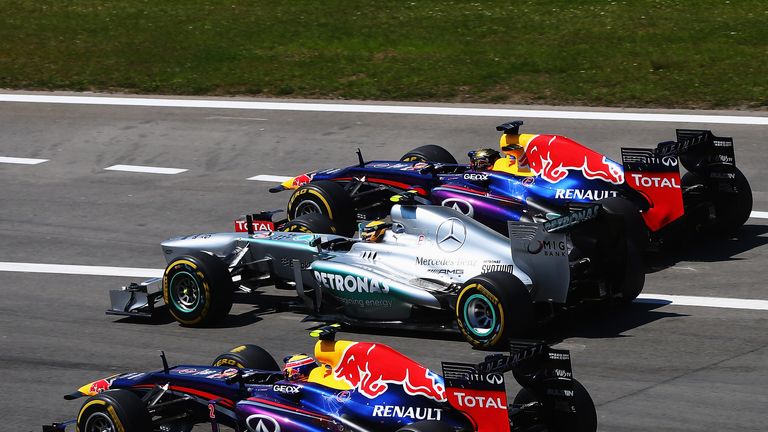
How much time did Lewis Hamilton lose behind his team-mate?
While Lotus were naturally the more vocal post-race about the time they lost behind the Mercedes duo of Hamilton and Nico Rosberg, Hamilton himself also had reason to feel more than a little aggrieved to have found himself trapped behind the sister Mercedes for so long given they were on opposing strategies. Having pitted at the end of lap six, Hamilton was told by his race engineer to give it a "big push" on his out lap as they aimed to undercut the Red Bulls and also, seemingly, keep track position ahead of Raikkonen, who would stop himself two laps later. However, after catching Rosberg mid-way round lap eight, Hamilton would, somewhat inexplicably, spend the next six laps running within a second of his team-mate - and at times nearly on the sister W04's rear wing - without being released. Hamilton was clearly annoyed, protesting over the radio that "Nico is not in the same race". Yet despite Rosberg getting told on lap 12 by his engineer "Nico you are on different strategy to Lewis, don't hold him up" it wasn't until the start of lap 14 that the German finally heeded this message. With Rosberg having consistently been lapping in the high-1:38s up until then, Hamilton had already completely lost touch with Vettel - his pre-stop deficit of 2.5s ballooning to 8.6s - and was also jumped by the flying Romain Grosjean. However, while it undoubtedly marked Mercedes' second questionable handling of strategy of the weekend, Hamilton's lap times didn't actually improve once he was ahead of Rosberg. Between lap 15 and his early second stop, the Briton never dipped into the 1:37s and actually twice slipped into the low-1:39s, with the sluggish pace even allowing Raikkonen to overtake him on track. The fact that Hamilton ultimately finished nearly half a minute behind the man he had started alongside on the front row really told you all you needed to know about Mercedes' race - and pace. Did Ferrari get Alonso's strategy wrong?
Ferrari's latest attempt to get round their long-standing single-lap pace woes at the Nurburgring saw them sacrifice any shot at qualifying on the front two rows on Saturday and set their Q3 laps on the slower medium tyres. The plan was to gain track position over faster cars ahead by running a longer first stint, and then going on the attack on the soft tyres when the fuel levels decreased in the closing stages. However, amid the highest temperatures of the weekend, the first part of that plan failed to pay dividends as Alonso only managed to stretch his opening stint to 12 laps, some nine tours shorter than Jenson Button's on the same compound - albeit Alonso had put three laps on his medium set in Q3 - and, quite amazingly, one lap less than Romain Grosjean managed on the apparently brittle softs. Although Alonso was able to duly attack when he himself eventually took to the softs after his lap-49 final pitstop, even setting the fastest lap of the whole race, he still missed out on the podium by a couple of seconds. Both driver and management were adamant after the race that the result wouldn't have been any different had they started a couple of places higher up on the grid as the F138 simply didn't have the performance to outrun the Red Bulls and Lotuses on outright pace in either qualifying or the race. The sobering reality for Ferrari's flagging title challenge is that it's hard to disagree with them. How much time did Jenson Button lose lapping the Caterhams?
There is no doubt that Lewis Hamilton was lapping quicker than Jenson Button when he caught and passed him on the final lap, but was his former team-mate right to blame Charles Pic and Giedo van der Garde for allowing the Mercedes driver to close on him? When the pair crossed the line on lap 55 to start the final five laps, they were separated by 7.068 seconds. That gap was cut by 1.595 seconds the next time around as the McLaren man lapped Max Chilton's Marussia - Button dropped eight tenths of a second on his previous lap time. Hamilton by contrast managed to set his fastest lap of the race when lapping the Marussia driver - his time on lap 57 was 1:34.156. Button by contrast had now caught the Caterhams and lapped the Nurburgring in 1:35.857. Button's time was slower by a further 1.154 seconds on lap 58 as he fought his way past Pic and van der Garde, allowing Hamilton to cut the gap to 1.922 - the Mercedes driver 1.853 seconds faster. Thus negating the time lost behind lapped cars, it would appear that Hamilton was consistently between seven and eight tenths of a second quicker than Button in the closing stages. That would not have been enough to close the seven second gap in the final five laps without the outside intervention of the Caterhams.
While Lotus were naturally the more vocal post-race about the time they lost behind the Mercedes duo of Hamilton and Nico Rosberg, Hamilton himself also had reason to feel more than a little aggrieved to have found himself trapped behind the sister Mercedes for so long given they were on opposing strategies. Having pitted at the end of lap six, Hamilton was told by his race engineer to give it a "big push" on his out lap as they aimed to undercut the Red Bulls and also, seemingly, keep track position ahead of Raikkonen, who would stop himself two laps later. However, after catching Rosberg mid-way round lap eight, Hamilton would, somewhat inexplicably, spend the next six laps running within a second of his team-mate - and at times nearly on the sister W04's rear wing - without being released. Hamilton was clearly annoyed, protesting over the radio that "Nico is not in the same race". Yet despite Rosberg getting told on lap 12 by his engineer "Nico you are on different strategy to Lewis, don't hold him up" it wasn't until the start of lap 14 that the German finally heeded this message. With Rosberg having consistently been lapping in the high-1:38s up until then, Hamilton had already completely lost touch with Vettel - his pre-stop deficit of 2.5s ballooning to 8.6s - and was also jumped by the flying Romain Grosjean. However, while it undoubtedly marked Mercedes' second questionable handling of strategy of the weekend, Hamilton's lap times didn't actually improve once he was ahead of Rosberg. Between lap 15 and his early second stop, the Briton never dipped into the 1:37s and actually twice slipped into the low-1:39s, with the sluggish pace even allowing Raikkonen to overtake him on track. The fact that Hamilton ultimately finished nearly half a minute behind the man he had started alongside on the front row really told you all you needed to know about Mercedes' race - and pace. Did Ferrari get Alonso's strategy wrong?
Ferrari's latest attempt to get round their long-standing single-lap pace woes at the Nurburgring saw them sacrifice any shot at qualifying on the front two rows on Saturday and set their Q3 laps on the slower medium tyres. The plan was to gain track position over faster cars ahead by running a longer first stint, and then going on the attack on the soft tyres when the fuel levels decreased in the closing stages. However, amid the highest temperatures of the weekend, the first part of that plan failed to pay dividends as Alonso only managed to stretch his opening stint to 12 laps, some nine tours shorter than Jenson Button's on the same compound - albeit Alonso had put three laps on his medium set in Q3 - and, quite amazingly, one lap less than Romain Grosjean managed on the apparently brittle softs. Although Alonso was able to duly attack when he himself eventually took to the softs after his lap-49 final pitstop, even setting the fastest lap of the whole race, he still missed out on the podium by a couple of seconds. Both driver and management were adamant after the race that the result wouldn't have been any different had they started a couple of places higher up on the grid as the F138 simply didn't have the performance to outrun the Red Bulls and Lotuses on outright pace in either qualifying or the race. The sobering reality for Ferrari's flagging title challenge is that it's hard to disagree with them. How much time did Jenson Button lose lapping the Caterhams?
There is no doubt that Lewis Hamilton was lapping quicker than Jenson Button when he caught and passed him on the final lap, but was his former team-mate right to blame Charles Pic and Giedo van der Garde for allowing the Mercedes driver to close on him? When the pair crossed the line on lap 55 to start the final five laps, they were separated by 7.068 seconds. That gap was cut by 1.595 seconds the next time around as the McLaren man lapped Max Chilton's Marussia - Button dropped eight tenths of a second on his previous lap time. Hamilton by contrast managed to set his fastest lap of the race when lapping the Marussia driver - his time on lap 57 was 1:34.156. Button by contrast had now caught the Caterhams and lapped the Nurburgring in 1:35.857. Button's time was slower by a further 1.154 seconds on lap 58 as he fought his way past Pic and van der Garde, allowing Hamilton to cut the gap to 1.922 - the Mercedes driver 1.853 seconds faster. Thus negating the time lost behind lapped cars, it would appear that Hamilton was consistently between seven and eight tenths of a second quicker than Button in the closing stages. That would not have been enough to close the seven second gap in the final five laps without the outside intervention of the Caterhams.