Matt Cooper writes about the huge impact Seve Ballesteros had on European golf, golfers and golf fans
Matt Cooper writes about the huge impact Seve Ballesteros had on European golf, golfers and golf fans
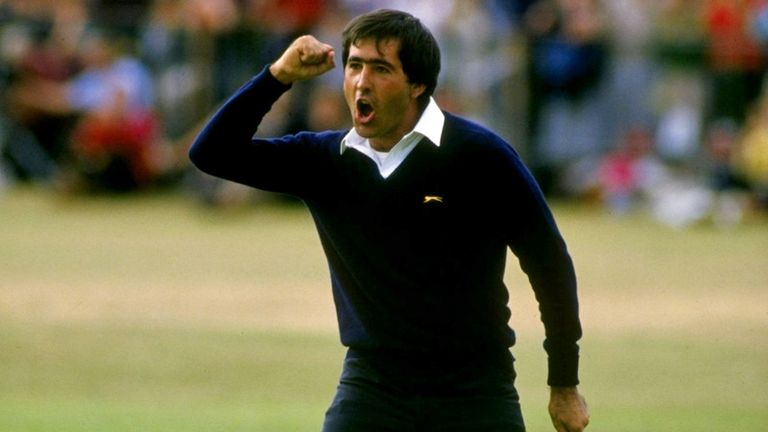
When I was a student my friend had the famous poster of Ernesto Guevara on his wall - the iconic image of a political revolutionary. I, on the other hand, had a photograph of Severiano Ballesteros winning the Open at St Andrews pinned to my notice-board - the iconic image of a golfing revolutionary.
My abiding memory of Seve is clear, distinct and magnificent: he is striding from the green, with the wind in his thick hair and the galleries roaring their approval. Acknowledging them, Seve smiles, raises one arm and then delivers his trademark fist punch.
This memory is born of watching television, peering at photographs and, for one glorious afternoon in 1993, seeing him in person. It is a vision of Seve at his imperious, magnetic and compelling best; thrilling the crowds but also - crucially - imploring them to join him on his journey.
All golfers have a fist-punch that is their own. Tiger Woods has always delivered fierce upper cuts against fate, whilst his great rival Phil Mickelson delivers a curiously under-stated fist-
squeeze that seems designed to thank destiny rather than overwhelm it.
Seve's was different again: with the upper arm parallel to the ground, he would thrust his forearm and fist upright where they would shudder with intensity. It was famously employed when he holed out to win the Open Championship on the 18th green at St Andrews in 1984 (the moment captured in my photograph) and he followed it up by twice propelling his arm skyward.
There was something militaristic about it, similar to the call to arms of a revolutionary leader like Guevara and they had much else in common: the brooding looks, the dark eyes and the millions of ardent followers.
Although a little over-blown, the comparison is not entirely without merit because in the eyes of golf fans - and on the basis of what he achieved for European golf - Seve was every bit as heroic and emblematic as Che. It is also true that, like Guevara, Ballesteros' legend cannot be measured by achievement alone, but by style, charisma and inspiration too.
Dashing
As a player he was dashing and slightly reckless. He possessed the fighting qualities of an alley-cat, the imagination of an artist and the daring of a matador. He introduced himself in mid-1970s as a smiling, carefree teenager but, as he travelled the world and his celebrity grew, he became, for a while, a wary and distrustful young man.
Partly this was justified - he was not always managed well, Deane Beman at the PGA Tour made his life difficult and he went to war with both the European Tour and the Ryder Cup committee. But there was also some paranoia - perceived slights and assumed grudges.
Like any true revolutionary he used these political squabbles to fuel his greatest glories and his finest achievement was not just winning those majors but motivating a continent. In the wake of his major successes a generation of European golfers believed they, too, could conquer the world (and did).
When, in 1983, Tony Jacklin urged him to return from self-imposed Ryder Cup exile (the consequence of one of his many battles with authority) it was a masterstroke - Ballesteros thrived on the responsibility. If his individual major success had been an indirect example of him fighting the Euro cause, his on-the-course leadership of the European team was a direct expression of continental pride.
When the Europeans narrowly failed to defeat the USA that year, many of the team were bereft until Seve delivered an inspirational (post) battle cry. "What is the matter with you?" he implored. "This has been a great victory. This proves we can beat them. We must celebrate."
Two years later he was proved correct and two years on the Americans were defeated on home soil for the very first time, thanks in no small part to one of the great Ryder Cup partnerships: Seve and his great friend Jose Maria Olazabal.
In those three matches the Ryder Cup had been pulled from the mire. Before it was an embarrassing mis-match, then it became a thrilling contest, now it is the third most watched sporting event on the globe. Seve changed that.
Don't overlook either the state of European golf before his emergence. Apart from Tony Jacklin the concept of a decent European golfer didn't really exist in the post-war era. The players rarely ventured to America and the state of the European Tour is best demonstrated by comparing transport and accommodation in the 1970s and today: then players travelled by and slept in small camper vans; now they fly in private aeroplanes and stay at 7-star hotels. Seve changed that.
Transformed
But he didn't merely inspire his peers, or turn a mis-match into a contest, or improve working conditions and pay, what he really achieved was genuinely revolutionary: he transformed a continent's mindset.
European golfers didn't just play inferior golf, they acted like inferiors too. In due course they were treated like them, even when one or two of them proved otherwise. Seve wasn't having any of that. It takes something special to reverse a culture of sub-servience and Seve had it; a potent blend of self-belief, righteousness and, yes, arrogance.
He also had something extra, an aura that was remarkable to behold and which, as mentioned earlier, I was fortunate to experience for the tiniest period of time. It was during the 1993 Ryder Cup, when, paired with Olazabal against Davis Love III and Tom Kite on the first afternoon, Seve holed out on the 11th green.
I had positioned myself next to the roped walkway to the 12th tee and watched transfixed as he marched towards me, waving to the crowd. "Muy bien, Seve," I squeaked before offering a lame fist-punch.
What happened next is seared into my brain. Seve's dark eyes looked straight into my own, he smiled, and then said, in that familiar halting English accent, "Thank you very much."
I'm not remotely embarrassed to say that I swooned. It wasn't just those few words and a glance in my direction; it was because I had never before, and I have never since, felt such electricity in the presence of another human being. It was utterly extraordinary.
European golf didn't have Seve for one or two seconds though, it had him for two glorious decades in which he went from that happy-go-lucky 19-year-old finishing runner-up in the 1976 Open Championship to the frantic, manic and very nearly lunatic captain of the Ryder Cup team at Valderrama in 1997.
That week completed his crusade for European golf. He had dragged it to the top of the world and his final dream was to be victorious on Spanish soil.
In some senses his players won that match in spite of him as he fretted every decision, darted in all directions and generally got under their feet. But in a greater sense they won it because of, and for, him; they recognised what the occasion meant to him, they appreciated his influence on their careers and they understood what he deserved.
Severiano Ballesteros was the greatest golfer the continent of Europe has ever produced. Others - Faldo for example - won more majors, but none impacted on the sport like the Spaniard did: not just an audacious shotmaker and short game genius, but a man who made the game globally significant.
For the fans there has been no other like him. The biggest difference between Seve and Tiger? Watch the galleries at the Open. Tiger attracts just as many thousands as Seve did but we
watch his progress, we don't interact. We admire Tiger, we loved Seve. When Seve stalked the fairways (and the rough), the thousands running up and down dunes weren't watching, we were being
led by him - he punched the air, we cheered our support and then we followed him. Our golfing revolutionary. Our hero.