
Ryder Cup 2014: Sir Nick Faldo on the pressures facing the players
Friday 5 September 2014 20:06, UK
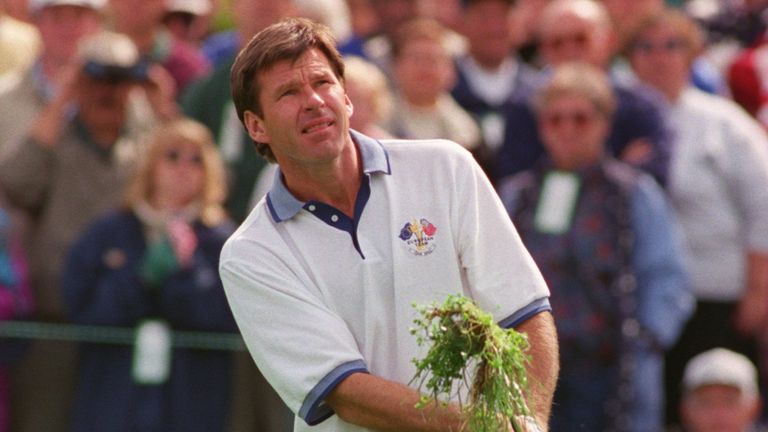
If you want an insight into the pressure and commitment involved in being a Ryder Cup player, there are few better qualified to ask than Sir Nick Faldo.
The six-time major winner was a mainstay of the European team over a remarkable 20-year period, and he played a huge role in transforming the biennial contest into the huge showpiece it is today.
Faldo made an instant impact on the Ryder Cup on his debut in 1977, winning both his matches alongside Peter Oosterhuis and then causing a major upset on the final day with a 1up victory over Open champion Tom Watson.
He went on to make 11 appearances as a player, and he remains in possession of a number of Ryder Cup records that only Colin Montgomerie has come close to overhauling.
The autumn showdown against the United States is now one of the biggest events on the sporting calendar, a far cry from the low-key encounters of the 1970s when the trophy took up permanent residence across the Atlantic.
The turning point came when the Great Britain and Ireland team became Europe in 1979 at the request of Jack Nicklaus, who felt the Ryder Cup was in danger of falling by the wayside if the American dominance continued.
Nicklaus was captain in 1983 when Europe cam agonisingly close to pulling off a stunning victory at PGA National, but they only had to wait another two years before Sam Torrance’s putt reclaimed the Ryder Cup after 36 barren years.
Under Tony Jacklin’s astute leadership, Europe’s players were sharper, more motivated, and they went into the contest undaunted by the might of their opponents.
Motivation
“I had no problem with motivation for the Ryder Cup. You always believe that everyone on the team is motivated and is going to give 100%,” said Faldo.
“In the early days they were more worried about giving you an Aquascutum raincoat! You were given two or three sweaters, you got your outfit and that was it – you went and played.
“There was none of the fanfare you get now, but it’s fantastic the way the Ryder Cup has progressed, and it’s thanks to what we did in the 80s. It changed the whole event.”
Faldo enviable work ethic and attention to detail made him better equipped than most to handle the burden of playing for 11 team-mates, an attribute he displayed countless times during his glittering Ryder Cup career.
“If you want to be there, be there, if you don’t want to be there, guess what – you won’t have made the team,” he said. “Pressure is a privilege, all you want is to be playing well.
“I’ve been there when I’m playing well, but I’ve also been there when I’ve been playing really badly, and that is the worst feeling in the world because you’re playing for other guys.”
Pressure
Faldo’s most talked-about Ryder Cup moment came in 1995 at Oak Hill, where his final-hole victory over Curtis Strange reduced both he and Seve Ballesteros to tears.
In the pivotal match of the singles, Faldo won the 17th to get back to all square before an errant drive at the last gave him no chance to go for the elevated green.
After laying up to 93 yards, Faldo kept his emotions and nerves in check to clip a sublime wedge to five feet, and the putt was never in doubt after Strange failed to get up and down from the punishing greenside rough.
“That was a great moment,” reflected Faldo, failing to mask an immense amount of pride. “It was the most pressure I ever felt when I was over that wedge shot – my legs had gone.
“There was no option with that shot. If I went over the green, I was done, if I over-spun it I was done, and it ended up perfect.
“It was a good thing that my ball just trickled off the fairway. If had I been on the fairway, I don’t know how I would have played it – it would have been all about the spin.
“In the first cut it was just sitting up enough and that saved me. It was still a controlled 93-yard shot, so if I’d had a bit of a twitch on that I would have been over the green and a different story.”
Favourite partner
Faldo was also keen to emphasise the importance of getting the pairings right over the first two days of battle, and he singled out Ian Woosnam as his favourite Ryder Cup partner.
“I started with Oosty and that was great as we played five together over ‘77 and ‘79 and won four.
“Then there was Bernhard Langer, and then Ian Woosnam. Woosie was probably the best one because we played so darn good at Muirfield Village in 87.
“That was a classic, we flew in on Concorde, and Tony Jacklin said: ‘Right, you two are together’. That evening, we literally ran out onto the course with our caddies for a practice round.
“We got on well and played great. Woosie could hit a persimmon three-wood 250 yards through the air, which in that era was huge.
“We dovetailed well together and had a great week. We had another good time at the Belfry in 89, but by the time we got to Kiawah Island in 91 we were both off. Another drama!
A good pairing has to dovetail really well. You’ve got to be more than comfortable - you’ve got to have two heads thinking the same. You can’t have one guy saying: ‘This putt is right edge’ and the other saying: ‘No, I think it’s four inches outside’.
Faldo was speaking at Urban Golf in Kensington at an event promoting Jaermann and Stubi, who have produced a stunning collection of watches from a significant set of golf clubs.
The master craftsmen at Jaermann and Stubi, who have conducted similar projects with Ballesteros and Ben Crenshaw, melted down the clubs used by Faldo to win the LA Open in 1997, his final professional tour victory and forged a series of 72 exquisite watch cases.
Part of the proceeds from the sales - $1,000 per watch - will go directly to the Faldo Series, the foundation set up by Sir Nick in 1996 to help identify and nurture the next generation of golfers worldwide.
“It’s such a cool idea,” said Faldo. “To have such a contribution from Jaermann and Stubi to the Faldo series is something I’m very grateful for.
“They wanted me to provide a set of clubs that had some meaning. I had these clubs just sitting around, so it was perfect.”