
Waterville course guide
Friday 19 October 2007 14:09, UK
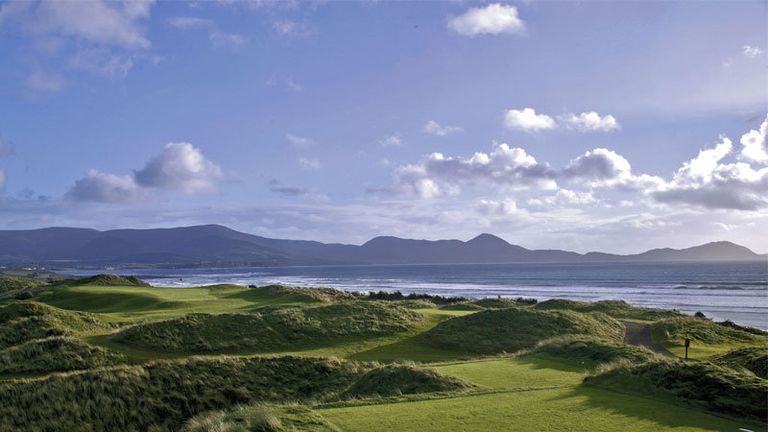
Nature and man have combined to stunning effect at Waterville.
To the trained eye, telling apart a century-old course from one less than half that age is not normally a difficult task. But then few courses built in recent times can boast either the natural advantages or the lofty ambitions of Waterville, on Ireland's West coast. Already a links of worldwide renown, Waterville has recently undergone a multi-phase redevelopment under the instruction of American designer Tom Fazio. The result is a links that combines tradition with bold invention, and on barely a single hole does the pace slacken - nor should it, because no stone has been left unturned, quite literally, in creating a course that is stunning more or less than start to finish. Waterville occupies a promontory at the furthest end of the famous Ring of Kerry. This spectacular coastal drive attracts tourists from the world over who are transported by the coach-load around precarious bends and narrow lanes to watch the Atlantic Ocean crashing into the rocks below. A round at Waterville is the golfing equivalent of this. With water on three sides, MacGillycuddy's Reeks on the fourth and holes that plough relentlessly through the dunes, this is golf on a grand scale. In fact, only a handful of courses created in the second half of the 20th century can realistically stand comparison; and of those perhaps only one or two can match it. Kingsbarns, in Fife, is certainly one, while the European Club close to Dublin is another. Some would put a case for Loch Lomond. Perhaps. That is an argument for another day but in an age when so many courses boast championship pedigree it is worth emphasising that Waterville is very much the real thing. It has strong American connections and each year in early July a phalanx of their top stars call in to begin their preparations for the forthcoming Open Championship. Tiger Woods is a regular guest, and it was here that Mark O'Meara warmed up before winning the Claret Jug at Birkdale in 1998. Payne Stewart was such an enthusiastic and regular guest that he was invited to become the club's millennium captain before his tragic death in a plane crash in 1999. A statue of him stands in front of the clubhouse. Much like Kingsbarns, Waterville began life as a modest nine-holer over 100 years ago and fell into disuse before being resurrected. It was in the early 1970s that John Mulcahy, an Irish-born American, bought the land and, with the help of Eddie Hackett, set about transforming it into something resembling that which stands today. He sold the property to a group of Irish-Americans in the 1980s, and they recently brought in Fazio to carry out upgrades. His principal brief was to work on the flatter terrain the front nine occupies and create an outward half as memorable as the inward one. The American described the site as "truly spectacular" and "one of the best I have seen for golf". His work was concluded as recently as last year, and from the back tees Waterville now stretches to a mighty 7,300 yards. The opening hole is called 'Last Easy', and while there may be an element of tongue-in-cheek about such a description, the point is made that good scores have to be earned every inch of the way here. That much is apparent as early as the second, a formidable par four that mercifully runs downhill towards the green, behind which are the first views of Ballinskelligs Bay. The 3rd hole is the only one on the course lacking a links feel to it - there is even a palm tree beside the water that runs down the right of the fairway - but the first of the short holes, the gorgeous 4th, is a more accurate sign of what is to come. What goes down must come back up, and the price for playing down to the shore on the 2nd and 6th is repaid at the 7th, a hole Fazio has created from scratch. By moving earth and designing a dogleg lined by a stream, he has done his utmost to divert attention from what is a significant rise in elevation on a hole that tends to play much longer than the yardage suggests. Impressive as Fazio's work on the front nine is, it is the second half of the course that remains the highlight. Many believe the 11th, 'Tranquillity', to be the best par five in Ireland and it is easy to see why. Played in magnificent isolation down a channel through the dunes, it is a classic seaside hole in the sense that it is defined by its contours that make the raised green such an elusive target. Then comes the 'Mass Hole', so-called because it was here in the dell between green and tee that the locals used to congregate in the dark days to avoid prosecution. This point-to-point par three is at its hardest when the wind is swirling. As all great courses do, Waterville builds to a crescendo. It begins with the remodelled par-four 16th, where former club professional Liam Higgins once recorded an outrageous hole-in-one, and continues with an inspiring short hole. The 18th is unusual, a mighty par five, and this too has been strengthened by Fazio to provide a more dramatic finish. Waterville is a links that combines the best of both worlds. The stunning natural setting houses a collection of holes that simply follow the lines dictated by the land. And where Mother Nature has not been so considerate of golfers, modern techniques have been introduced so that what were once the weaker holes are now entirely worthy in their own right. The resulting combination is a layout with a versatility that makes it as capable of seducing the first-time visitor as it is of hosting a professional championship. The Americans think little of crossing the Atlantic to play here; more of us Brits should hop on the next available flight into nearby Kerry or Shannon Airports and join them. For more NCG articles click here