
Walton Heath course guide
Friday 19 October 2007 14:07, UK
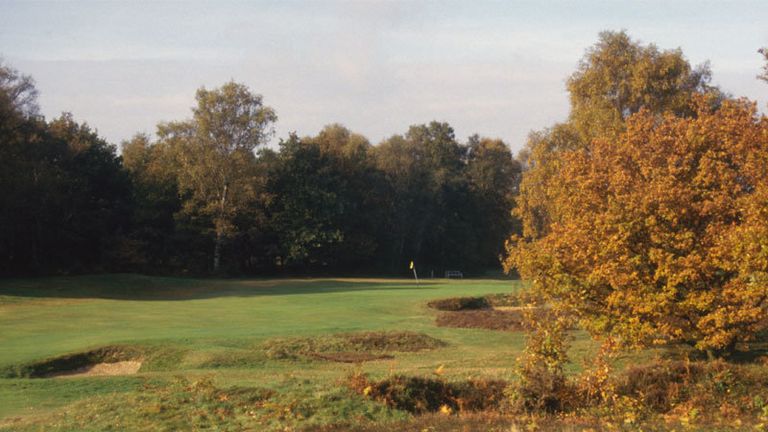
Walton Heath is a quintessentially English venue.
Pause for a minute in the middle of the great expanse of heathland common on which Walton Heath's Old and New Courses stand and consider this. Exactly 20 miles due north are the neon lights and tourist-thronged thoroughfares of Piccadilly Circus. To those unused to the experience, playing on the great Surrey and Berkshire courses, at the likes of Walton Heath, Sunningdale, Wentworth, Swinley Forest and The Berkshire, can be disconcerting. How can it be that these huge, seemingly endless areas of golfing nirvana lie in glorious solitude more or less in the middle of one of the world's most populous conurbations? In the case of Walton Heath, the far end is bordered by the M25, with Gatwick just a few miles further south. Yet although the incessant drone of London's relentless traffic can be discerned around the turn of the Old Course for a few holes, in another sense you could hardly be further away from the rat race. Indeed, the next time you find yourself orbiting the south of the capital, keep your eyes peeled and you might just catch a tantalising glimpse of an exclusive golfing paradise before your eye is drawn back, inevitably, to the brake lights in front of you. This is the most traditional of courses, the kind of place where the idea of a round without a hearty meal either before or after is unthinkable. The clubhouse is a regular meeting place of the great and the good, while membership is a privilege restricted to a lucky few. So many courses in this area boast golfing lineage of the most esteemed order, but none more so than Walton Heath. It was here, on the 18th green of the Old Course, that Winston Churchill is said to have issued the following challenge to his fellow member David Lloyd George: "I'll putt you for the Premiership." And during his year of captaincy in 1935, the Duke of Windsor became King Edward VIII, making this the only club able to claim a reigning monarch as a member. Walton Heath is not an unfriendly club - far from it - it is just that, as one of the original inland courses in England, things have always been done in a certain way round here and outsiders unused to the particular atmosphere and customs of the place are readily apparent. Take the pro shop, which has been standing for over a century yet only had three occupants. The first was James Braid, who took up the post in 1904, shortly after winning his first Open, and added another four while doubling up as a servant of the club. Not until 1950 did he retire, at which point Ken Busson, the clubmaker extraordinaire to whom the world's best would routinely turn when they wanted a new persimmon driver building, took over. His 27-year stint was followed by that of the present incumbent, Ken MacPherson. Both the Old and New Courses were designed by Herbert Fowler, making his first foray into architecture in his mid-40s. In fact, there is little age difference between the two courses. Fowler's work began in late 1902, with the Old officially opened by an exhibition match between the Great Triumvirate - Braid, JH Taylor and Harry Vardon - in May 1904. The first nine holes of the New were laid out in 1907 with the full 18 holes in play by 1913. So these are very much two courses that belong to the same era, and indeed they belong to the same piece of land. Of Walton Heath's 36 holes, only the opening hole of the Old Course, a long par three, stands apart. It and the clubhouse lie on the other side of the Sutton-Dorking road. Unlike other Old and New combinations - St Andrews and Sunningdale are two that spring to mind - these two courses are very similar in style. It is true that the Old follows a more traditional routing whereby the front nine travels outwards towards the furthest end of the property before the second nine turns back for home. On the New, meanwhile, according to Bernard Darwin: "There is more tacking hither and thither and less of a straight run out and home." But in terms of the style of holes, it is almost impossible to define a characteristic which is not shared. Without wishing to state the obvious of a heathland course, there is much heather at Walton Heath - arguably more so than at any other course in Britain. It threatens almost every tee shot, and wraps round almost every fairway, sometimes even encroaching into the bunkers and right up to the very borders of the greens. This means that driving is at a premium. The fairways are by no means the narrowest you will ever encounter, but should you miss one the chances are you will pay a heavy penalty. On such occasions, presuming you are lucky enough to find your ball, simply reach for your nearest wedge and hack sidewards and outwards. Although it can be intimidating from the tee, there is nothing unfair about the golf here. The fairways are wide, firm and bouncy, while the principal hazard depends on the strength and direction of the wind. Walton Heath is several hundred feet above sea level and the trees offer little protection. Both courses offer a wonderful mix of long and short par fours. On the Old, the 3rd tempts the longer hitter to drive the green while the same can be done at the opening hole on the New. At the other extreme, the Old's 2nd is a fearsome two-shotter where a good drive sets up a long approach from a hanging lie to a raised green. Perhaps the pick of the par fours on the New is the 5th, which swings downhill and to the right over the course of its 460 yards. The most famous stretch is the closing three holes on the Old. The 16th, formerly a par five, is now a mighty four, with a cavernous bunker awaiting the approach that is either a fraction short or right. Then comes a par three from an elevated tee before the striking last hole, which is dominated by the yawning cross bunker some 40 yards short of the green. Somehow, it does feel that the Old has a touch more character about it, though it can be hard to pinpoint exactly why. It is easier to say what is good about both - fabulous fast, true greens and fairway turf it is simply a delight to strike irons from. As long-time tournament venues, both courses have been lengthened over the years. Nowadays it is the New that is the longer, when played from the latest set of back tees designed strictly for the experts only. In the European Open that was played here during the 1980s, winners included Paul Way and Andrew Murray. But for all the great names in the club's history, be they professionals or statesmen, one stands out. That is James Braid's, who served here for almost half a century, until beyond his 80th birthday. Fittingly, the last two rounds of golf he ever played were at his beloved Walton. Both were in the low 70s. His class, pedigree and longevity live on to this day at Walton Heath, which remains an oasis of calm on the outskirts of London as it enters its second century of golf. For more NCG articles click here