
Interview: Ray Floyd
Monday 7 March 2011 11:41, UK
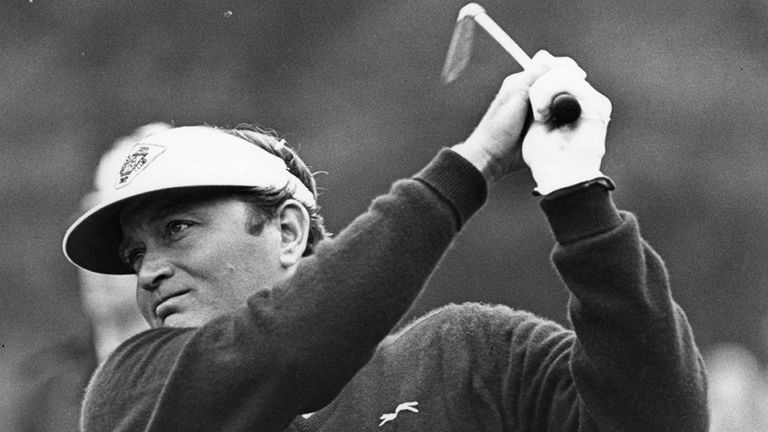
The eight-shot winner in 1976 talks exclusively to skysports.com about that memorable triumph and the loss that hurt most.
Ray Floyd is one of golf's legends. Nearly 30 years separated his first and last wins on the US Tour and in his glittering career he won the PGA Championship in 1969 and 1982, The Masters by a then record eight shots in 1976 and the US Open in 1986. But for a play-off loss to Nick Faldo in the 1990 Masters, he would have been the only man to ever have won a Major in four different decades. He also played for the U.S. on eight Ryder Cup teams (1969, 1975, 1977, 1981, 1983, 1985, 1991, and 1993) and captained the side at The Belfry in 1989, a year which saw him inducted into the World Golf Hall of Fame. After an unbroken run of 45 Masters appearances (the same number as Jack Nicklaus), dating back to 1965, Raymond Loran Floyd decided to call it a day ahead of last year's event. In this exclusive interview with Skysports.com, he tells us about that decision, reflects on his glorious career at Augusta and tells us who he fancies to win this year's event. Hi Ray. You made your first start at Augusta in 1965, aged 23. How special was that? RF: Very special as I was born and raised in the geographic area. I was from North Carolina so as a youngster all of my mind games about golf were always if I make this I win The Masters, if I hole this par putt I win The Masters. So it was a great thrill to play there. I was tied for the lead in the opening round, or maybe just one back, after I shot a 68. But I was paired with Arnold (Palmer) in round two and shot 82 and missed the cut. But the following year you finished tied eighth - the first of 11 top 10s at Augusta. Why was your game so suited to the course? RF: I was long and I hit the ball high. That's always been of great benefit at Augusta, to be able to carry the ball to the tops and not land it in the walls which costs you so much distance. I had the length to reach the par 5s and that was imperative - as it is today. Although you posted good finishes, it took you until 1976 to finally win there. Was it a case of just learning the course until it all came together? RF: I think everything came together after my marriage to Maria in December '73. In my mind I had two careers. One before and then one after I married Maria and had my family. That was when I matured as an individual and a player. I had a god given talent and if I wanted to be as good as I could be I had to work at it. And it 1976 it came together spectacularly when you won the Masters by an incredible eight shots. What were you thoughts ahead of that tournament? Did you feel as if something special could happen? RF: I was really, really confident. I had played so well the whole early Spring on the Florida Swing. My putting wasn't great but my ball striking was really phenomenal, the best I had ever played. And then the last round at Greensboro I shot a 66 and had a good putting round and driving down to Augusta I was just full of confidence and that carried on right into the tournament. I felt my putting was coming around, my hitting's great, this is the kind of course I love and cherish and this is my week. And you won by eight shots with a new record score of 17-under. RF: I tied Jack's record (-17). It was an incredible week of golf. I led every round. I went wire-to-wire. I was comfortable and it was easy. I hit more par fives in two than I missed greens in regulation. I played tee to green, three-under-par, phenomenal. I killed the par fives. I also putted well, everything was on. It's very rare that everything comes together in any tournament but for it to happen in a Major was pretty special You were a great chipper of the ball. Did that play a part too? RF: Not that week. I didn't need to be because I wasn't missing any greens. But throughout my career I took pride in my short game. I worked very hard on it because I knew that no matter how good a player you were you were going to have those bad playing days from tee to green and the only way to be a consistent winner was to be able to salvage those rounds. You know your bad round had to be 71 or 72. You couldn't have your bad round be 75 or 76 in one tournament. That was always my thought. You also had three second places at Augusta - 1985, 1990 and 1992. What are your memories of those? RF: 1990 (Ray lost in a play-off to Nick Faldo). That was my hardest loss as a player. I could normally put them away and go but I still think about that one because I was again playing well but on the 71st hole I played to the middle of the green instead of playing to the flag over on the right side and my ball just trickled over and left and it was an impossible two-putt. My first putt I got to eight feet which was pretty good but I ended with a three-putt to lose my one-stroke lead. I look back and say that was not a physical error but a mental error and that cost me. And that's why it hurt so bad. And on the second play-off hole I made another mental error. I was on a little downward lie with the ball a hair higher than my feet and I wanted to hold the ball against the lake with a cut. I didn't want it going left and I didn't put into the equation the lie. I was standing on a pull lie so I needed to play for that and I didn't and I actually hit a real solid, perfect shot but it started right in the corner of the water and stayed right there. So I made two mental mistakes to blow that Masters. That was my toughest loss because I was known as a pretty smart player. And 1992? RF: I was 49 then. That was Freddie's Masters Famous of course for his tee-shot at the 12th in the final round when Freddie's ball somehow clung onto the bank instead of rolling back into the water. RF: Yes, that ball on the 12th. That was just the way it was supposed to be I guess. Where were you when it happened? RF: I was in front of him so I had no idea that that had happened. It was only later that I found out. Just prior to last year's event you decided to call time on your Masters career. What prompted that decision? RF: I'm not from the ilk to announce that this is my last and do the fanfare and all those things. I wanted to play when I felt like I could play and when I felt like I couldn't that was the end. I didn't want to go and say this is my last, months prior to the tournament. I wasn't 100% whether I wanted to play last year or not. I wanted to go there and see how I felt and eventually I elected not to play and I was very comfortable with my decision. But I always will go and be at the players' dinner. Do you still play the Par 3 contest? RF: Oh yes, absolutely. I'll always go back god willing if healthy enough and participate. That's the great thing about Augusta - they honour the past champions and it's part of the ambiance to have the past winners there. Is it typical that this is the only time of the year you get to see most of the former champions? RF: Exactly. As we play less, or not play any longer you don't see your guys. Their homes are around the world and you never see them so it's a real nice get together. And there's nothing better than the Champions dinner. Do you recall what your chosen food was in 76? RF: In '76 it didn't go that way. That started in the early 80s I think. We sent out invitations that were sent out by the champion but the club picked the dinner and then it became a tradition. Do you remember a favourite dinner you've had? RF: They're all favourites. We've had the ethnic themes with some of the foreign winners. Did you have haggis when Sandy Lyle won? RF: Well, as you well know, nobody ate it (laughter) Ever had it since? RF: I tried it the first time I ever went to Scotland but I wasn't fond of it.Looking ahead to this year's event, who would you pick out as the likely winner? RF: The guys that come to my mind immediately are Tiger, Phil and I like Dustin Johnson because of what he's shown of late. I think you've got some young guys now who realise that Tiger is no longer so dominant and that's going to elevate their games. But length has always been a huge asset and all these kids now hit it so far. They're incredibly long with the equipment changes and technology but the one thing about Augusta is that they stay ahead of that curve. You can't leave out your Ernies and Retiefs and Lee Westwood has got to be considered a favourite too. You've got a lot of good young players to watch out for. Do you give Bubba Watson a chance after his recent win at Torrey Pines? RF: Look at his length. You get a guy like that with a couple of wins under his belt and now his next goal becomes a major. Plus he had that Ryder Cup experience. If you can handle that, you can handle majors too. Thanks Ray and enjoy the dinner!