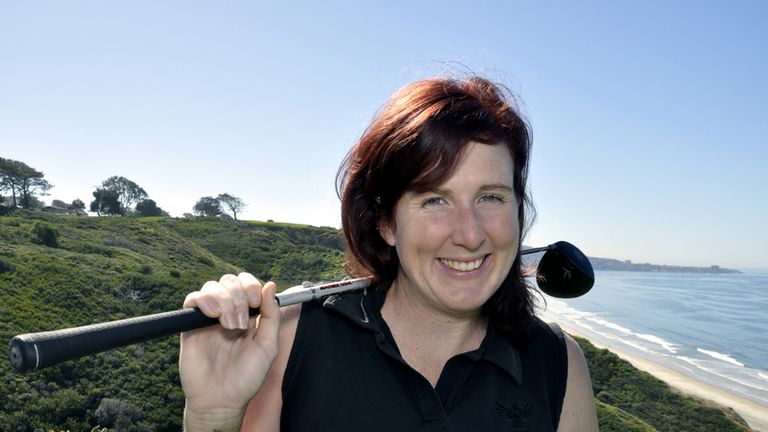
Matt Cooper tells the story of Beth Allen's return to the course after a life-changing two months.
American star returns after donating kidney to her brother
When golfers return to the course after a break they say things like "I'm not quite 100%," or, "I'm not all there," or maybe even, "Something's missing." They are hazy, half-hearted words designed to lessen expectations.
But not if Beth Allen utters them this week.
At the Turkish Airlines Open in Belek, Allen, unlike her fellow competitors, can quite literally quantify those sporting clichés. Not for her the vague sense of something missing. Instead she knows exactly what has gone and it is not form she has lost but a kidney, which she donated to her brother Dan just two months ago.
Allen is a 29-year-old from San Diego, but in golfing terms she's most at home in Europe. Her fun-loving nature, karaoke turns and love of the continent's diverse culture are more suited to the LET than the more intense LPGA. Popular with fellow players and fans alike, her return is eagerly awaited and her operation was much discussed at the recent European Nations Cup where Sophie Gustafson said: "What she has done is so generous and just typical of Beth. She's a total legend."
Life-changing
For Allen's friends Mel Reid and Breanne Loucks this has been a longer journey, as they have witnessed the decision-making process and post-op firsthand. "When Beth first told me she was giving her brother a kidney I thought it was a 'might' not a 'certain'," says Loucks. "But she's so kind-hearted and cares so much for the people close to her that it was as easy as giving him her last piece of candy! It's such a selfless thing to do, I'm so proud of her."
When Reid played in (and briefly led) the Kraft Nabisco Championship at the start of April, the recuperating Allen walked (and, in all likelihood, probably hollered along) the fairways in support. "She looked great," says Reid. "It was amazing considering that it was just a few weeks after the op, but then she's been incredible ever since she first made this decision. I've seen her work so hard and make sacrifices to maximise the chances of the donation being a success. It's such a big deal for her brother but I think it will change her life too; you can't do something so big and not feel the benefit."
Whilst others are keen to highlight her bravery, Allen deflects the plaudits, recalling the harsh reality of her brother's life. Born with small kidneys, he has needed dialysis ten hours a day, every day, for the last 13 years. "Despite that he worked full-time which is kind of unheard of," she explains. "In my opinion, he is more of a hero than me for living the life that he has been forced to live and having the attitude that he does. He is one of the most positive guys I have ever known and my biggest fan."
Whilst understanding of her brother's strength of character, the LET's physiotherapist Adam Olarenshaw is in no doubt about Allen's courage. "Any surgery is a risk and she'll have been made aware of that prior to the operation," he says. "But she did it all the same."
As Reid witnessed, the recovery has gone well. "For the first week I was in a fair bit of pain but never bed-ridden," says Allen. "I was uncomfortable for about two weeks but then completely fine. I've done a lot of chipping and putting, and I finally hit balls for the first time about five weeks after surgery." She also learned that the incisions left the stomach muscles a little weak. "It's amazing how much we use our stomach muscles and don't realise it, by the way! It's been very interesting, learning to listen to my body. I've never really had to do that before."
It begs the question: what does it actually feel like to be lacking a fundamental chunk of your body (approximately the size of two fists)? "Do you know how many people have asked me that?!" she laughs. "I don't sense anything missing but there is something different. The left part of my mid-back is pretty sore sometimes and they took my left one so I have to believe it has something to do with it."
And if Allen is feeling different, what about her brother? "His body hasn't functioned properly for at least five years so it's a process. His dialysis machine was taken away which was fantastic because I think it provided some closure. We won't know for about two months if the kidney definitely takes. He still needs close to 40 pills a day but, as far as I know, my kidney works in his body. Weird, right? They told me it worked on the operating table! I think that is so cool. Fingers crossed it will keep on working for a long time!" Appropriately, prior to flying to Turkey, Beth and Dan played 15 holes together. "He's looking good," Allen tweeted. "Must be the new kidney!"
Percentages
Percentages matter in modern sport; 100% is no longer good enough. Colin Montgomerie "always gives 110%", cricketer Kevin Pietersen "demands 300%" and footballer John Hartson claimed to have utilised "1000%". Australian cricketer Doug Bollinger even insisted he managed a bizarrely arbitrary "150,000%", whilst football manager Harry Redknapp topped the lot with an outrageous "one hundred million percent". Even the normally magnificent Rafa Nadal got confused, planning to "give 200% to be at 100%" in the Wimbledon men's singles final of 2009.
Although the mathematics are wonky, the sentiment is not: modern sportsmen and women are desperate to squeeze every possible advantage. They might fall back on wild exaggerations but it is actually - and paradoxically - because of a desire to stress the significance of small margins and in this respect Beth Allen's actions make her an exceptional exception. Olarenshaw summarises it best: "In a time when every athlete is looking for that extra one percent, Beth has gone the other way; she's sacrificed a percentage. That says it all about what she's done - it's just awesome."