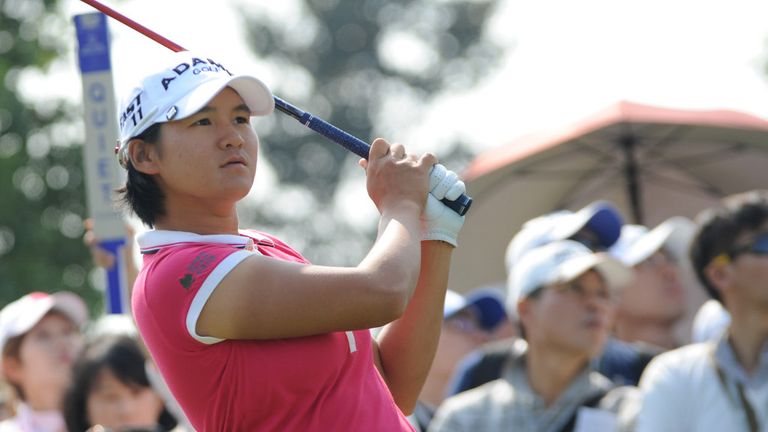
Yani Tseng might be dominating ladies golf but there's more to her than wins, says Matt Cooper.
Yani Tseng might be dominating ladies golf but there's more to her than wins, as Matt Cooper explains
Yani Tseng (the G is silent) is a special golfer.
This week the 23-year-old Taiwanese player will tee it up in the first LPGA major of the 2012 season, the Kraft Nabisco Championship, and the field is in no doubt who it needs to beat.
The sheer weight of statistical and factual evidence to support the notion that she is exceptional is almost overwhelming - and yet it also needs to be repeated to fully appreciate what she has achieved in less than five seasons in America.
In 2008 she won the LPGA Championship becoming, at 19, the second youngest winner of a an LPGA major. The following year she became the second fastest LPGA earner of $2 million, taking just 32 events to break that barrier.
Most golfers would have been happy at that stage of their career, but not Tseng. She was deeply unsatisfied with her inability to make the most of winning opportunities. Having recently purchased the former home of Annika Sorenstam, she asked the previous tenant for some advice on improving her mental strength and the results of that union have reaped amazing rewards.
In 2010 she won the Kraft Nabisco Championship and Ricoh Women's British Open to become the youngest ever winner of three majors. If that proved her ability to win the tournaments that matter, her performances since January 2011 have proved she has the appetite to win week in-week out as well.
In the last 15 months she has played 30 events on the LPGA and LET, winning no less than 13 times (two of them majors). She has now won four of the last eight majors and never once in that period been outside the top 20.
Just over two years since asking for Sorenstam's guidance she has completed the transformation she hoped for: she is consistent, she wins regularly and she wins when it matters; she is not just a player who has topped the world rankings, she is the undisputed best player in the game.
More to Tseng than supremacy
But stats and records can go only so far and there is more to Tseng than supremacy over her peers. Not least because she defies the stereotype of the "anonymous" Asian golfer who is unwilling to embrace the English language. Bumping into her over the last three years has enabled me to witness the emergence of not just a superb golfer but one of the most enthusiastic and endearing personalities in the game.
I first met her in 2009 when we quite literally bumped into one another as we rounded a corner of the Royal Lytham St Annes clubhouse from different directions. We exchanged apologies and went our separate ways. Later that day she saw me again, mimed falling over and then laughed. We got talking and I asked her to help with a feature I was writing.
It was a frivolous piece about typically British things and had prompted some excellent responses from Paula Creamer and Christina Kim, but whilst they found the cultural references (to the likes of Hugh Grant, James Bond, fish and chips and mushy peas) entertaining, they were, it was soon clear, a baffling mystery to Tseng.
But here's the thing - Tseng spoke very limited English at the time, but she persisted, she brushed off my growing embarrassment at asking a Taiwanese person about mushy peas, she asked me questions and then she laughed at the explanations. I've come to expect greater patience and involvement from lady golfers than men, but this was extraordinary even by those standards.
Twelve months later, at Royal Birkdale, her English was vastly improved and she revealed in a press conference that she was playing one of the par-fives that week as a par-four. Afterwards, I asked her if she had ever flipped the idea and played a tough par-four as a par-five. She gave it some thought, nodded and then whispered, "No I haven't, that's a great idea, but, hey, it's just between us right? Our secret!"
She then gave one of her trademark laughs, a slightly nervous, shoulder-shrugging giggle that punctuates just about every sentence.
Here's something else that's odd. Ahead of her defence of the 2011 Ricoh Women's British Open she was one of the few players to attend a sponsor's function at Glamis Castle.
What is surprising is not that the others didn't attend (it was the eve of a major; rest made sense) but that she did. And nor did she impatiently hang around until it was safe to go. Instead she wandered round the castle, admiring the antiques, laughing at the paintings and having her caricature drawn.
It is qualities such as these that make Tseng stand out, just as much as her on-the-course achievements because although she is somewhat awkward and gauche in public, she never hides. Instead she is keen and eager. It's a combination that is easy to warm to.
The wider golfing world remains a little ignorant of what she has to offer, but her home nation isn't. When it hosted an LPGA event in October last year the response was extraordinary. Fans lined the fairways in the tens of thousands, hanging from trees to glimpse her and queuing for hours to get her autograph. She sat in a tent and accommodated them before winning the tournament by five shots.
What comes next, then? Her dominance has continued in the early weeks of 2012 (she's won three of the five LPGA starts this year), but she is aiming high.
First of all she knows how many trophies the previous occupant of her house collected and wants to top that figure. She'll also be keen to improve her record in the U.S. Open because her career-best finish is "only" a tie for tenth (shoddy only in the world of Yani).
First of all, though, she'll be concentrating on this week. Tseng makes no claims to be mentally strong - in fact she is always very open about her weaknesses - but that, paradoxically, is a strength because she is always working at it, always learning and always in the moment.
It's one of the many things that makes her special.