Team GB take lower expectations to Holland, but what does that mean for 2012, asks Richard Moore?
World championship medal haul set to be lower than four years ago
Four years ago, in the spanking new Palma Velodrome on the island of Majorca, the British track team did the cycling equivalent of planting their flag on the summit of Everest.
They finished top of the medals table, with seven golds, two silvers and two bronzes. Australia, who were second, won only two golds.
It was a statement of intent, as well as an awesome display of utter domination, with Chris Hoy in the keirin (and kilo), Bradley Wiggins in the pursuit, and the team pursuit quartet, especially impressive.
Star of the show, though, was Victoria Pendleton, who managed a clean sweep of her sprint events, with three golds in the sprint, team sprint and keirin. What a shame - and what a scandal - that she was only able to target one gold at the Beijing Olympics (which she duly delivered).
Many suspect that this week's world championships in Apeldoorn, at the equivalent point in the Olympic cycle, are going to be very different for the British team.
Pendleton has already hinted as much, saying that she is embarking on a two-year build-up to the London Olympics. In other words, her absolute peak - her Everest - will come in 17 months, not now.
Wednesday's first night of competition seemed to vindicate Pendleton's cautious approach, which might also be described as 'managing expectations'.
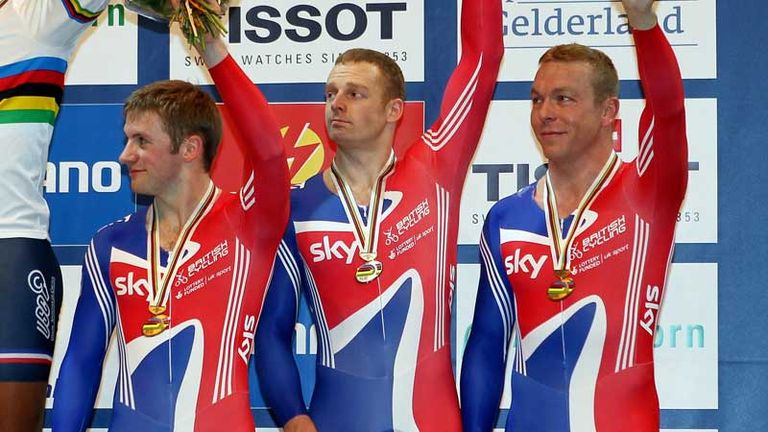
In the first five medal events, Britain had to settle for two bronze medals, in the men's team pursuit and team sprint.
It is London that matters, of course. And the British team - many of whom are survivors of the dominant Beijing squad - have the confidence of having scaled the very highest peaks in the past. They will also note that, of the five events on the opening night, only two will feature on the London programme - and GB medalled in both.
But what Palma seemed to do was to imbue in the whole team - riders, coaches and back-up staff - a sense of belief and confidence that smoothed the road to Beijing. More than that, such was the momentum established in Palma, that the road wasn't just smooth - it seemed downhill.
Path
I remember, on the final day, watching Dave Brailsford and Chris Boardman in the track centre, locked in conversation. They had found themselves in the kind of position that every coach dreams of. They seemed to have done everything right. The championships couldn't have gone much better. They knew all they had to do was to carry along the same path.
There was a healthy sense of cheekiness, or cockiness, in Boardman as he later admitted that he was looking out for 'spies' from other countries, sniffing around the British bikes and riders, trying to discern any secrets.
"We do it," said Boardman with a mischievous smile, referring to the alleged spying. "I don't do it myself, because that would be too obvious. I have somebody doing it for me, and I can assure you they're not wearing a GB T-shirt... You have to be clever."
As we were to find out in Beijing, such cocky confidence was not misplaced. But it seems unlikely to be replicated in Apeldoorn.
Will another nation emerge from Holland with the same sense of confidence and of gathering momentum? It could be Australia, though it's unlikely any one nation will crush the opposition, either in Holland or in London, to the extent that Britain did four years ago.
That would be good news for the Olympic track cycling programme, because it would have done the sport no favours for one country to dominate to the extent that Team GB did in Beijing.
Not that thrilling competition and a more even spread of medals are likely to offer any consolation to Brailsford and his team.
Follow me on Twitter:
twitter.com/rbmoore73