Richard Moore was surprised to see the peloton protest against Mark Cavendish in Switzerland
The protest against Cavendish was unusual and unexpected
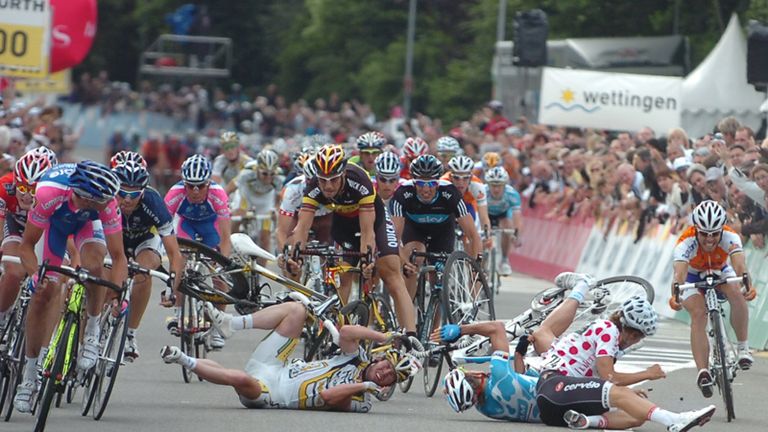
Mark Cavendish's crash at the end of Tuesday's stage of the Tour of Switzerland ranks alongside some of the most spectacular bunch sprint pile-ups of the last couple of decades.
It brought to mind Djamolidine Abdoujaparov's encounter with the barriers on the Champs-Élysées in the Tour de France in 1991, Wilfried Nelissen and Laurent Jalabert's sickening collision with a policeman early in the 1994 Tour, and Mario Cipollini's face-plant, also in 1994, at the Tour of Spain.
Cavendish hit the tarmac so heavily - and then acted as a human speed bump for several of those following him - that it was a surprise to see him pick himself up and finish the stage, albeit on the back of his lead-out man Mark Renshaw's bike.
It was also surprising to see the HTC-Columbia sprinter start the following day's stage after what must have been a very painful, possibly sleepless, night. You try sleeping with large chunks of flesh missing - it isn't easy.
Protest
Yet arguably most surprising of all was what apparently happened before the next stage. The peloton staged a short protest on the start line, aimed at Cavendish, who - after he deviated from his line and collided with Heinrich Haussler - they deemed responsible for the crash.
Bizarrely, this meant that Cavendish - who remained in the race - took part in a protest against himself. That must have been awkward.
Such demonstrations are the standard way for the riders to register their unhappiness; they happened, most famously, at the 1978 and 1998 Tours de France, the first aimed at the race organisers' demands on the riders, the second over the drugs raids carried out by the French authorities.
Yet previous protests have seen the riders unite to complain about a third party. I cannot recall a single occasion when they have united in this way against a fellow rider.
And for it to follow a crash in a bunch sprint is also strange, because such clashes are almost routine in the rough and tumble of the mass finish, even if Cavendish has generally avoided them because he has been so much quicker than his rivals, and two or three lengths clear rather than shoulder-to-shoulder.
Blunted
This year has been different - for various reasons, Cavendish's edge has been blunted, he's being pushed harder by his rivals, and sprints involving him are inevitably closer and more dangerous.
But the focus of the protest seemed not to be Cavendish's manoeuvres in the finale of the previous day's stage, but "respect" - or Cavendish's perceived lack of it. "We just want to send a message to Cavendish to ask him for more respect," said Gilles Mas, directeur sportif of French team Ag2r.
It is difficult to know what to make of it. There is no doubt that Cavendish - through his effortless superiority, the huge number of wins he's racked up in his short career, his tendency to wear his heart on his sleeve and to speak his mind, regardless of who might be upset by some of his pronouncements - will have stoked jealousy and made enemies, who would relish the opportunity afforded by a "protest" to give the 25-year old a taste of his own medicine.
It's also true - as Cavendish knows only too well when he has accused other riders of the same thing - that to be accused of lacking respect by your fellow professionals is arguably more serious than to be accused of dangerous riding.
But for the rest of us, there is another important consideration. Cavendish is a unique talent, a unique personality; he is often controversial, but he could never be accused of not being interesting. How many - other than the rivals he has clearly upset - would want him to tone down his act?