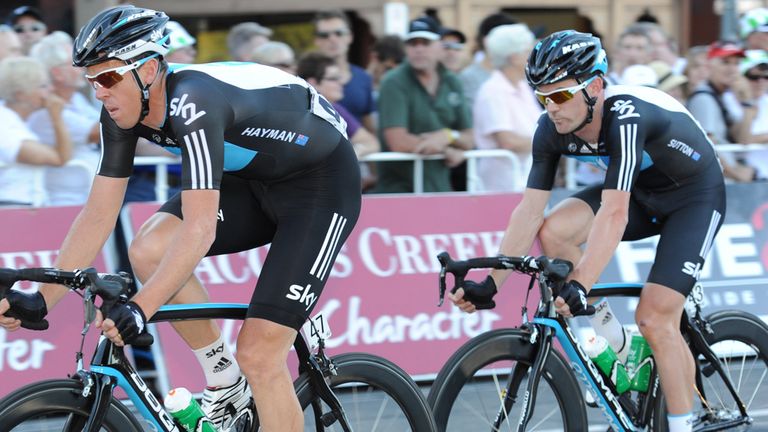
The Tour de Wallonie takes in lumpy terrain while also giving the sprinters a chance to shine.
Preview of the 39th edition
The Tour de Wallonie takes in the lumpy terrain the Ardennes region is famous for whilst also giving the sprinters a chance to shine.
Recent editions have favoured the fast men, with Greg Van Avermaet and Russell Downing topping the last two general classifications, but the winner of this race must be able to survive plenty of short, steep climbs.
The Belgian riders always provide a fierce fight on home terrain, meaning it will take a real strongman to claim victory on the challenging roads of this cycling-mad region.
Stages
Saturday 21 July: Stage one - Tournai to Lessines - 159.7km
The race starts in Tournai, a town that hosts a stage of a professional race for the second time in three weeks after being the venue for the finish of stage two of this year's Tour de France. The riders will head west from the start over four categorised climbs before embarking on two laps of a finishing circuit. The last intermediate sprint comes just 11km before the line so the pace is sure to be high in the closing stages. The flat run in should ensure the opening day ends with a sprint finish.
Sunday 22 July: Stage two - Binche to Mettet - 205.5km
The race heads into the heart of the Walloon region on stage two, with five categorised climbs on the menu throughout the day. The most significant of those is the first-category Cote de Lustin, but its positioning with over 40km to go may discourage attacks. The final ascent of the Tienne Hinrault comes 27km from home, which means a reduced group are likely to come to the finish together. A further uphill drag to the line could scupper the hopes of the pure sprinters.
Monday 23 July: Stage three - Marche en Famenne to Beaufays - 185.9km
The third stage takes in many of the climbs used in the Liege-Bastogne-Liege Classic. These include the Cote de Saint Roch, Cote de Wanne, Col de Stockeau, Col du Maquisard and Mont Theux. However, the two most decisive climbs are set to be the Cote de Florzee and Cote du Hornay, both of which come within the final 10km. Although only short, the two ascents have the potential to split up the peloton, with the winning group likely to be formed on the Hornay, a climb that could well be decisive in the fight for overall victory.
Tuesday 24 July: Stage four - Huy to Oreye - 207km
The penultimate stage starts in Huy, but the riders will be relieved to find out that they will not be asked to tackle the town's famous 'Mur' climb that features at the end of Fleche Wallonne. Instead the peloton will loop around through hilly terrain, including four categorised climbs, before a 70km run in to the finish that is mainly comprised of flat roads. As a result, the longest stage of the race should end in a bunch sprint, and with bonus seconds on offer the finish, it is sure to be fiercely contested.
Wednesday 25 July: Stage five - Welkenraedt to Perwez - 179.2km
Despite the German-sounding stage towns, the final stage of the race does take place in the French-speaking Walloon region. The Col du Maquisard features on the route again, but comes too early in the stage to cause any real selection. Like the previous day, there is a long, flat run to the finish where the peloton will sprint it out for the potentially-decisive bonus seconds.
Tactics
With several opportunities on offer for the fast men, Team Sky duo Davide Appollonio and Chris Sutton will hoping to get into the mix in the expected bunch sprints. Salvatore Puccio and Michael Barry will also look to test themselves on some of the hillier stages.
Team Sky history
Russell Downing claimed overall victory in the race for Team Sky back in 2010, snatching the win with his success on the final stage. Race coach Kurt-Asle Arvesen finished third in 2006, while Jeremy Hunt won the second stage a year previously.