
Richie Porte on climbing
Friday 24 July 2015 18:26, UK
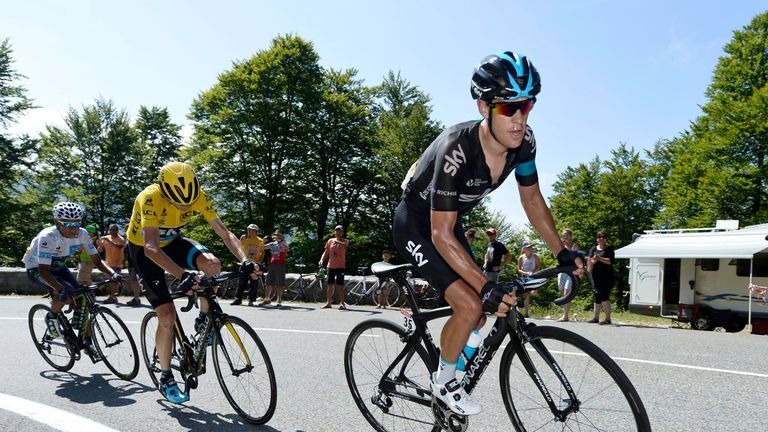
Team Sky's Tasmanian star gives us an in-depth insight into the art of ascending as the Tour de France heads into the Alps.
With the final week of the Tour de France set to play out in the mountains there are still four tough days of climbing before the yellow jersey battle is decided.
Richie Porte has quickly earned a reputation as one of the most feared climbers in the sport, routinely ripping races apart in recent years to secure wins for both himself and his team-mates.
The 2015 Tour de France has been no exception, with the Tasmanian repeatedly setting a searing uphill tempo. His huge acceleration provided the final springboard for Chris Froome’s stage victory at La Pierre-Saint-Martin, before regrouping to make it a Team Sky 1-2 at the summit.
We sat down with Porte to take a closer look at the art of climbing and both the physical and mental battles involved.
Climbing is tough and painful – is it something you truly enjoy or did you just find you were good at it?
I guess being smaller you’re maybe more inclined to be a bit of a climber, but I do enjoy it in terms of the training – especially where I live in Tasmania. It’s quite hilly there, I wouldn’t say mountainous, but now living in Monaco everywhere we go is always uphill. You could easily get 3000 metres of altitude in a day. I think that makes it a little bit easier - rolling home via the (Col de la) Madone, which is probably the most famous climb where I am. I really enjoy doing that. During the season Froomey and I often train a lot together and we often go over the Madone.
Can you put your finger on what you love about climbing?
Maybe it’s the view at the top. You get to the top of any climb and there’s a sense of achievement once you arrive there. There’s also the descent. It’s not so much fun in the winter months when you have to rug up and then freeze on the way down. But it’s always warm going uphill!
How do you measure your efforts so you don’t blow up half-way up the climb?
I think it’s a fitness thing. Half the time when you are chasing fitness you do blow up. That’s the thing with the mountains – it’s what separates the men from the boys in these stage races. It goes either way for guys like myself. In the 2013 Tour I was making it into the select group on the climbs, but then last year the hills were against me. This year it's different again. It’s funny because on mountains like the Tourmalet or Alpe d’Huez you have good experiences but also bad ones. Regardless of the condition you’re in it’s always totally different each time you climb a mountain.
Are watts and data key when you’re in a race situation or is listening to your body more important?
A lot of people get carried away with the whole watts per kilo thing. But at the end of the day in a race you can only do what your body is capable of doing. The powermeter doesn’t dictate what you’re going to do. Certainly someone like Froomey he knows his capacity and his capability on those climbs. Some guys like myself ride more on feeling. It’s different depending on the rider. Take sprinters – a lot of them can climb if they have to. Once they get a sniff of a victory and hanging in there then you do see them climbing front group.
Do you prepare and look at the key climbs before you ride them?
Certainly at the Tour we’ve usually seen most of the climbs somewhere in recon. I guess most races, from Paris-Nice, Romandie and the more important ones – you’ve raced over most climbs before in some way, shape or form. There’s also that old thing of, if you can stay at the front it’s much easier. I think the first few minutes of the climb are absolute agony but once you settle down it’s not too bad.
How do you keep going when your body is screaming it wants to stop?
That for me is why the radio is the best thing. You’ll have (Sport Directors) Nicolas Portal or Servais Knaven telling you who is getting dropped and things like that. It does make it a little bit easier, or you have Froomey behind you, telling you to squeeze a bit. I wouldn’t say I’m a violent person but it is nice to put your colleagues into a bit of pain. And I’m sure that they love putting us in pain too.
Is there any way to describe how you feel when you’re on the limit?
It’s a funny one. You do have some of the most random thoughts. I think it’s always good to be in a positive frame of mind. You start thinking about the little things. Sometimes you can start thinking about something negative and feel like ‘I don’t need to hurt myself more than this’ and then there’s other times where you do push on. I think that’s a lot of climbing really, it’s a mental thing, as well as punching and fighting.
Have you ever been beaten by a climb where you just had to stop?
I remember once I was out with my mate Joe Gambles, who is actually one of the best triathletes in the world now. It was the only one time I got off my bike. He absolutely smashed me I wasn’t very fit at the time. He drove the boots into me and I ended up getting off three quarters of the way up this climb – but then I realised I had to climb up it anyway. It does happen. Obviously you get over climbs easier sometimes. Usually it’s a weight thing (laughs)!
In terms of the technique of climbing – are there things you can do to improve?
Obviously core helps a lot. It really does. I think also cadence has a lot to do with it. I find that when I’m in really good shape I can stay in the seat more. I like to climb out of the seat a little bit too, but I don’t think there’s any right way to climb a mountain. The commentators have got their opinions but I don’t think they really know sometimes.
When you are being drafted up a climb on a team-mates wheel – how much do that really help you, or is it more of a pacing thing?
Certainly it helps. It doesn’t matter whether it’s a Sky team-mate’s wheel or another team. It is nicer to see your own team on the front, drilling it and making it hard than another team. It makes it easier if it’s your own team as you know that you’ve planned it and you know what you need to do. By the time it comes around that you’re the man to blow the rest of the field away that’s a nice feeling. But it’s the old swings and roundabouts too.
Do you get nervous as you’re heading onto a big climb and you know it’s coming?
Yeah. I think it’s more nervous getting into position. Sprints are messy but so is going into a climb. I think it’s easier when you’re in good form. You can sprint up the side and settle into the groove. We do get a bit of respect our team in terms of getting to the climb on the front.