Our tech expert John Stevenson gives us explains exactly how modern gear systems work.
Everything you've ever wanted to know about gears
Human beings are lousy vehicle engines. Even the fittest of us can only generate a few hundred watts for any length of time – that's about half a horsepower. And our legs, hearts and lungs work best at in a fairly small range of speeds and motions.
Fortunately, bikes turn our effort into motion with amazing efficiency. Bikes have gears to allow us to get the most out of legs, heart and lungs from 45km/h time trial efforts to eking our way up the mountains.
The principle is exactly the same as car gears. However, car engines operate efficiently across a wide range of operating speeds. Humans work best in a narrower range of pedalling speeds, so bikes have more gear ratios, closely spaced.
So that you don't have to remember decimal points, bike gear ratios are expressed in 'gear inches' in the English-speaking world, and in 'development' or 'rollout' in most other countries. Rollout is straightforward; it's the distance in metres the bike travels for one turn on the pedals.
Gear inches are more mysterious. In the days of the Ordinary or 'penny-farthing' bike the cranks turned the front wheel directly and a bike's single gear was determined by the size of the wheel. Gear inches tell you the wheel diameter of an equivalent Ordinary. It is, if we're honest, a slightly mad and English way of doing things.
On a typical road racing bike, the highest gear comes from a 53-tooth front sprocket or chainwheel and an 11-tooth rear sprocket. That gives a rollout of 10.4m and a 130-inch gear. A typical low gear with a 39-tooth chainring and a 25-tooth sprocket gives a rollout of 3.4m or a 42-inch gear. Sheldon Brown's
articles on gear ratios and much more explore this subject in a lot more detail.
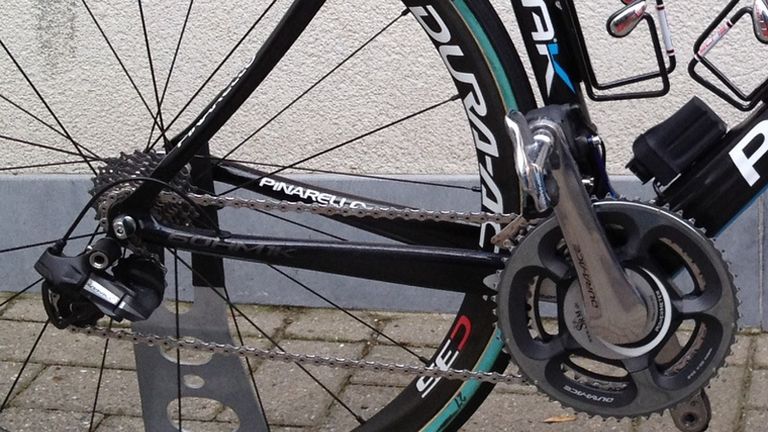
Almost all modern gear systems are based on the derailleur – a mechanism that moves the chain between sprockets of different sizes to give the rider a choice of gear ratios.
To shift between gears, most bikes have two derailleurs, operating on the chainrings and the rear sprockets. Controls on or near the handlebars – usually built into the brake levers on road bikes – pull cables to actuate the derailleurs.
The rear derailleur uses a pivoting parallelogram mechanism and pulley wheels to delicately lift the chain between sprockets. The front derailleur is rather cruder, using metal plates to shove the chain around.
If you look closely at the rear sprockets and the back of the chainrings you find all sorts of ramps, steel pins and shaped teeth. These shapes guide the chain from one sprocket to the next, reduce the force needed to shift and speed up the gear change.
The latest derailleur systems are powered by batteries and use motors to shift the chain. The rider controls them with switches on the handlebars. By eliminating human error from the process, electronic shifting delivers almost-infallible, extremely quick gear changes.
In recent years the formerly little-regarded hub gear has made a comeback. Hub gears have a system of cogs called an epicyclic gear inside the rear hub to provide a range of ratios, and are very reliable because the mechanism is fully enclosed. However, friction between the cogs means these gears are a little less efficient than external systems.