
Michal Kwiatkowski overtakes Peter Sagan as the best young all-round talent in cycling
The Pole has kicked on but the Slovak has stalled, writes Matt Westby
Friday 3 October 2014 15:49, UK
There was a time when Peter Sagan’s status as the most exciting all-round young talent in cycling appeared untouchable.
Since a breakthrough 2010 season in which he won two stages of Paris-Nice, one at the Tour de Romandie and two more at the Tour of California, all aged just 20, the sport’s fans and commentators have been scrambling for superlatives.
There have been comparisons with Eddy Merckx, nicknames such as The Tourminator and suggestions that after he has conquered the Classics he could go on to win stage races and even Grand Tours.
Even his fellow pros have gushed with praise, with Mark Cavendish, no less, describing him as a “once-in-a-generation” rider.
Now 24 years old, he can still be regarded as rising star in terms of age and the breadth of his talents, but can he still be considered the best in that bracket of riders?
The 2014 season would suggest not.
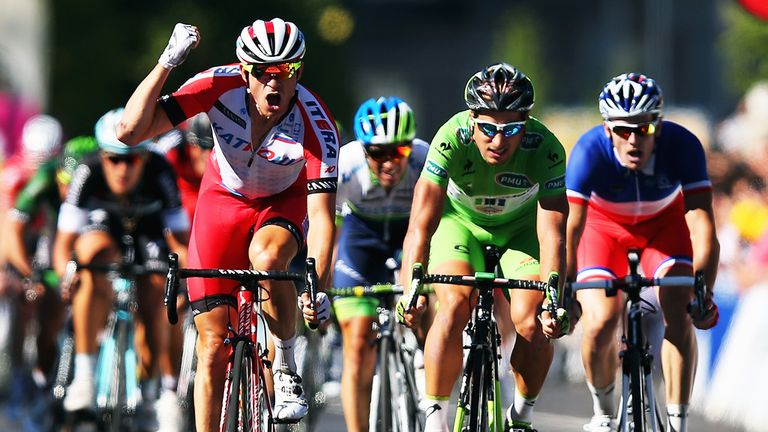
The numbers, to begin with, show that Sagan has not just plateaued this year, but has even regressed. In 2013, he took a colossal total of 27 wins and 43 podiums, but this time around he has achieved just seven wins and 21 podiums.
Then there are the tactical shortcomings he has continued to display over the past nine months, which have repeatedly cost him victories in Classics and stage races alike. Despite having power to equal anyone in the peloton and a considerably faster finish than most, he has not yet shrugged off the tendency to launch ill-conceived attacks, chase when he should be saving energy and hesitate when he should be accelerating.
And finally, there is Michal Kwiatkowski, his fellow 24-year-old and the new world road race champion.
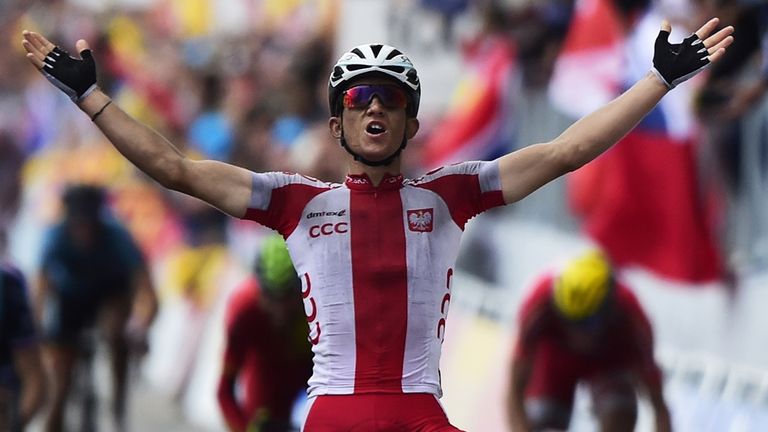
It is easy to describe the Pole as the new “brightest young all-round talent in cycling” four days after he claimed the rainbow jersey, but in truth, the evidence has been there all season.
Starting once again with the numbers, Kwiatkowski has more wins and podiums than Sagan in 2014 – nine and 22 respectively - which is a vast improvement on 2013, when he managed only one win (the Polish national road race) and eight podiums.
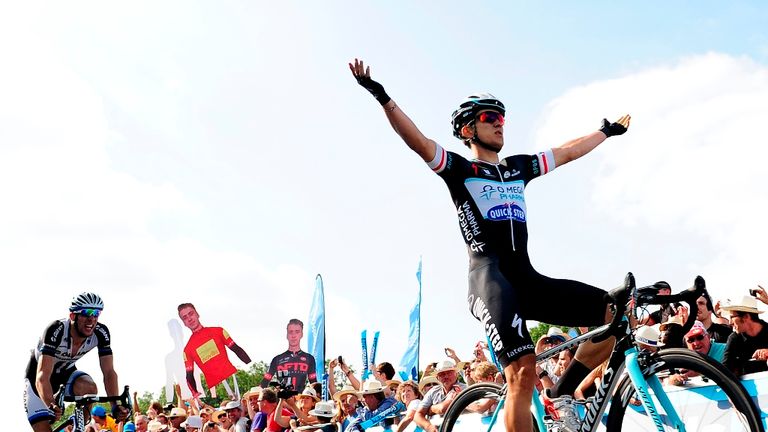
It is also pertinent that they have come across a broader spectrum of races and terrains. While Sagan’s successes have been predominantly in flatter finishes, Kwiatkowski’s have encompassed one-day races, stage races, time trials, mountain stages, rolling routes and solo escapes.
His versatility was perhaps best encapsulated at February’s Volta ao Algarve, where he claimed overall victory, out-climbed Alberto Contador to win a mountain stage and 24 hours later out-powered Tony Martin to win a time trial. Granted, it was early in the season, but it was early in the season for everybody.
He has also displayed outstanding tactical nous, no better example of which was at the world championship road race on Sunday, where he comprehensively outwitted decorated and seasoned veterans such as Fabian Cancellara, Simon Gerrans, Alejandro Valverde and Philippe Gilbert to claim the most impressive of wins.
While they all waited for the final climb of the day to launch their attacks, Kwiatkowski instead chose the rain-soaked descent of the penultimate climb to make his move and was not seen again (his descending ability and wet-weather riding are two more of his many attributes).
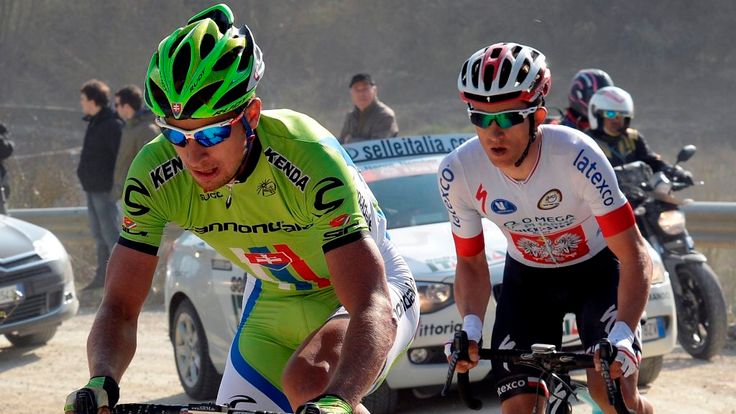
To directly compare Sagan and Kwiatkowski tactically, you need look no further than March’s Strade Bianche to see that the better of the two is the Pole, who won with almost embarrassing ease.
The pair were clear of the rest of the field going into the last 20km and although the finale admittedly favoured Kwiatkowski over Sagan, with the 800m climb of Via Santa Caterina carrying a maximum gradient of 16 per cent, Sagan should surely have recognised he stood no chance on the ascent and attacked long before then. Kwiatkowski, on the other hand, displayed the necessary poise to sit on Sagan’s wheel and then blow him off the road as soon as the incline reared up.
But then Kwiatkowski is not without his shortfalls either, and there have been times this year when he has suffered his own fair share of embarrassment.
He still has plenty of room for improvement on long climbs and does not yet look ready to be able to sustain a high level of performance in a mountainous stage race lasting a week or more, both of which were brutally exposed at March’s Tirreno-Adriatico.
There, he led the way after four of seven stages but then exploded spectacularly on a hilly fifth stage in which he was dropped early in the day and lost more than six minutes to eventual race winner Contador.
However, the fact that he can be battling with Contador one week and then beating Sagan the next emphasises the staggering variety of his talents and underlines his claim to be the new best young all-rounder.
Even the great Sagan must doff his cap in admiration.