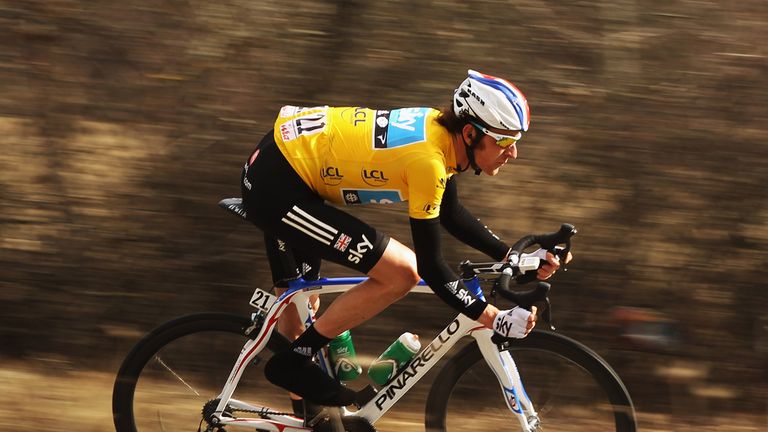
Our latest performance article looks at three models from Pinarello and finds the features of the top bikes have an influence right down the range.
Comparing the Dogma 2 with the FP Due and Treviso
Ever wondered why one bike costs more than another? We look at three machines from Team Sky bike sponsor Pinarello and find that the features of the top bikes have an influence right down the range.
The road bike of Team Sky, Pinarello's Dogma 2 is regarded as one of the most sophisticated racing machines in the world. It embodies the vast experience of Pinarello in building race bikes, a history that includes providing bikes for top riders such as Miguel Indurain, Bjarne Riis, Pedro Delgado, Jan Ullrich, Alessandro Petacchi, Erik Zabel and now Team Sky stars Bradley Wiggins and Mark Cavendish.
But even a bike manufacturer as prestigious as Pinarello doesn't just make bikes for top professionals. A replica of Team Sky's bike would cost over £7,000 – a bit expensive for most riders. Pinarello's range includes bikes more financially accessible to us mere mortals, so let's look at the £2,299 FP Due and the £1000 Treviso and see how they differ from the team superbike.
Frames
Our trio of bikes use two different materials for their frames. The Dogma 2 and FP Due are the high and low ends of Pinarello's carbon fibre bike range, while the Treviso is made from aluminium alloy.
Every detail of the Dogma 2 frame has been studied and designed to be light while still being tough enough for the rigours of professional road racing. For example, Pinarello uses Torayca carbon fibre containing tiny aluminium particles that 'explode' under very high loads to protect the carbon from breaking. This technology helps make the bike safer for the riders, but it's not cheap.
The FP Due's frame is also made from carbon fibre, but the complete bike costs less than a Dogma 2 frame. Pinarello achieves this in several ways. For example, Pinarello uses less-advanced carbon fibre for the FP Due so the frame is 200g heavier than a Dogma 2 frame, and offers the frame in fewer sizes.
Pinarello uses aluminium alloy to build the Treviso. Bicycle manufacturers use different types of aluminium to make frames, but the Treviso's is very typical: its 6061 alloy contains silicon and magnesium to increase its strength over pure aluminium. The tubes have thicker walls at the ends to cope with the loads on the frame joints, a feature known as 'butting'.
Another significant difference is in the range of sizes on offer. Pinarello makes the Dogma 2 in twelve different sizes, and the FP Due in seven. Each size requires its own mould and the cost of making those moulds is a significant part of the eventual cost of a frame. Elite riders need a bike to fit them like a fine suit, so Pinarello makes the closely-spaced sizes of the Dogma 2 to satisfy that need, and makes very large and very small sizes to fit a very wide range of riders.
The Treviso is more about round-town practicality than out-and-out performance, so there's no need for a fine range of sizes, which also helps keep the cost under control.
Perhaps the biggest difference is in the manufacturing process. In order to make a very high-strength, light frame, Pinarello moulds each Dogma 2 frame around a polystyrene form, which is removed from the finished frame with solvent. The FP Due frame is made by a more conventional technique with a reusable bladder inside the frame.
The Treviso frame's tubes are welded together. It's not long since welded aluminium frames were a very common sight in the pro peloton. It's a reliable, straightforward technique.
Gears and brakes
The gears and brakes on our three example bikes cover the full range of road bike parts from Team Sky sponsor Shimano.
At the top, Team Sky's Dogma 2 bikes are equipped with Shimano Dura-Ace brakes and Di2 electronically-controlled gears. Since its launch in late 2008, the Di2 shifting system has been acclaimed as the fastest, most reliable gear system available, and in 2011 Shimano introduced a less expensive version – Ultegra Di2. Dura-Ace components are designed to endure the massive amount of riding a professional rider does. An annual total of 20-25,000 miles of racing and training isn't unusual, and so the materials and especially bearings and other moving parts are selected and designed to be durable as well as light.
The FP Due's Shimano 105 component group is the 'everyman' version of Dura-Ace. You don't get electronically-controlled shifting, but you do get the same basic design of brakes, chainrings, sprockets and gear shift mechanisms that makes the Dura-Ace components work so well. To bring the cost within the reach of folks with mortgages to pay, Shimano uses less refined materials to make 105 parts, so they are heavier than their Dura-Ace equivalents. For example, a pair of Dura-Ace brakes weighs just 293g; the 105 parts weigh 376g.
Our Treviso uses Shimano's value-for-money components, the Sora group. Unlike the 10-speed 105 and Dura-Ace groups, Sora is a 9-speed system. Racers like to have lots of closely-spaced gears so they can maintain their most efficient pedalling speed, but this is less important for recreational and urban riders.
It's worth noting that both the FP Due and the Treviso use complete Shimano gear sets. It's not unusual to see manufacturers save money by substituting cheaper components in place of, for example, the chain and cranks, but you get better shifting from a complete ensemble.
Wheels
Wheels and tyres are vital to the performance of a top-class bike. Team Sky uses a wide selection of wheels from Shimano and PRO. The team's 'workhorse' wheels are the Shimano Dura-Ace C50 and C35 tubulars. These wheels have aerodynamically-shaped lightweight carbon fibre rims and glued-on tubular tyres, a combination that makes for light, fast wheels that are nevertheless reliable.
The FP Due and Treviso also use Shimano wheels, but they are the less rarefied R500 model. With aluminium rims for conventional clincher tyres, they're about 550g per pair heavier than the C35. Nevertheless, you can see the family resemblance to the team's wheels. They all have straight-pull spokes for strength and use Shimano's own bearings for durability.
Other components
The most striking difference between the Treviso and our pair of carbon fibre bikes is the handlebars. The Treviso's are flat, for an upright position that gives you a better view of the traffic. Both the FP Due and the Team Sky Dogma 2 use drop handlebars, which give a range of positions and allow the rider to get into a wind-cheating tuck when it's time to go hard. Team riders can choose from the range of handlebars from sponsor PRO, which includes shock-absorbing carbon fibre models such as the Vibe and Mark Cavendish's signature super-stiff Vibe Sprint.
The team's Dogma 2 bikes have carbon fibre seatposts that are shaped to fit the bike's aero seat tube and lightweight fi'zi:k saddles, while the FP Due and Treviso use round aluminium posts and saddles from Pinarello's own MOST range. The FP Due and Treviso also have MOST stems, while the team bikes have stems that match the PRO handlebars. Saving weight is a major reason for using components from specialists like PRO and fi'zi:k.
Marginal gains
The differences between the FP Due and the Dogma 2 team bike show how much it costs to make the marginal gains that are vital to a top-performing bike. The differences make up a couple of kilograms of weight, but on a long climb such as the famous Alpe d'Huez, that difference can be worth a couple of minutes.