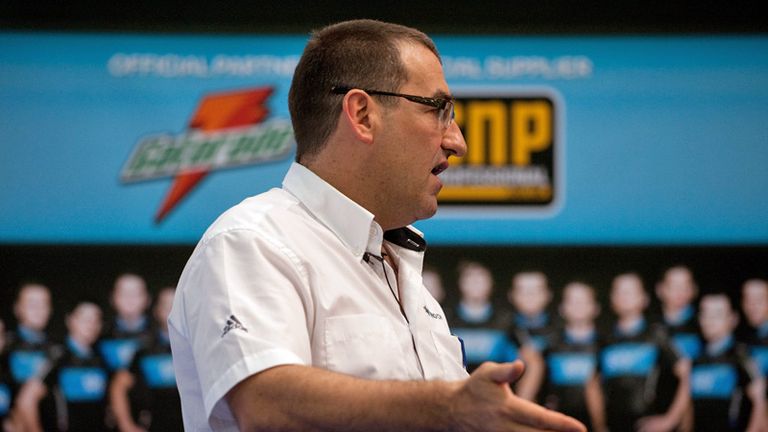
Team Sky's Head of Nutrition Nigel Mitchell offers his advice for optimum Sportive preparation.
Team Sky's Head of Nutrition on summer sportives
At the Sky track day at the Manchester Velodrome last month TeamSky.com assistant editor Nick Howes caught up with Team Sky's Head of Nutrition Nigel Mitchell to gain some top tips about how best to prepare for the summer sportives, and also asked the questions Sky Velo fans sent in on Facebook.
This is what he had to say:
"A lot of people will only want to get their bodies into a condition where they can get through to the finish and enjoy the day as opposed to flogging themselves on the very limit. During the preparation phase the important thing from a nutrition point of view is that people stick to the basic principles of healthy eating.
People don't have to live like monks, instead they should follow an 80-20 rule where they live the dream 80% of the time, but the other 20% they have the odd treat and let their hair down a bit. The races should be enjoyable and never seen as a burden.
Riders should concentrate on quality over quantity and the following is a basic guideline which riders should aim to follow:
Breakfast:
A good quality muesli or porridge oats are really popular as they release energy and carbohydrates slowly, as opposed to a quick peak. I also add a teaspoon of Goji berries, flax and sunflower seeds to them which taste really good and are easily digested. You can get them from most healthfood stores. Skimmed milk is also preferable as well as you don't need the excess calories you get with the other kinds, and a spoonful of natural yoghurt also goes down a treat. All these are quick and easy, cheap, and really set you up for the day.
Mid-morning snacks:
These are really important to keep the blood sugar levels topped up and can be anything like a banana or CNP's flapjack bars. These are absolutely ideal and even half a bar should suffice, you can always eat the other half after lunch. They have good quality carbs and good quality protein in them and should generally be eaten about three hours after breakfast.
Lunchtime:
Most people like a sandwich at lunchtime and I find the best are those which are on wholemeal bread with some tuna, salad or tomatoes in them. Because you've had the snack in mid-morning you don't eat massive amounts, but if you are still hungry afterwards you can always add a larger side salad as well. Another good idea is to take some leftovers with you from the night before - pastas/rices etc - and warm them up.
If you're really rushed off your feet though, or looking to loose some weight, CNP's Pro MR's are an excellent meal replacement because they provide all the goodness you need without the excess calories.
Afternoon snacks:
This is basically the same as the morning where you can either eat the other half of your flapjack, have another banana or some natural yoghurt.
Evening meal:
There's nothing wrong with the traditional meat/fish/chicken and veg meals, or those with pasta. Always go for fresh ingredients wherever you can though and try and eat fish at least three times a week - salmon, tuna, cod etc - because the fats that they have in them are really good for you. Fish is relatively expensive these days and pretty easy to cook, and there isn't much waste with them. Salmon slices go really nicely into stir fries, as do cod pieces from a fishmonger.
Quinoa is also getting more popular all the time and cooks very similarly to couscous. You can get it at all good supermarkets these days. I mix that 50-50 with rice and it tastes really good - even the kids like it. Plenty of salad and vegetables are vital as well.
For people who don't want bulk, vegetable juices are a great option and can be made in a smoothie maker. The Team Sky riders love the beetroot and ginger.
Supper:
There's nothing wrong with having a light snack before you go to bed. Yoghurt or camomile teas with a spoonful of honey are perfect, as is a small bowl of cereal.
Drinks:
When average people are exercising they often sweat more than they think they do so energy drinks like Gatorade can be really useful for them, especially as it gets warmer.
Sky Velo Responses:
Sky Velo: It would be useful to get a view on balancing carbs, electrolyte and protein intake. I think a load of our riders are worried about protein supplements turning them into meatheads rather than being an essential part of preparation and recovery.
You don't gain muscle by the food that you eat - exercise acts as a stimulus on the body, which then reacts to it in turn. If you do weight training you're telling your body you want it to be stronger. The protein is then used by the body to build muscle. If you're doing endurance exercises the protein is used differently and builds enzymes and mitochondria that you need for that instead.
Protein is really important for any type of exercise but you don't really need any protein supplements because you'll get enough from a normal diet. The benefit of using them though is that they are very convenient and cost effective. A pint of milk and a few bananas will work just as well, but CNP's Pro MR or recovery drinks are great meal replacements and contain probiotics which are good for the stomach.
Hazel Baker: Do you have any nutrition strategies that are compatible with good teeth, my dentist made me promise to avoid sports drinks.
Like with most soft drinks and foods in general, sports drinks can cause problems with the teeth. The most important thing to conquer this is obviously good dental hygiene - brushing your teeth twice a day and using mouthwashes which keep the bacteria down. Also, don't overuse sports drinks, take a bottle of water out with you as well and mix the two. If you eat more solids on the bike as well, you don't have to rely on sports drinks for your nutrients. Sandwiches can be a good substitute.
Hilary Perchard: Gluten-free ideas are always welcome.
Oats are questionable from a gluten point of view but only true pheliacs can't have them. Rice, potatoes, sweet potatoes and quinoa are all gluten free so people should try and add these into the diet in place of wheat-based products. Unless your condition is serious though, you should be able to stomach one wheat product every few days. Rice crackers are other good alternatives.
James Shillaw: Are there any benefits from using amino acid supplements like i-glutamine?
If people are getting good quality proteins then they supply all the amino acids people should need. Glutamin is really important for good gut function and the immune system, but is one of the most abundant amino acids we have. If people have got normal health they won't gain much of an advantage from taking them. If people have bad stomachs, they could help, but other things like clostrum or CNP's protein supplements might work even better.
Mary Estall: Is taking vitamins beneficial, or will a varied diet suffice?
Most normal people should get all the vitamins and minerals they need but if people are really cutting back on the amount of food they are eating then it could possibly help. The simple one-a-day multi-vitamins provide a broad spectrum.
Simon Bradley: How much and what is best to eat on a long ride?
On long rides, maintaining blood sugar levels and muscle glycogen are the most important things. People should aim to consume roughly 60g of carbohydrate an hour, and start to take it after 30 minutes. A CNP energy bar has 40g of carbs in them, a large banana has 30g, even a Gatorade bottle has 25g (check). At Team Sky we try to mix and match our sources and add race food every hour like rice cakes, bars.
Nick will try and catch up with Nigel again before the sportives begin in order to get clued up on how best to fuel up on the big day.