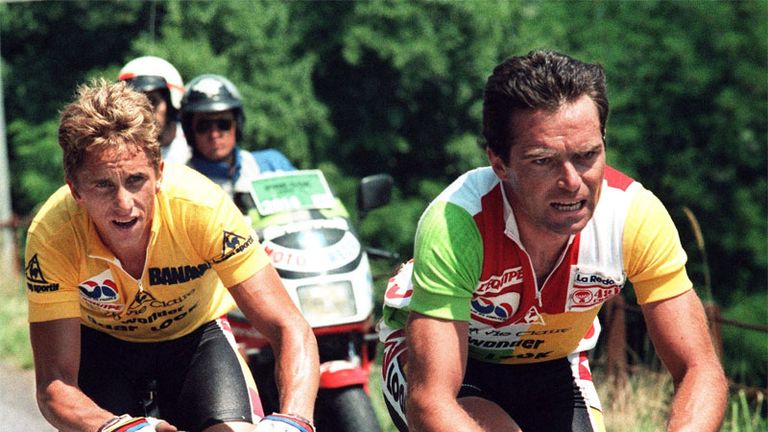
Richard Moore reflects on Greg LeMond and Bernard Hinault's rivalry during the 1986 Tour de France.
LeMond and Hinault's battle had Richard rapt in 1986
Allow me to teleport you temporarily away from cycling's travails - from Alberto Contador's questionable participation and probable victory in the Giro d'Italia, to the latest allegations against Lance Armstrong - and take you to a more innocent time.
Twenty-five years ago we witnessed the greatest ever Tour de France. At least, that's what I'm claiming in my new book,
Slaying the Badger, which is published on Thursday. Many will disagree, but I have my reasons. Plus, it was the first to be broadcast in its entirety in the UK by Channel Four.
A more innocent time? Well, it's all relative. In fact, the 1986 Tour was not great for noble sporting reasons. On the contrary: it was a Tour of deceit, duplicity and double-dealing, which also happened to involve a great sporting rivalry, between Greg LeMond, the young American, and Bernard Hinault, the great Frenchman and five-time winner.
Incredibly, LeMond and Hinault were La Vie Claire teammates. It made their rivalry - already perfect in so many ways - delicious. First, they had to pretend to get along, and to be singing from the same sheet. But that could never happen, because they were polar opposites. It's what made their rivalry so perfect: cycling's equivalent of Borg and McEnroe.
Aggressive
Hinault was gruff and aggressive, a five-time Tour winner going for a record sixth in his final season. He was Le Blaireau - the Badger - so-called because, when backed into a corner, he came out fighting. The Badger could be ferocious; he had a permanent snarl; he rode with his jaw clenched, as though gripping something with his teeth.
My favourite Hinault story comes from 1984, during Paris-Nice, when striking workers blocked the road. While the other riders stopped before the picket line, Hinault carried on; he rode straight into the protesters, and started throwing punches.
LeMond was a blond-haired, blue-eyed Californian, and one of the English-speaking 'foreign legion' of the early 1980s. LeMond, friendly and open, was a bit of a square peg in the round hole of European cycling.
He bucked many of the traditions and conventions, such as the long French lunch, which he considered a waste of time. So - to his French teammates' horror - he would sit reading a novel.
"I was bored," LeMond explained when I went to visit him at home in Minnesota. "In my first four weeks with the [Renault] team, I read about twelve Robert Ludlum books."
I asked LeMond about another story I'd heard - that during one meal he removed his shirt. He looked startled - not at the allegation - but that anyone should doubt it. "Oh yeah. The French riders were all shocked, but I think I was right to do it because your core temperature goes up. We'd be sitting in these ovens. I was like, I can't handle it. You gotta get the heat away from you."
Help
For the 1985 season, LeMond was signed by Hinault's La Vie Claire team, specifically to help the Badger win his fifth Tour. He duly did that and finished second overall himself, but LeMond emerged in the final week of that Tour as the strongest rider in the race, and he had to nurse the wounded Badger - with two black eyes and a broken nose sustained in a crash - to the finish in Paris.
On one stage in the Pyrenees, he even claimed he was told to hold back and wait for the struggling Hinault. LeMond was furious, and he claims now that he was promised - on the same evening - that in 1986 the roles would be reversed: Hinault would ride in support of LeMond.
Hinault repeated his pledge to help LeMond at the finish in Paris. But, going into the 1986 Tour, as the media got behind the Badger's bid for a sixth Tour, and François Mitterrand called Hinault urging him to do it for France, the deal seemed to be forgotten - by Hinault, if not LeMond.
Rapt
The 1986 Tour, the first I watched from beginning to end with rapt attention, was thrilling. That was one reason for wanting to write the definitive story of the race. Another was my fascination with Hinault and LeMond, who remain two of the most captivating personalities ever to grace the sport (even if 'grace' is not a word you'd readily associate with the gruff old Badger!).
I wanted to find out what had actually gone on. And how the team - owned by the colourful Bernard Tapie, who had just taken over Olmpique Marseille, leading them to the Champions League in 1993, but then ending up in jail for match-fixing - had coped with the internecine warfare.
Rumour had it that, by the second week, the five French riders were eating at one table, the three North Americans at another - with the two Swiss in the middle, as befitting their neutral status.
I went to visit LeMond, as I've mentioned, and also Hinault, at his farmhouse in Brittany, on a freezing cold winter's day. Hinault's willingness to talk about events that might not reflect all that well on him is admirable.
Yet there were hints during my visit of the old Badger - one line in particular which is unrepeatable here, but which suggested that he remains convinced he could have "had" LeMond at the 1986 Tour. (For those wondering, the line is in the book - obviously.)
So, LeMond faced several hurdles that should have been insurmountable. They included: having to overcome his teammate, Hinault; 80 per cent of the peloton (according to a L'Equipe poll, which claimed that most of the field wanted Hinault to win); factions within his own team; rumoured sabotage, with the Tour organisers warning him they "couldn't guarantee his safety"; and himself - for LeMond did not possess the confidence or leadership qualities of Hinault, who - as one former team worker told me - "was like Hitler, Stalin and Mussolini rolled into one."
LeMond, in contrast, was nervous, fearful, anxious - he was, according to one French journalist, "this birdlike character, very fragile, who you felt could break, even in the race itself, at any moment."
How did he overcome Hinault? Indeed, did he overcome Hinault? (OK, so the outcome of the race might be implied by the title.) I'm afraid I can't spoil the ending. You'll have to buy the book to find out!
Slaying the Badger: LeMond, Hinault and the Greatest Ever Tour de France is published on May 26 by Yellow Jersey, £12.99.
Follow me on Twitter: twitter.com/rbmoore73