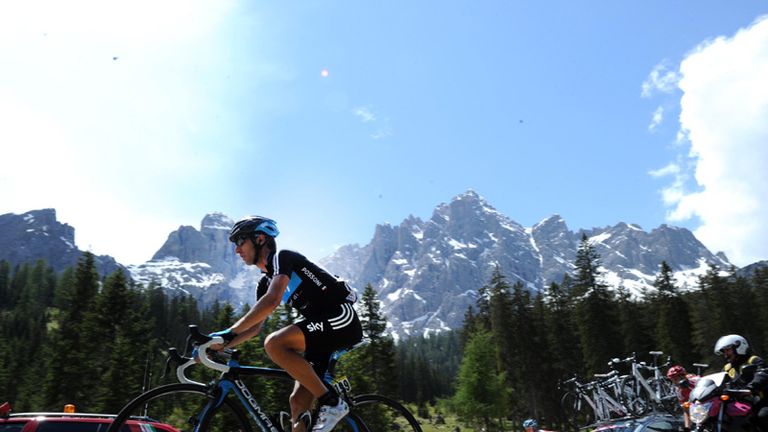
We take a look at the highly testing route that makes up the eight-day Osterreich Rundfahrt.
Preview of the 63rd edition
Despite the Tour de France soaking up much of the headlines the eight-day Osterreich Rundfahrt (or Tour of Austria) presents an alternative challenge to teams with climbing tests in abundance.
The race gets off to a tough start with a mountaintop finish on the famous Kitzbuheler Horn coming on just the second stage. Further forays into the Central Eastern Alps ensure this race is not one for the faint of heart, with picturesque backdrops doing nothing to soften the harsh terrain.
The race spans the entire width of the country and moves east for a pivotal time trial and two flatter stages to appease the shell-shocked sprinters in the bunch.
Team Sky arrives in Austria with a well-rounded eight-man squad made up of: Kurt-Asle Arvesen, Michael Barry, Jeremy Hunt, Peter Kennaugh, Morris Possoni, Ian Stannard and Chris Sutton.
Sunday 3 July – Stage one: Dornbirn to Gotzis – 139.7km
The race begins with an opening stage nestled in the far western corner of the country and an opening salvo taking in two passes of the 722m Alberschwende. The second category climb should allow a break to head clear with a first ascent after just 18.6km. After the opening climbs the stage flattens out for the final 100km with a few small undulations and a third category dig up the Schwarzer See (98.3km). The ‘stage in reverse’ profile should help bring things back together ahead of a slight uphill finish into Gotzis.
Monday 4 July – Stage two: Innsbruck to Kitzbuheler Horn – 158.3km
The towering Kitzbuheler Horn casts an imposing shadow over the second stage with all roads leading to the punishing climb as the riders leave the city of Innsbruck. The peloton begin with a gradual descent into Kirchbichl (53.1km) before climbing out of the valley with two quick climbs. The third category Itter (59.3km) is followed barely six kilometres later by the fourth category Hopfgarten. The climbs serve as a brief taster ahead of an undulating run into Kitzbuhl and a circuit around the famous ski resort before the final test. The 1670m climb should split the peloton to pieces and bring the race’s overall contenders to the fore.
Tuesday 5 July – Stage three: Kitzbuhel to Pragraten – 179.3km
The climbing continues with a second successive day of Alpine punishment. Straight out of the blocks the riders hit the third category Pass Thurn (15.5km) with a ten kilometre descent the only recovery time ahead of an even sterner test. The first category Felbertauern (41.9km) is again likely to thin out the bunch before a long gradual descent into Leisach (91.6km) and a feed zone. Tired legs will be burning as the leaders arrive at the foot of the wall-like Pustertaler Hohenstraße (112.9km). An elite group should form on the descent and the drag up to Matrei (158.8km) ahead of an uncategorised dig up to the line at Pragraten.
Wednesday 6 July – Stage four: Matrei to St.Johann/Alpendorf – 199.3km
The race continues east into the third and final torturous day in the mountains. The second category Iselsberg (37.4km) acts as a precursor and at 1203m, is relatively short by stage four standards. The road then ramps up at Dollach (57km) ahead of the lower slopes of the Hochtor. The hors-categorie giant maxes out at an eye-watering 2504m and is quickly followed by another push up the second category Fuscher Torl (84.6km). A steep descent follows which could inspire some heroics on an epic run into Taxenbach. The road falls away further before the final climb of the day, the first category Dientner Sattel (167km). From there only a run into Alpendorf remains and a welcome stage finish to mark only the half-way point of the race.
Thursday 7 July – Stage five: St.Johann/Alpendorf to Schladming – 157.2km
The final stage in the centre of Austria sees the riders greeted with a medium mountain test that will likely see the main contenders mark one another to let a breakaway or a solo attacker prosper. First up is the fourth category Pass Lueg (27.9km) before the sterner test of the Abtenau (48.7km). The terrain flattens out as the riders pass through Eben with a well-earned feed marking the half-way point in the day. Only the third category Mitterberg (129.5km) stands in the way of the peloton on a loop around Schladming and a long false-flat drag up to the line.
Friday 8 July – Stage six: Hainburg to Bruck an der Leitha – 155km
The entire race transfers east for a final trio of stages and altogether flatter terrain. Three fourth category climbs are unlikely to cause a stir after the peaks that have already been conquered, but an early ramp on an opening lap around Hainburg (16.1km) could allow a break to move clear. A pan-flat 100-kilometre stretch will be blessed relief for the peloton ahead of a finishing circuit around Bruck. Two ascents of the fourth category Hoflein climb will require the sprinters to stay vigilant but are unlikely to prevent a bunch kick for the line.
Saturday 9 July – Stage seven: Podersdorf to Podersdorf (individual time trial) – 30.1km
A hefty time trial could provide a tense penultimate stage if a pure climber is forced to defend his lead over unfavourable terrain. The out-and-back drag around Podersdorf is completely flat and should suit a powerful rider who has not left his legs behind in the Alps. A finish along the Seeuferstraße will likely see the race decided with just a straightforward sprinter’s stage remaining.
Sunday 10 July – Stage eight: Podersdorf am See to Wien – 122.8km
The race heads north on the final stage with just the smallest of rises likely to pose no obstacles to a peloton thankful to be nearing the finish. The race enters a finishing circuit in Wien with three laps of a circuit containing sprint points at Burgtheater ahead of a near-certain sprint finish to bring the challenging race to a close.