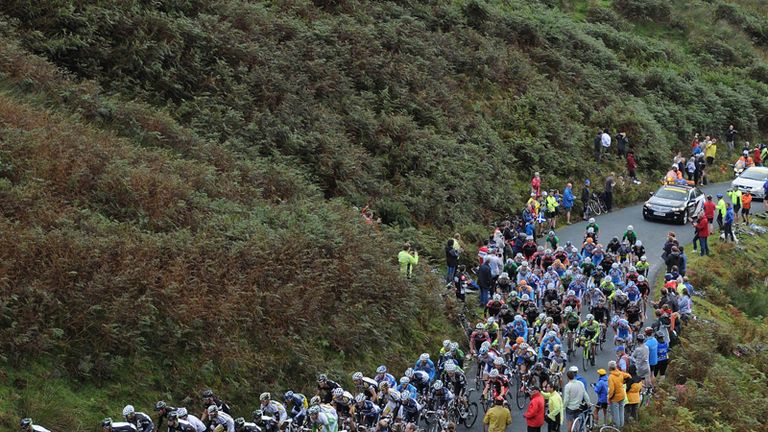
We take a look at the tough and testing route for the biggest race on UK roads - the Tour of Britain.
Preview of the eighth edition
The Tour of Britain grows has grown in stature every year since its return to the cycling calendar in 2004, routinely attracting some of the biggest names in cycling to the British Isles.
The race is a very attractive prospect for a number of riders looking to put the finishing touches to their preparation for the World Championships in Copenhagen.
Attacking racing is ensured as some of the world’s best professional teams duke it out with the best of British in the fight for the IG Markets leader’s jersey.
Six-man teams make controlling the race a feat in itself as it criss-crosses the United Kingdom, while a penultimate stage time trial looks likely to change the complexion of the entire race.
Sunday 11 September – Stage one: Peebles to Dumfries – 170.3km
A sprint point at Innerleithen after just 7.2km should ensure the race kicks off with a bang and could provide the springboard for a break to move clear. The route then heads back south-west towards the first categorised climb of the race at Megget Hill (38.4km). There will likely be a fight to hit the top of the next peak first as the riders tackle the entertainingly named third category Devil’s Beef Tub (59.5km). The riders then head south through a sprint at Moffat (70.8km) towards the finish at White Sands. The peloton will get a first taste of the finish area and the crowd in Dumfries before heading onto a tricky finishing loop that takes in Banks Hill. At 30km from home the third category test should not cause too many issues but could see a handful of brave riders go on the attack in a bid to foil a likely bunch sprint back into Dumfries.
Monday 12 September – Stage two: Kendal to Blackpool – 137.7km
The race heads south for the second day of action which should culminate in a trademark Tour of Britain sprint finish along Blackpool promenade. The stage gets under way in Kendal and leaves Abbot Hall before heading east to the first test of the day. A category two climb at Grayrigg (9.3km) is the most significant ascent of the race thus far and should see a break head clear. From there the route heads south, jutting through Sedbergh (18.8km) for a sprint point before a similar sprint into Kirkby Lonsdale (34.5km). The stage veers towards the coast before two quick third category climbs at Grizedale (76.2km) and Bank Farm (78.1km) come into play. The close proximity of the ramps could cause problems as the speed intensifies on the run west towards the sea. A bunch kick is likely to decide the stage which finishes alongside the famous Blackpool Tower.
Tuesday 13 September – Stage three: Stoke-on-Trent – 140km
There will be action in the Potteries as the race returns for its now familiar trip to Stoke. A tough ring to the east of the city begins in the sedate surroundings of Trentham Gardens before dropping down to Eccleshall. The riders then head east to Stone (22.4km) for the first sprint of the day as the route continues to wind east as far as Uttoxeter (44.8km). The race then ventures north in search of climbs with a second category peak at Ramshorn (63.2km) before continuing towards the top end of the day’s loop. It is here that the famous Gun Hill makes an appearance, the first category climb threatening to make a selection ahead of a run for home. The peloton will drop through Leek for a sprint (94km) with a chase likely on as groups try to force an advantage. A final second category ascent at Commonside (112.6km) will hurt the legs before a twisty run back into the centre of Stoke. A new race leader could be crowned at the finish on Albion Street after a tough day in the saddle.
Wednesday 14 September – Stage four: Welshpool to Caerphilly – 182km
The race returns to Wales for stage four with the picturesque surroundings of Powis Castle in Welshpool providing the backdrop for the stage start. The day is spent heading south through Mid-Wales on a potentially decisive stage, with Newtown (22.9km) the first stop for an early sprint point. The twisting terrain continues through to Llandrindod Wells (67km) for a second sprint. The race then passes through Builth Wells before attention turns to the first climb of the day. The third category Llyswen Hill (97.5km) acts as a precursor to the more testing first category climb on Brecon Beacons. The terrain should lend itself to attacks with another sprint point at Mountain Ash (153.9km). The stage will likely be decided on the Caerphilly Mountain (177.1km). The first category climb comes just five kilometres from home, meaning the first man to the top has a great chance of holding on during the brief run to The Crescent and the finish.
Thursday 15 September – Stage five: Exeter to Exmouth – 180.3km
Stage five sees the race take in a technical lap around Exeter with a tough route featuring three quick climbs. The day begins in Cathedral Yard in Exeter before heading west en route to an early sprint at Cherlton Bishop (12.1km). The stage then reaches Whiddon Down and turns left to take in a gruelling lap around Moretonhampstead. Continuing south the course then loops around towards the first category Haytor Rocks (48.1km). There is no let-up in the undulation as two second category tests follow hot on the heels, with Coffin Stone (57.8km) and Huccaby Tor (59.6km) likely to take their toll on the field. With the trio of climbs behind them the field will exit the loop and head back through Whiddon Down for a long loop around to the north of Exeter. Two further sprint points at Crediton (125km) and Rockbeare (154.6km) punctuate the run for home before a finish on The Esplanade.
Friday 16 September – Stage six: Taunton to Wells – 146km
Stage begins with what should be a rapid run out of Taunton with a brief early category three climb at Fivehead Hill (11km). The riders pass through Langport (19.6km) for a sprint before turning north over exposed roads. Conditions could be a factor if wind and rain buffet the peloton, yet there will be a number of determined riders targeting the tough finale. The field enters Cheddar for a sprint point before a tough ascent of Cheddar Gorge (87.1km). From there the riders descend down into a finishing loop around Shepton Mallet. The circuit hands the riders a glimpse of the finish in Wells before taking on the tough final climb. The first category Old Bristol Hill (119.8km) comes just after the finish and should cause splits in the bunch. There will be a big chase over the second passage of the loop with 26km back to the finish on Priory Road.
Saturday 17 September – Stage seven: Bury St Edmunds to Sandringham – 199.7km
The lengthiest test of the race and the longest at the Tour of Britain since 2004 winds its way north through Suffolk and Norfolk. The day begins at Angel Hill ahead of a run down to the third category Lavenham Hill (12.2km). The route then loops back up through Ipswich featuring a sprint point (44.2km) and a climb in Christchurch Park (46.9km). Another climb at Framsden arrives before the race enters Norfolk via a sprint point at Diss (89.7km). With the real climbing now behind them the field continues north as far as Reepham before heading west towards the finish. A twisting run into Sandringham should make things exciting ahead of a likely sprint finish which ends outside the local visitor centre.
Sunday 18 September – Stage 8a: London (individual time trial) – 8.8km
The peloton transfers across to London for a decisive double-header. A time trial makes a welcome return to the race for first time since 2005. The riders will roll down the ramp on Whitehall Place. The stage then heads over to Trafalgar Square before arriving at the Thames and a quick left turn onto the Embankment. The riders must settle in for a long straight run up to Tower Hill and a hairpin turn next to the Tower of London. The riders then head back in the opposite direction, flying past famous landmarks aplenty before heading briefly through Parliament Square and back onto Whitehall and the finish line. The power course is only a relatively short blast around the nation’s capital but looks likely to decide the race.
Sunday 18 September – Stage 8b: London – 80km
A near-identical course is used for the final as the peloton take in 10 laps of the London circuit in the afternoon. The will be an on-going battle for sprint points and bonus seconds at the line in Whitehall at the end of laps two, four and six. With a list of previous winners reading like a who’s who of sprinting talent, there will be a battle among the fast men to add their name to the list as the race comes to a spectacular close.