Anyone who didn't grow up with BBC Sports Personality of the Year as a pre-Christmas ritual must be baffled by the annual debate that it provokes.
When Carlos Sastre won the Tour, in 2008, it owed more to team tactics, and his CSC squad having strength in numbers, than any other Tour I can think of. Otherwise, it is rare that you can say the winner of the Tour won because he had a strong team (which, again, is not the same as saying that the winner of the Tour does not need a strong team; he does).
The danger of putting too much emphasis on the team is that it creates the perception that an average rider can be towed around France if his team is the strongest in the race. This perception has a long tradition: in 1929, when Maurice De Waele, backed by the powerful Alcyon team, suffered crashes and sickness yet still managed to win, the Tour organiser, Henri Desgrange, complained: "My Tour has been won by a corpse."
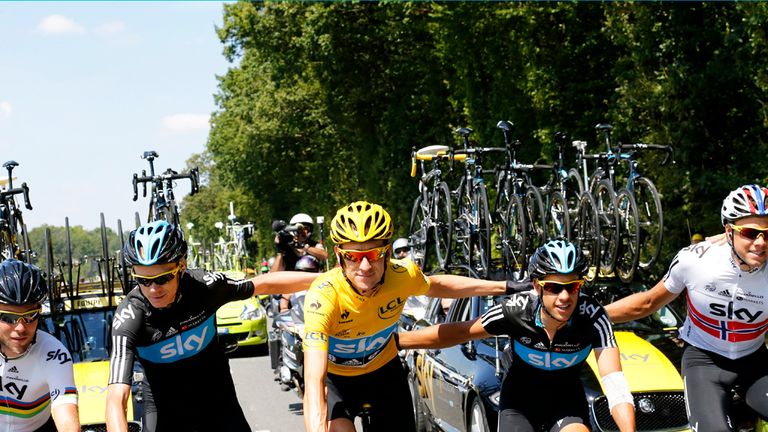
And, true, there have been other incidents - in 1985, when Greg LeMond felt he could have beaten his injured teammate, Bernard Hinault, and maybe even this year, when Chris Froome felt he could have claimed time on Wiggins in the mountains, had he not been held back by team orders. But was that the difference between him winning and losing? I'm not sure.
Sprint train
What about Mark Cavendish? It's difficult to argue against the assertion that he wouldn't win so often without his lead-out train - but would his team form such an effective and motivated lead-out train if they didn't have such faith in Cavendish's ability to finish off the job?
Take Cavendish's victory at the 2011 world road race championship in Copenhagen. Would he have won without the exceptional work done by the British team that day?
Perhaps not. But perhaps he would. On a flattish course there was, say, a 70-80 per cent chance of the race being decided by a sprint finish, regardless.
The work done by the British team increased those odds. Ultimately, however, there was another incident that was arguably just as significant as the six hours of solid team work that led up to that moment. As Matt Goss of Australia led it out in the final 300 metres, he left a gap that Cavendish was able to sneak through. Had Goss moved fractionally to his right, Cavendish would not have won.
A popular suggestion before the Olympic road race in London - in which the British team work did not pay off for Cavendish - was to present medals to the whole team. In some cases - such as Copenhagen - that might be justified. But Alexandre Vinokourov's victory in London owed little to his one Kazakhstan teammate, Assan Bazayev. It would have been odd to see him presented with a gold medal.
To emphasise the team aspect to road racing is to argue that it is manageable and controllable - but as Vinokourov's victory in London demonstrated, it isn't. It is gloriously unpredictable.
Team work and team tactics make the sport fascinating, beguiling, mysterious. The impact of the team is unmeasurable and adds an intriguing dimension. I can't think of parallels in other sports. Perhaps if Andy Murray didn't have to play rallies, but had to run on a treadmill to the side of the court before coming on for the most difficult shots.
But here's the key question: would that make the most difficult shots any easier? I don't think so.
Twitter.com/richardmoore73