Brian Barry
GAA Editor @BrianGBarry
Bloody Sunday: 100 years on from the GAA's darkest hour
"At the heart of the appalling tragedy at Croke Park 100 years ago was a group of innocent people who went to a match and never came home," explains GAA president John Horan ahead of the centenary of Bloody Sunday.
Last Updated: 21/11/20 1:36pm
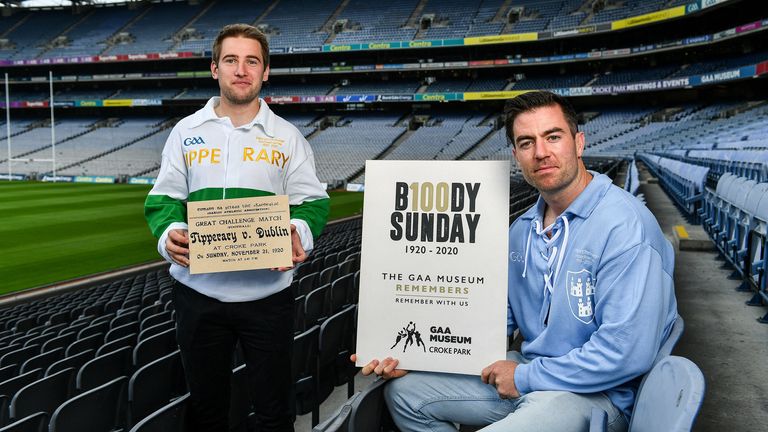
This is no ordinary weekend for the GAA.
Saturday marks the centenary of undoubtedly the darkest day in the association's 136-year history: Bloody Sunday.
On the morning of Sunday, 21 November 1920, the Irish Republican Army executed 15 British army personnel and intelligence agents in Dublin. Retaliation and retribution was sought, as the War of Independence had well and truly arrived in the capital.
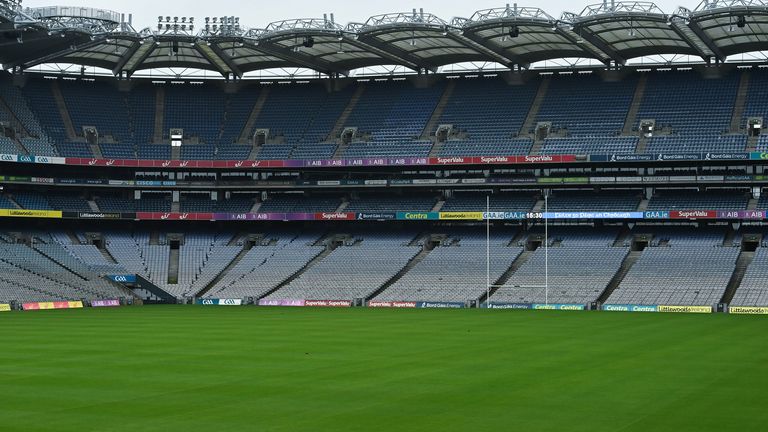
Later that afternoon, the Royal Irish Constabulary, Auxiliaries and British Army arrived at Croke Park, where Dublin and Tipperary were playing a Gaelic football match. The original intention was to search and interrogate all those in attendance at the Jones' Road venue.
Instead, they opened fire on those in attendance. A massacre ensued.
Fourteen civilians, including Tipperary player Michael Hogan, were killed:
- Jerome O'Leary (10), Blessington St, Dublin. Schoolboy
- William 'Perry' Robinson (11), Little Britain St, Dublin. Schoolboy
- John William 'Billy' Scott (14), Fitzroy Avenue, Dublin. Schoolboy
- Tom Hogan (19), Mechanic from Tankardstown in Limerick
- Joseph Traynor (20), Labourer from Ballymount in Dublin
- Michael Hogan (24), Farmer and Tipperary footballer from Grangemockler
- James Teehan (26), Publican from Tipperary
- Tom Ryan (27), Gas Company worker from Glenbrien in Wexford
- Jane Boyle (29), Butcher's shop assistant from Lennox St in Dublin
- Daniel Carroll (30), Bar manager from Templederry, Tipperary
- James Matthews (38), Labourer from Nth Cumberland St, Dublin
- Michael Feery (40), Unemployed from Gardiner Place, Dublin
- James Burke (44) Originally from Tipp. A van driver from Windy Arbour, Dublin
- Patrick O'Dowd (57) Originally from Meath, a labourer from Buckingham St, Dublin
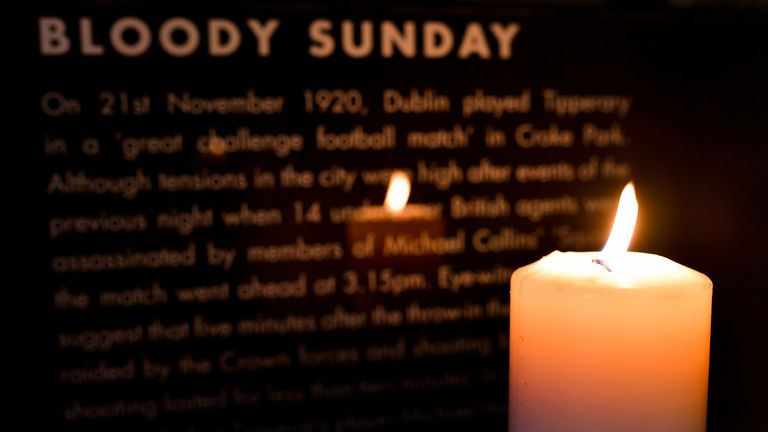
100 years on...
Call it a quirk of fate; but the impact of the coranavirus has forced the GAA Championships into the winter months.
It means - rather fittingly - that both the Dublin and Tipperary football teams are in action this weekend in their respective provincial finals.
Both sides will mark the occasion with special jerseys.
Dublin will wear the names of the 14 victims on their sleeves, while the Premier will revert to the green-and-white shirt that they were wearing in 1920; the colours of the Grangemockler club.
A minute's silence will be observed before all GAA Championship matches this weekend.
On Saturday evening ahead of the Leinster Football Championship final between Dublin and Meath, the GAA will stage a special remembrance ceremony to honour the 14 victims killed at Croke Park by Crown Forces on Bloody Sunday, November 21, 1920.
There will be a lighting of 14 flames in a dedicated area of Hill 16 and a corresponding pillar of light dedicated to each of those who died.
GAA director general Tom Ryan and president John Horan will lay wreaths on the spot where Tipperary corner back Michael Hogan was fatally shot that day, an area of the field in front of Gate 43 at the northern end of the stadium.
They will be joined by Uachtarán na hÉireann Michael D Higgins and An Taoiseach Micheál Martin.
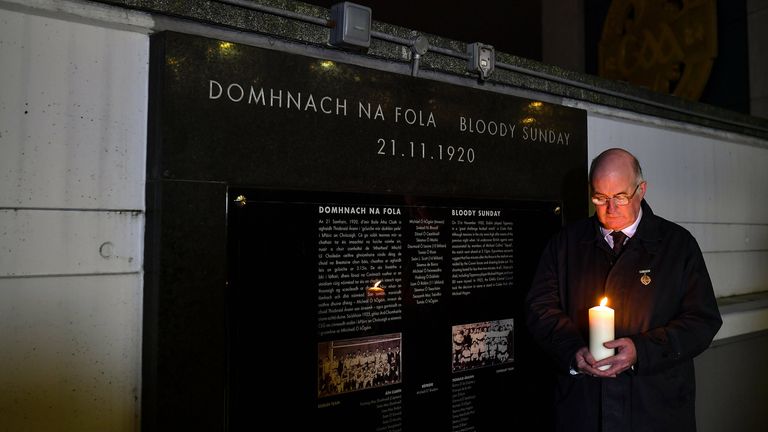
"At the heart of the appalling tragedy at Croke Park 100 years ago was a group of innocent people who went to a match and never came home," said Horan.
"The attack on Croke Park was a defining moment for the GAA and gives us a connection to this venue that goes deeper than it being just another pitch.
"Our work on the centenary has focused exclusively on remembering the people who died, paying respect and tribute to their lives and making a commitment to ensure they and the events that occurred are never forgotten."
In the absence of spectators being permitted at Croke Park in line with Government Covid-19 restrictions, the GAA has encouraged members throughout the country to pay their own tribute to those who died at Croke Park by lighting their own candle at dusk.
Since 1926 the main stand at Croke Park has been dedicated to the memory of Tipperary's Michael Hogan from Grangemockler. The club in Tipperary will unveil a statue to him in their village on Sunday.
Further information about Bloody Sunday is available on the GAA's website, or through The Bloodied Field podcast.