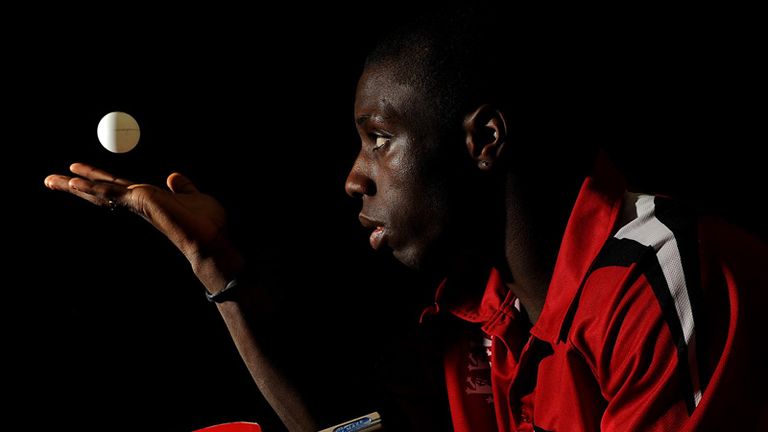
Table tennis has become a global game from its origins in English country houses in the late 19th century.
Table tennis has become a global game from its origins in English country houses in the late 19th century.
It now has a massive worldwide following - particularly in the Far East - and professional leagues all over the world, although not in its homeland, where table tennis is still often regarded as slightly quaint, a game for the family rather than a sport for athletes.
The rules are pleasantly simple.
- The serve must bounce on both sides of the net, all other shots just on the opponents' side.
- Service alternates every two points regardless of who wins the point, and - in the final game of a match - when one player reaches five points, the players switch ends.
- A game is won by the player or pair to score 11 points (it was formerly 21)unless both players or pairs score 10 points, when the game shall be won by the first player or pair subsequently gaining a lead of two points.
- Championship matches are traditionally staged over the best of five or seven games.
History
Table tennis was first played in the 1880s in England as a parlour game. The dinner table was cleared, books were used as an obstacle or 'net', other books served as 'rackets' and golf balls were batted across.
It's journey to fully-fledged sport and then into the Olympic Games has been remarkable.
Late 19th century capitalism played a key part - manufacturers quickly cottoned on to he popularity of the concept and the availability of bespoke equipment quickly fed the enthusiasm for the game.
By 1901 table tennis tournaments were being organized and an unofficial world championship was held in 1902. In 1921, the Table Tennis Association was founded in Britain, and the International Table Tennis Federation followed in 1926. London hosted the first official World Championships in 1926.
Table tennis was introduced as an Olympic sport in Seoul in 1988.
Best of British
Paul Drinkhall: The 21-year-old from Middlesbrough is the British number one and could get amongst the medals in 2012. No Briton has ever won a medal in Olympic table tennis. The English Senior No.1 won three gold medals at the European youth championships in Terni, Italy staying undefeated throughout the entire competition - team event, singles, doubles and mixed doubles. National Champion in every age group so far eligible to compete in - Under 10, Under 11, Under 12, Under 14, Under 17, and Senior Men. Paul became the youngest player since Chester Barnes to win the English Senior Men's title in Sheffield in March 2007.
Olympic greats
Table tennis is immensely popular in China, with an estimated 100million regular players. It is fitting therefore that the greatest of all players is China's
Wang Nan.Wang won four Olympic golds, the same number as fellow Chinese players Deng Yaping and Zhang Yining, but he also won a sliver medal in the singles in Atlanta in 1996.
Chinese players
Liu Guoliang, Wang Liqin and South Korean
Yoo Nam-Kyu have won the most medals in the men's competitions, with four each, while Ma Lin (China) is the only male with three gold medals.
Since 1992, the winner of the women's singles has also won the doubles or team event: Deng Yaping, in 1992 and 1996; Wang Nan, in 2000; and Zhang Yining, in 2004 and 2008. In the men's competition, only Liu Guoliang (1996) and Ma Lin (2008) have achieved this feat. Besides Deng and Zhang, no other female or male player has successfully defended their singles title.
China has been the most successful nation in Olympic table tennis, winning 41 medals (20 gold, 13 silver, and 8 bronze.) At the 2008 Games in Beijing, China achieved an unprecedented medal sweep in both the men's and women's singles tournaments and won both team tournaments.
Ones to watch
Wang Nan: The 32-year-old Chinese woman is the most successful player in history. She has won four Olympic gold medals and 15 world championships. London is likely to be the left-hander's swansong and if selected by her country she will be desperate to avenge her 2008 final defeat to Zhang Yining.