
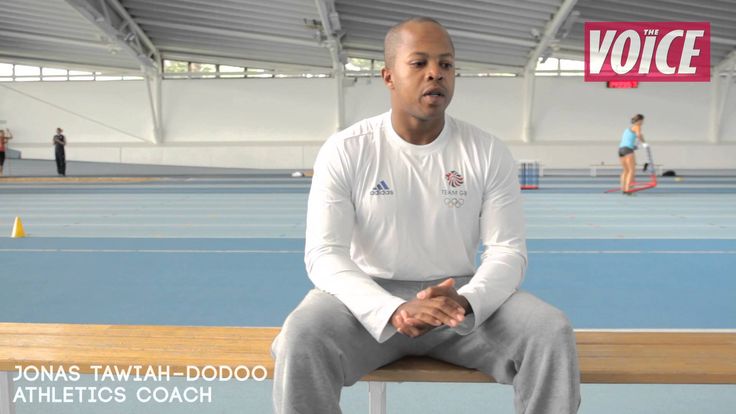
Jonas Tawiah-Dodoo reveals his plans to maximise Olivia Breen's potential
Tuesday 3 February 2015 18:16, UK
After a highly successful 2014, coach Jonas Tawiah-Dodoo has spent much of the athletics off season looking for ways to build upon that success in the forthcoming season.
Tawiah-Dodoo helped to guide long jumper Greg Rutherford to Commonwealth Games and European Championships glory, sprinter Chijindu Ujah to run a sub-10 second 100m and, of course, Sky Academy Sports Scholar Olivia Breen to the T38 100m bronze medal at the IPC European Championships.
Looking at things from more of a functional perspective or a biomechanical perspective seems to be my conclusion of the way I want to go forward.
However, far from resting on his laurels Tawiah-Dodoo, with the help of the Coaching Development Programme, is striving to improve both himself and his athletes in 2015 as the countdown to Rio begins in earnest.
“I’ve been thinking of the best ways to analyse my programme, to analyse, assess and quantify progression in the programme,” he explained to Sky Sports.
“I’ve researched a few different tools that are out there and a few different processes. Through talking more and more to my mentors and people in my network I’ve come back to where I was and I’m looking more at using functional assessment to really make an assessment and to set goals.”
Tawiah-Dodoo, a disciple of renowned American coach Dan Pfaff, has spent the last few weeks trialling a number of different software programs to help him deliver more effective feedback to his athletes and believes the difference it can make could be huge.
“My philosophy is very much based on movement and movement efficiency. I use my coach’s eye to make an assessment on what I see but my eye is still subjective,” he said.
“I also take a lot of video to give video feedback to the athletes and what these programs allow you to do is be more precise with your video feedback by allowing you to measure angles, distance and time, for example.
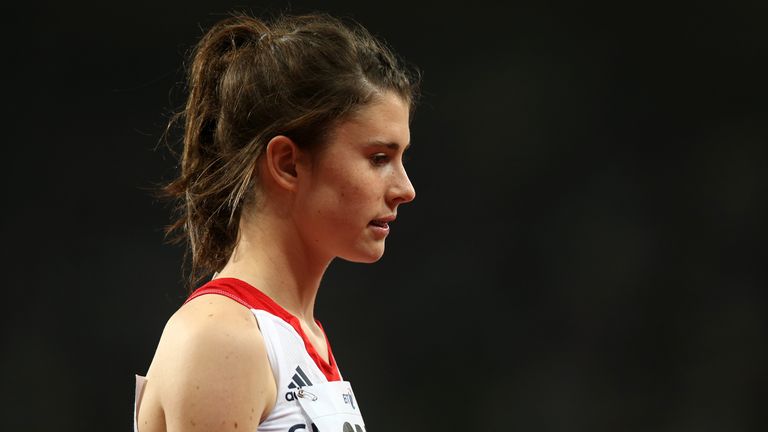
“It allows you to overlay one over another so that you can make very, very clear distinctions between two different runs. For example, Olivia versus Carmelita Jeter. I can draw lines and angles, I can annotate the video which allows Olivia to watch and see precisely what I am looking at.
“If you look at two runs and just say ‘your hips were higher in run two’, higher doesn’t necessarily translate the same way in the brain to different people. But, if you are able to annotate and show on a video exactly what you mean, you can be far clearer and more effective with your feedback. The video analysis allows me to be far more scientific, quantative and accountable with my feedback.”
I think modern coaching has proven that you can peak at athlete two or even three times in a year
Certainly, it seems that the approach is working wonders for Breen who smashed her 60m personal best in her first race of 2015 last month and while Tawiah-Dodoo is thrilled with her progress, he insists that this is the beginning of a process that must be completed before the Paralympic medallist can be fairly judged.
“We’ve been doing a lot of video analysis with Olivia and the progress she has made in the past 12 weeks since we’ve gone into more specific training is quite huge,” he added.
“We use some timing gates that give us a very clear and precise measurement of her speed and at the beginning of December she was running 60m in training in 9.5s and with some very clear changes in her biomechanics and her starting and her upright position she has got that time down to 8.6s.
“That puts her very highly up there because the British record I think is 8.5s. In actual competition, two weeks ago, she ran around 8.6s and in training she has proved that through the changes we are making biomechanically she can actually run faster.
“She showed it in training, she learnt a lot from the video analysis that we’ve done and she made the necessary changes and actually applied it in a race. So that was really good.”
With the IPC World Championships in Doha not taking place until the end of October it is set to be a long year for both Breen and Tawiah-Dodoo. However, the young coach hid any concern he may have about what is likely to be a demanding season and insisted he was confident Breen could perform throughout the year and peak at the right time.
“I think modern coaching has proven that you can peak at athlete two or even three times in a year,” Tawiah-Dodoo said.
“I think it is very important for athletes to feel confident throughout their training, so Olivia is doing an indoor season to be able to focus on the first part of her race and each phase of training we go into we will build upon that.
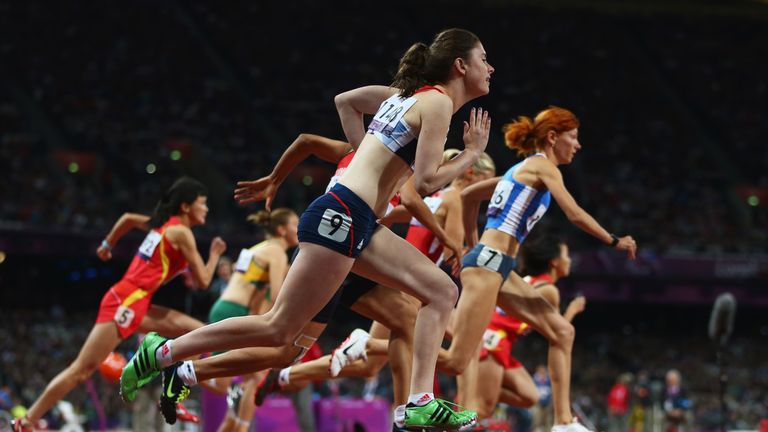
“This winter the focus has actually been about her first 20m and so in this indoor period we haven’t been doing loads of speed work that focuses on the whole run, we’re really addressing those first 20m and we need to carry on doing that.
“When we come to the first stage of the summer it will be about executing her first 40 and 60m so even though we are racing 60m at the moment, training isn’t necessarily on that.
“So when we see good results we know that actually, even though she is running PB’s in the 60m, if we wanted to and really focused on the 60m she could probably run faster. But if we really focus on the 60m now then the base work, the fitness and so on needed for outdoors wouldn’t get done. We have to sacrifice a bit now so that Olivia can perform well throughout the year and peak when it really matters.”
It is all about the process, a point Tawiah-Dodoo stressed a number of times. Even when a major championship comes around it is the process rather than the outcome that is the priority.
“Throughout training, from the beginning to the end, even in the preparatory stages you make a link between technical execution and the result,” he said. “By making specific changes to Olivia’s technique, allowing her to run more efficiently, the times that she will run will go down.
“She has a very clear understanding that if she executes the processes that we have worked on then we can almost estimate the time that she is going to run.
“We set up those systems very early on in training and as a result when we go to major championships she has very clear technical goals and process that she has to go through – either to do with technique or to do with sports psychology that means she will execute what we want her to execute.
“That, in turn, will result in a specific time, plus or minus .1 or .2s depending on the conditions. So when we enter a competition thinking about medals or times could be quite a distraction.
“It depends on the individual but certainly for Olivia, focusing on her race and enjoying herself, blocking out the distractions and focusing, those are the key things that we focus on and as a result the times, medals and achievements they come almost secondary.”