
On the perch
Wednesday 7 November 2007 13:40, UK
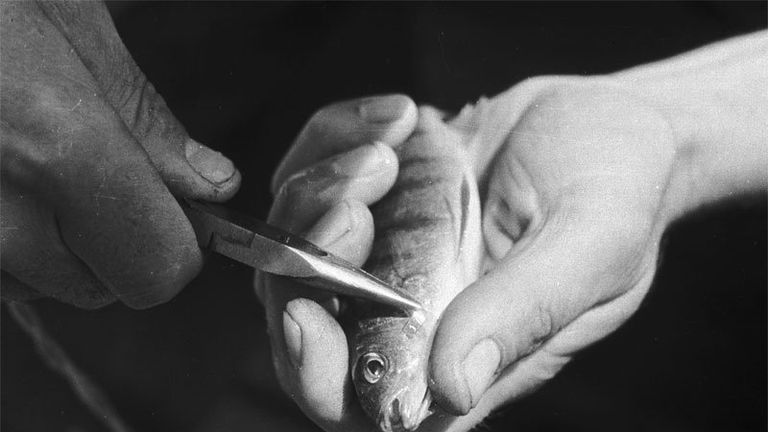
Keith Arthur gives some top tips on how to go about catching 'Billy the Burglar' this winter.
Watch Keith Arthur on Tight Lines every Friday on Sky Sports
EMAIL KEITH ARTHUR Now that the latest 'Indian Summer' appears to have departed I daresay many anglers' thoughts will turn towards perch. Billy the Burglar (I first heard that name on a canal match in the 1980s, assigned to the perch because of the stripes on either flank, similar to the archetypal cartoon burglar, with his striped vest and 'swag' sack) is currently out there herding up shoals of fry to build up strength for spawning. Perch are one of the earlier spawning species, usually they are done and dusted by the time the close season on rivers arrives. By January the smaller 'cock' perch will be carrying a lean, mean look with a decidedly red edge to their normal olive colouring. The females will just be big and fat. These are certainly halcyon days for perch and those that pursue them. I have never known so many large perch in so many various waters and some of the best places to look are commercial fisheries. Unfortunately most of those won't allow spinning or fishing with livebaits so two of the prime methods are no-go. The one bait to go for in that kind of situation is a lobworm. They can now be purchased, usually imported from Holland, even Canada, and make superb baits. The imported variety are not the same as 'our' lobs and if we have two mild, wet days left this autumn, it may be possible to get out and 'snitch' a few from any mown or cultivated grass. Roads with cultivated gardens adjoining the pavement are a good source of worms on wet evenings, as they come out of their burrows and stretch across the ground hoping to meet a like-minded lobby for a bit of nuptial pleasure. Although worms are hermaphrodite it still takes two to make more worms and the means of doing so is quite interesting. The worms collide, then slide inside each other's saddle; the collar-type band that runs around the worm about 25% of the way down the body. In this manner each worm is fertilised and eggs are laid. If I happen across two worms conjoined, I let them get on with it: well, would YOU like it?Toughen up
Once collected, keep the worms in shredded paper and they will toughen up and remain good for 2-3 weeks as long as they are kept cool (NOT in a fridge, too cold) and well ventilated. I like a box with slits on each side so it can be turned regularly. Many tackle shops will sell large dendrabena worms, and sometimes label them as 'lobs'. They are not lobworms (they are striped and a very different creature altogether) and are nowhere near as effective as the real thing. They are relatively easy to breed though and are very popular with match anglers for 'chopping', which seems to attract plenty of small 'billies' but few big perch. To fish with lobworms it is necessary to use a decent sized hook and with 'barbless only' being the usual rule, steps must be taken to prevent the worm from simply wriggling free. There are two ways of ensuring this; one easy, the other less so. The easy way is to hook the worm right through the body, just above the 'saddle' then slip a piece of cut elastic band over the point of the hook and onto the bend. The other is to cut the head off the worm, use a baiting needle to pass the line right through the main section with the hook at the cut end, then put the 'head' on the hook by threading the point through the cut end and out the side. With the hook at the head end it is quite in order to strike pretty quickly as perch have cavernous gobs and will swallow the lot in seconds. Incidentally, if you have a perch that is deeply hooked, a SLAMO disgorger will remove it readily. If you fish for big perch on commercial fisheries - even where they are not reported they will be there if there is a breeding stock of roach or rudd - seek out water with some cover - under trees if there are any, close to bankside vegetation or in tucked-away corners. That's where the fry will over-winter and Billy won't be far from his dinner! Canals are also great sources of big perch. I remember as a lad that a couple of contemporaries used to 'walk' spinners along the lower reaches of the Regents Canal, around Mile End and Stepney, and catch some big perch, and over 3lb was a big perch in the early 1960s. They'd enter the canal at a bridge, cast their spinner - either a Mepps in silver with a red wool 'tag' over the hooks or a 'Voblex' in gold with black stripes and the obligatory red wool - then walk slowly along the bank pulling the spinner as they walked. Possibly without even thinking about it, they were fishing the right area, the marginal ledge, and covering a massive amount of water. I cannot believe a similar trick wouldn't work today, when perch stocks are at their highest levels since the perch disease of 1968, which wiped out massive amounts of every schoolboy's first fish. Bait fishing will work and of course on most canals half an hour with punched bread - small punch size - can catch you half a dozen small livebaits. Remember all livebaits can only be used in the water from which they have been captured. Return alive all baits you don't use as 'deads' rarely, if ever, work for perch. Keeping them in a keepnet whilst fishing is a great idea; it's like groundbait! Of course worms will also work on canals. Natural lakes and big gravel pits also hold big perch and usually plenty of pike and working your way through scores of jacks in a vain attempt to catch a big stripey is not something I care to do.Security
If I know there are big perch there, it will be lobworms first, second and third choice as bait to avoid the toothy critters. Using 'lives' means a wire trace as security and perch are not that keen on stainless steel attached to their lunch! Finally, rivers, and many huge perch have been caught from small rivers in the past decade, with the Upper Great Ouse as stand-out. That is far from the only river with good numbers of big billies though. Almost every river will have them, it's just a case of whereabouts. Close to weirs, in the nearest slack below the weir is a great starting point; below locks, where the 'cut' meets the flow and on deep inside bends if there is not too much flow are the best places to look. If the water is clear, following high pressure, lures can be great fun: jigheads with rubber tails are a great joy to fish with. Worms can work too but you could be 'chubbed' to bits - no bad thing I guess - but by far the most productive method is livebaiting, trotting a small bleak or gudgeon, if you can catch them first! The final bait worth a try in ALL situations is king prawn. Expensive but an excellent perch-catcher, especially where there are crayfish present. Don't fiddle about peeling them either. Use raw or cooked - I prefer raw - and whole, with heads, legs and antennae still attached. The reason I prefer raw is that if I take cooked I can rarely waste them on feeding the fish!Now let's look at some of this week's questions... EMAIL KEITH ARTHUR Hi Keith, I fish the odd match on commercial fisheries using the feeder as I don't own a pole. When fishing the margins for carp float fishing I keep foul hooking fish. How can I stop this? I was also wondering if you ever came across my grandfather Maurice Fulker, also known as Polly? He fished for Dartford and district and was quite successful mainly in the sixties and early seventies. John Carding dedicated his book, Match Fishing, to him. He sadly died when I was young so I never had the chance to fish with him. Many thanks, Robby Everitt. KEITH SAYS: Hi Robbie, I am certain I recall the name Maurice Fulker, although my involvement in the area didn't arise until the late 1970s when I managed a fishing tackle shop in Ladywell Road, Lewisham. It was one of about seven within a five minute drive: there is just one for the entire area these days. Anyway, to your question. Margin fishing for carp can be a nightmare as they definitely have the ability to pick out the 'wrong-un'. The problem is we see the fish, get carried away and end up over-feeding the swim. Paste is one way to help avoid foulhooking because it is not necessary to feed anything except the hookbait. A small sprinkling of pellets will interest the fish but once there is a fish there, and one at a time is the best number, use a lump of paste, catch that one, then wait for the next one. There will be enough taste to interest the next margin prowler. But one method that I feel we ignore is freelining. Just a hookbait, hook and that's it. Put the rod on the bank and wait for the line to go tight, lift up and it's game on. Lay the bait in where you need it, then allow the line to fall slack against the bank. Try it and see. Hi Keith, A friend of mine is going to Cuba in January and would like some advice on where to fish for Tarpon and Barracuda, without boat hire if possible. Is there a website he can visit? William Gough KEITH SAYS: Hello William. That's a bit of a tough ask. In my experience a guide makes all the difference to a great fishing trip and a blank. Finding flats with fish on is one thing: knowing the direction from which the fish enter and leave the flat, whether they feed on the up or down of the tide and even spotting the fish is something that guides excel in. A lot will depend on which area of the island your pal visits too: the usual holiday destinations usually have guides 'on tap' and a recommendation is worth lots of approaches on the beach! From memory, I would say that January will be good for barracuda, possibly bonefish and maybe permit. Mangroves may hold small (5-15lb) tarpon but the big guys will be away until Spring. EMAIL KEITH ARTHUR