
Understanding Short Track
Great Britain Performance Director Stuart Horsepool talks to Sports Scholarships about the unpredictability of Short Track and the work required to compete with the world's top nations...
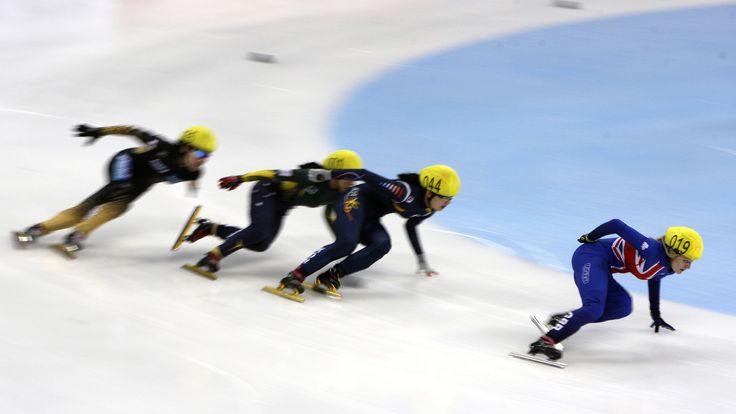
Thursday 16 January 2014 09:45, UK
The ISU World Cup short track season is well under way after meets in Shanghai and Seoul in September and October, respectively, with the world's best skaters starting their preparations for the Winter Olympics in Sochi in earnest.
Once at these highly competitive events, the unpredictability and gruelling nature of the sport becomes increasingly clear with a straight knock-out format meaning the slightest error can see a skater eliminated as early as the preliminary stage. "The sport basically is about getting through rounds, but it's unlike, say athletics, where you have one round one day and then you have a couple of days to rest before the next round," Horsepool told Sky Sports. "In short track you basically go through the whole day, skating round after round. You can start off with say around 120 athletes in one distance, and then they are gradually cut down round by round first to around 85, and then 64 and so on and so on until you've got a final. "You can race six, seven times in a day quite easily. As you go through the rounds it's usually the first two who qualify for the next round, but depending on the numbers, the fastest third place finishers could also go through, which highlights the speed of the races if you like. That means that it can be an advantage if you go at a stronger pace in a round." To consistently reach the latter stages as Christie did last season then is incredibly difficult and Horsepool is wary that as a result of her performances during 2012-13 people may expect similar or better finishes as a matter of course this time out. "That's one of my fears - that people think that because Elise was world number one last year, that it will give her a massive advantage this year, but that's not the case," he said. For Christie this season will provide a new test in that she may find herself targeted in certain races, according to Horsepool. The fact she was ranked second in the world overall last season means that there will be no surprise element this time around to her bold style of taking an early lead and backing herself to hold on until the finish line. Implementing new tactics will be key for Christie and, indeed, all British skaters and it was something they started working on in Shanghai. "There will be a lot of tactics involved so one of the key things for our athletes to take from this event is to learn as much about how others are skating this year," said Horsepool. "Elise, for example, could be a target for some nations seeing as she was ranked world number one in the 1000m last season, and her characteristic style of skating, leading from the front of the pack, has become a trademark. "It has been important for all the athletes, including Elise, to work on different styles of racing and it's something we have been looking at since the World Championships in March." The development of the sport in the UK is vital for Horsepool as other nations throughout the world plough more and more money into a sport that offers eight medals opportunities at the Winter Olympics. However, keeping the standard of the skaters as high as at present is just as important given the levels needed to make the sports major events. The levels required to even reach the British team are incredibly high. Horsepool admits that whilst it does mean more will miss out, it ensures that the resources at his disposal are used to help the absolute best the country has to offer in terms of short track skaters. "I think from a performance point of view, development is a key focus of ours because we need to ensure that we've got skaters coming through at a lower level that can then be developed into world class athletes." "To give you a figure, 62% of people who've come on our programme since 2000 have made the top 10 in an Olympic Games. It's not like we take nobodies, they have to be within 6%, or be on a path to be within 6% of the world record before they can even train at the national performance centre at the National Ice Centre in Nottingham. That's the standard we set for the national team.