
Sky Sports' beginner's guide to Gaelic Games
Tuesday 5 May 2015 09:59, UK
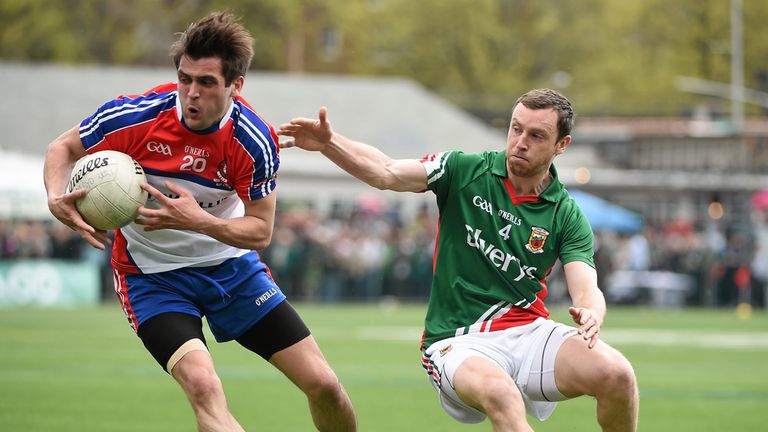
Sky Sports will be screening 20 live matches from this summer's GAA championships.
And while most of you will be more than familiar with the rules and regulations of Ireland's two most popular sports, there will be some people in dire need of a beginner's guide!
With that in mind, skysports.com has drawn up a basic introduction to Gaelic football and hurling, which will help people grasp some of the aspects of both codes.
Gaelic Games
Gaelic football is played with a ball that is slightly smaller than that used in soccer, while in hurling players use a stick - or hurley - to strike the ball, called a sliotar, which is similar in size to a hockey ball. Hurling is believed to the oldest and fastest field sport in the world.
Teams in both codes consist of 15 players - one goalkeeper, six defenders, two midfielders and six forwards. Six substitutions can be made in football, five in hurling.
Matches are played on a pitch that is bigger than that used for soccer and rugby - it can be up to 145m long and 90m wide. Goalposts are similar to rugby, with the crossbar slightly lower. Lines are marked parallel to the end lines at distances of 13m, 20m, 45m and 65m. The middle of the pitch is marked with a small parallel line that has a maximum length of 10m.
Rules
Inter-county matches consist of two 35-minute halves, while club games are 30 minutes per half.
In Gaelic football, players are allowed to carry the ball in their hands and it can be kicked or hand-passed. After every four steps the player must bounce or solo the ball. A solo involves dropping the ball onto your boot and kicking it back into your hand. You cannot bounce the ball twice in succession but you can solo as many times as you wish. The ball cannot be lifted straight off the ground - a player must put his boot under it.
Shoulder-to-shoulder contact is permitted, while a player can slap the ball out of an opponent's hand. More than one player can tackle the player in possession but their tackle must be aimed at the ball. Deliberate body contact such as punching, tripping, jersey pulling or a full frontal charge is forbidden, as is blocking an opponent's shot with the foot.
In hurling, the ball can be struck on the ground or in the air - with the hurley or boot - but it must be lifted off the ground with your hurley. The ball can be carried in your hand for a maximum of four steps. After that you can bounce the ball on the hurley and back to your hand, but you cannot catch the ball more than twice. Players get around this by balancing the ball on their hurley while running.
Players can block an opponent's strike using their hurley. They can also hook a player's hurley as he is attempting the strike the ball. Like football, shoulder-to-shoulder contact is also permitted.
Scoring
A goal is scored when the ball crosses the goalline between the posts and under the crossbar, while a point is scored when the ball goes over the crossbar. A goal is the equivalent of three points. Teams' scores are written in a goals-points format. For example, 2-10 is two goals and 10 points, which is a total of 16 points.
A goal is signalled by the umpire raising a green flag, while a white flag signals a point. The game restarts with the goalkeeper kicking out the ball from the 13-metre line.
Format
Each county competes in their provincial championship before then competing for the All-Ireland Championship.
There are four provincial championships in football - Connacht, Leinster, Munster and Ulster - and three in senior hurling - Leinster, Munster and Ulster. However, the Ulster Hurling Championship is a standalone competition, meaning the winners don't advance to the latter stages of the All-Ireland series.
Galway are the only county to play senior hurling in Connacht so they compete in Leinster, as do Antrim.
When a county loses a provincial game they enter the All-Ireland qualifiers. The provincial winners progress to the All-Ireland quarter-finals in football, and semi-finals in hurling.
Officials
Match officials comprise of a referee, two linesmen and four umpires.
Two umpires stand at either end of the pitch - beside each goalpost - and signal scores, wides, '45s' or '65s', and assist the referee in controlling the game.
Dead balls
A '45' is signalled in football when a defending player knocks the ball over his own endline. Instead of a corner like in soccer, a free-kick is awarded to the opposing team on the 45-metre line. The same occurs in hurling but the free is taken from the 65-metre line.
When a team plays the ball out over the sideline in football, a free-kick from the hands shall be awarded to the opposing team. In hurling, a sideline cut is awarded, but the player must strike the ball off the ground.
Discipline
Yellow and red cards are issued in both codes but there is also a black card in football, which is issued for cynical behaviour fouls such as deliberately pulling down an opponent. The offending player is ordered off but can be replaced, provided the team hasn't already used their full quota of six substitutions.