
'Janky' defense: How modern NBA defenses have evolved; international influence behind Nick Nurse and Steve Kerr's innovative schemes
Sky Sports analyst Huw Hopkins describes the different priorities NBA teams exhibit on the defensive end, and explains how the innovative defensive schemes of Nick Nurse and Steve Kerr are similar to what you see in the game abroad; Watch Warriors @ 76ers, 1.30am tonight on Sky Sports Mix
Saturday 11 December 2021 15:13, UK
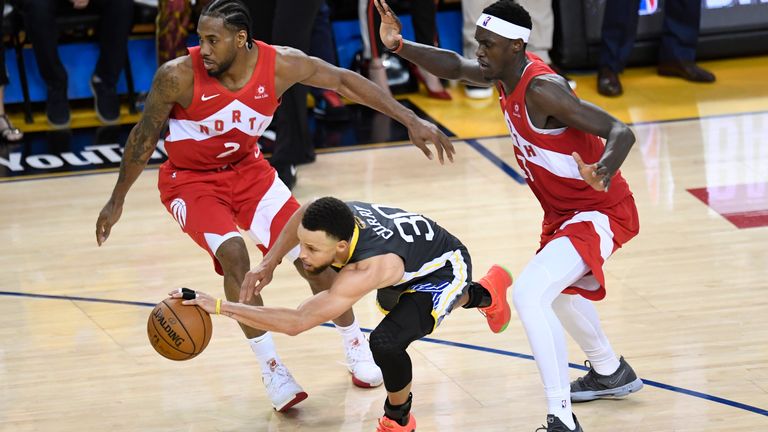
"Hand down, man down," is the catchphrase of colour commentator and former NBA coach Mark Jackson.
During his play-by-play analysis on ESPN and ABC broadcasts, he regularly uses this line when referring to a failed defense: when the defender is beaten by the offensive player he is assigned to.
American basketball, especially the men’s NBA, tends to stick to man-to-man defense. The concept is as simple as it sounds: one player on Team A guards one player on Team B.
The thing is, guarding an NBA player one-on-one is not easy. Even the worst players in the league are still 1,162-times better (approximately) than those on your standard local basketball team. But at the top level, against players of a similar standard, an average NBA player’s offensive output is manageable with a good defensive system and a handful of passable defenders.
This is because teams on defense have gameplans in place and make decisions depending on the situation. For example, when the offense moves the ball and runs plays to get their players open, the defense might have already decided in the locker room that they will ‘switch’ - basically, swap players - or help by putting pressure on the player with the ball, and rotating back to their individual assignment as the offense continues its possession.
These pre-game decisions aside, at its most basic, man-to-man defense means you are accountable for your player and nothing else. It is your job to stay with them and stop them from scoring. And even with a good gameplan, it’s not easy to stop a player from scoring every time.
Take, for example, DeAndre Jordan of the LA Lakers. While he had some good years in the past, he is not an offensive weapon these days, unless he is rolling down an open lane after setting a screen - so, stopping him is easy. And think about the likes of Joe Harris on the Brooklyn Nets - he is only aiming to do one thing when his team has the ball, getting open to shoot it from the perimeter.
On the same teams, you also have the likes of LeBron James and Kevin Durant, respectively. The strength, size, handles, shooting and wingspan of these players make it impossible for one player to lock them down by using just one technique. And this is why you occasionally see coaches implementing new strategies. Because, why waste a player to closely man-mark Jordan or Harris, when their defenders could probably cheat off them in certain situations and help slow down the superstars on their teams?
You will often see defenders ‘trap’ a leading ball handler, which means one player on defense will leave their assignment to double-team the likes of, for example, Chris Paul. They are right to do so, because he is scoring 1.12 points per possession every time he has an isolation play.
A double-team can also be implemented away from the ball. In situations featuring the likes of Joel Embiid, he might be trying to receive the ball close to the basket - where he scores 69 per cent of the time - but a second defender might leave their assignment to cover him before anyone can pass him the ball.
Many teams also have a basic zone defense in their arsenal, where players defend areas, or ‘zones’, on the court, rather than individual players. This means team-mates can help if an offensive player enters their zone.
But some coaches in more recent years have been building a hybrid.
Defensive innovations in the modern NBA
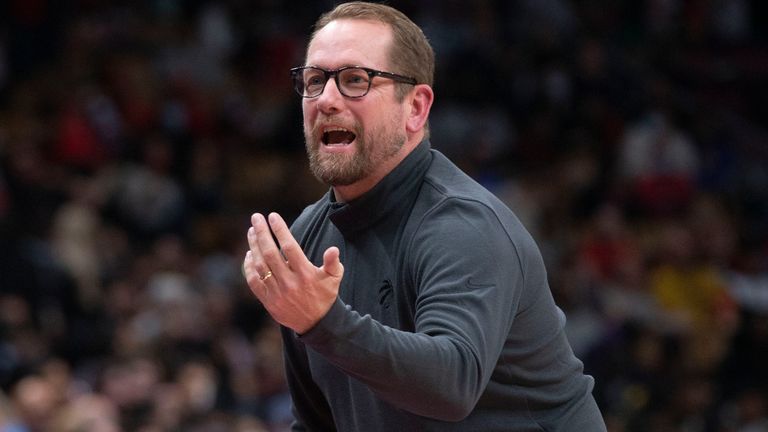
NBA Finals 2019: Nick Nurse is a first-year head coach with the Toronto Raptors, a team that has pushed all its chips into the middle of the table to make a run at the Larry O’Brien trophy, and acquired Kawhi Leonard, Danny Green and Marc Gasol. It worked and the team was up 1-0 against the defending but depleted champions, the Golden State Warriors.
In Game 2, the Warriors were without Klay Thompson and Kevin Durant due to injury, so Stephen Curry was the main point of attack. Seeing an opportunity to cut off the head of the snake, Nurse established a box-and-one system: one player would chase Curry in an individual effort while four Raptors would defend an area on the court, and add secondary pressure to the Warriors guard whenever he came into their zone.
Toronto might have lost that game, but they cut a 20-point deficit using a defense that Curry described as “janky”, and scored 10-straight to close the gap in the final few minutes, nearly sealing the victory before Andre Iguodala hit a clutch three to win it for Golden State.
As the series continued, the Warriors couldn’t stay healthy, and the box-and-one was used at different times to disrupt the decreasing number of offensive players on the court. It essentially helped the Raptors win the championship.
London Lions head coach Vince Macauley has coached former NBA players, and owned the team when Nurse was still coaching in the British Basketball League, and he believes it’s the international influence that helped inspire the creative defensive schemes. He said: “In the NBA, you’ve got 10 super athletes on each team who can do a bit of everything. As you move down the leagues across Europe and so on, you get to situations, much like we had in the early days of the BBL where you had just two American players, who were significantly better than their local counterparts.
“You had those two players who accounted for 60 points per game, and you had to find a way to stop them, and regular man-to-man wasn’t going to stop them. Those junk defenses, as we called them back in the day, you used them to nullify those threats.”
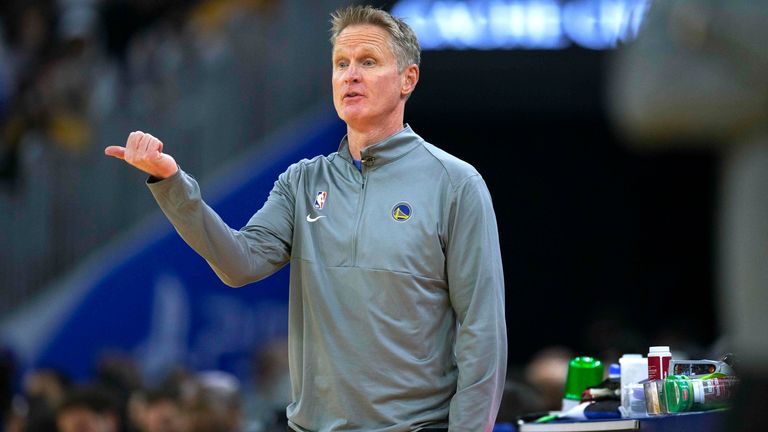
This year, Warriors head coach Steve Kerr has learned from facing that box-and-one, and he has also built up his own raft of international experience as an assistant coach on an Olympics-winning Team USA staff.
Earlier in the season, Golden State faced off against the Brooklyn Nets. To combat the offensive juggernauts of Kevin Durant and James Harden, he set up a triangle-and-two - similar in principle to the box-and-one, but with three zone defenders (two along the baseline and one in the free throw area) and two playing switching, man-to-man defense.
It’s not something we’re accustomed to seeing in the NBA, but it has happened throughout history and is likely going to increase in usage as the game continues to become more international. This year, the season started with 109 players from 39 countries outside the USA and 14 of the league’s current head coaches have varying experience overseas - playing or coaching.
Macaulay agreed: “I laughed when I saw those defenses, because that tells you that you’re dealing with a coach with experience across the world.
“You play basketball to win. And whatever it takes to win is good enough. You shouldn’t shy away from any particular type of defense or offense.”
While it might appear janky at first, Stephen Curry and Steve Kerr are a prime example that they can learn from something that beat them. It helps to have great defenders like Draymond Green, Gary Payton Jr, and high IQ players like Curry and Andre Iguodala, but having a team-first system in their pocket will help reduce the amount of times any one player is beaten by themselves - especially in the playoffs, where every edge is needed.