
Rowing
Wednesday 30 July 2008 16:28, UK
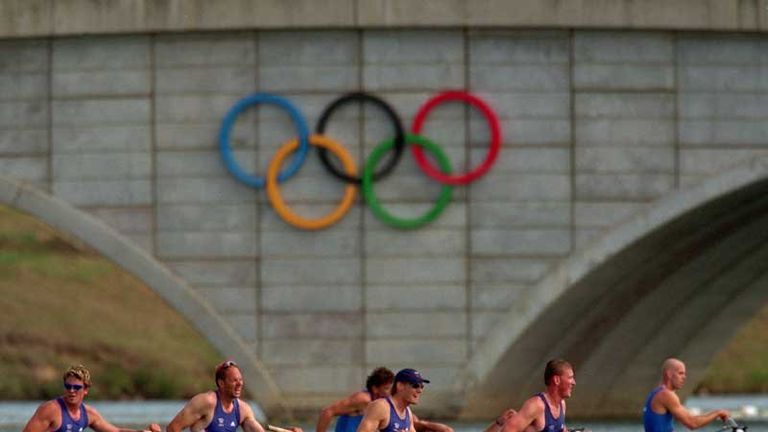
Rowing can be traced as a sporting event back to the 17th and early 18th centuries in England and as a competitive sport there are no Olympic events that go further back. The University race between Oxford and Cambridge first took place in 1823 while Yale and Harvard competed in 1852.
The races are divided into scull and sweep oar and have a lightweight and heavyweight division. Sculling is where the rower has an oar in each hand while sweeping is where they just have one. Boats can have up to eight rowers and coxswain in.
There are 14 medal events in the Olympics with women competing in six. The men compete in single, double and quadruple events in the scull category, and double, quadruple and a large boat race with eight oarsmen in the sweep races.
Women only compete in a double and quadruple sweep race and a coxed eight oarsmen race.
Competition is made up of heats with the winner progressing to a semi-final or sometimes straight to a six-boat final. Depending on the number of boats, everyone who does not win their heat will get another chance to progress with a further race in the repechage.
Eight and Alternate plus cox
Carla Ashford, Jess Eddie, Alice Freeman, Katie Greves, Natasha Howard, Alison Knowles, Natasha Page, Beth Rodford, Sarah Winckless, Caroline O'Connor (cox)
Pair: Louisa Reeve, Olivia Whitlam
Quad Scull: Annie Vernon, Debbie Flood, Frances Houghton, Katherine Grainger
Double scull: Elise Laverick, Anna Bebington
Alternate - Tina Stiller MEN Four: Tom James, Steve Williams, Peter Reed, Andy Triggs Hodge
Eight: Alex Partridge, Tom Stallard, Tom Lucy, Richard Egington, Josh West, Alastair Heathcote, Matt Langridge, Colin Smith, Acer Nethercott (cox)
Pair: Robin Bourne-Taylor, Tom Solesbury
Single Scull: Alan Campbell
Double Scull: Matt Wells, Stephen Rowbotham LIGHTWEIGHT WOMEN Double scull: Helen Casey, Hester Goodsell MEN Four: Richard Chambers, James Lindsay-Fynn, Paul Mattick, James Clarke
Double scull: Zac Purchase, Mark Hunter
Alternate - Rob Williams
History:
Rowing has taken place at each Olympics since 1896 and is a widely followed event. Women's events were introduced in 1976 and the sport undertook a major overhaul for the Atlanta Games in 1996 when the lightweight division was brought in for the first time. The earliest recognised champion was Toronto's Edward 'Ned' Hanlan, nicknamed 'The Boy in Blue', because of his penchant for racing in a sky blue outfit. He has been described as the first true world champion of any sport. The sport can boast arguably the greatest ever Olympian in Sir Steve Redgrave, who won gold at five consecutive Games.Olympic Greats:
Soviet rower Vyacheslav Ivanov was a three-time Olympic champion, winning the single sculls in Melbourne in 1956 before going on to successfully defend his title in Rome and Tokyo. The first victory was notable for a sensational sprint finish that took him over five seconds clear of long time leader Stuart Mackenzie of Australia, while in 1960 he defeated East German Achim Hill by an even wider margin. Ivanov was to lock horns with Hill once more four years later, but trailed by seven seconds with 500m to go. The Russian's power-packed finish was in evidence once again as he drew ahead, but such was his effort that he briefly lost consciousness 50m before the finish. He awoke to find himself still in the lead, and went on to win by 3.73 seconds for a third gold medal. Finnish fireman Pertti Karppinen became the second single sculler to win three Olympic golds when he defeated old rival Peter Michael Kolbe in Los Angeles in 1984. The pair had clashed in Montreal eight years earlier with Karppinen coming from behind to beat the world champion from West Germany, and he went on to defend his title in Moscow beating the Russian Vassily Yakusha. Kolbe missed the 1980 Games due to the anti-Russian boycott but came up against Karppinen on Lake Casitas, leading until the 250m mark. But, as eight years before, the tall Finn powered home to claim a third gold medal. Karpinnen also competed in Seoul and Barcelona finishing seventh and 10th respectively.Best of British:
There can be no greater rower in the history of the sport than Sir Steve Redgrave, who picked up five gold medals over a period of 16 years - with a bronze thrown in for good measure. Redgrave was 22 years of age when helped the coxed fours to victory in the 1984 Games in Los Angeles, and four years later teamed up with another member of that team - Andy Holmes - to win a second gold in Seoul in the coxless pair, with bronze coming in the coxed pair. By 1992, Redgrave had found a new partner in Matthew Pinsent and they raced to victory in both Barcelona and Atlanta, after which Redgrave famously announced his retirement from the boat. However, he was coaxed back into training for Sydney in 2000 and, alongside Pinsent, Tim Foster and James Cracknell, claimed an historic fifth gold medal at the age of 38. Pinsent stepped out of his team-mate's shadow in Athens four years later, again teaming up with Cracknell, Steve Williams and Ed Coode to claim a fourth gold medal following a titanic duel with the Canadian boat. It took officials an agonising three minutes to reach the conclusion that the British four had won by 10cm. Redgrave was preceded by Jack Beresford as the only rower to pick up medals at five different Olympics - in Beresford's case three gold and two silver. His run began in 1920 by coming second in the singles sculls, and he went one better four years later in Paris. 1928 saw Beresford join the silver-winning eights and by 1932 he was part of the successful coxless fours crew. He added a third gold in Berlin four years later in the double sculls and only the cancellation of the 1940 Games due to the war stopped him from competing in a sixth Olympics at the age of 41.Ones to Watch:
Elise Laverick/Anna Bebington A new pairing that is one of Britain's best hopes. Laverick, who took bronze four years ago, is looking to be the first female rower to win Olympic gold for Britain after pairing up with Anna Bebington. They took bronze at the world championships last year and were reunited recently, taking gold at the World Cup in Poland and hold genuine title aspirations. Women's quad Led by veteran Katherine Grainger, this team have been world champions for the past three years and are expected to at least finish on the podium - hopefully going one better than in Athens where they took silver. Grainger is joined by Annie Vernon, Debbie Flood, Frances Houghton. Zac Purchase/Mark Hunter The lightweight pairing have dominated one of the most competitive events in rowing, and go into the Games having not lost a race all season. They scored a confidence-boosting victory over world champions Denmark at the recent World Cup, making them the team to beat in Beijing. Men's coxless four Steve Williams returns to attempt a second gold medal after successfully teaming up with James Cracknell, Matthew Pinsent and Ed Coode in Athens. Fourth at last year's world championships, the quartet overcame injuries to Tom James and Andy Triggs-Hodge to take silver at the recent World Cup in Poland, and along with Peter Reed, appear to be peaking in time for Beijing.Team GB:
OPEN WOMENEight and Alternate plus cox
Carla Ashford, Jess Eddie, Alice Freeman, Katie Greves, Natasha Howard, Alison Knowles, Natasha Page, Beth Rodford, Sarah Winckless, Caroline O'Connor (cox)
Pair: Louisa Reeve, Olivia Whitlam
Quad Scull: Annie Vernon, Debbie Flood, Frances Houghton, Katherine Grainger
Double scull: Elise Laverick, Anna Bebington
Alternate - Tina Stiller MEN Four: Tom James, Steve Williams, Peter Reed, Andy Triggs Hodge
Eight: Alex Partridge, Tom Stallard, Tom Lucy, Richard Egington, Josh West, Alastair Heathcote, Matt Langridge, Colin Smith, Acer Nethercott (cox)
Pair: Robin Bourne-Taylor, Tom Solesbury
Single Scull: Alan Campbell
Double Scull: Matt Wells, Stephen Rowbotham LIGHTWEIGHT WOMEN Double scull: Helen Casey, Hester Goodsell MEN Four: Richard Chambers, James Lindsay-Fynn, Paul Mattick, James Clarke
Double scull: Zac Purchase, Mark Hunter
Alternate - Rob Williams