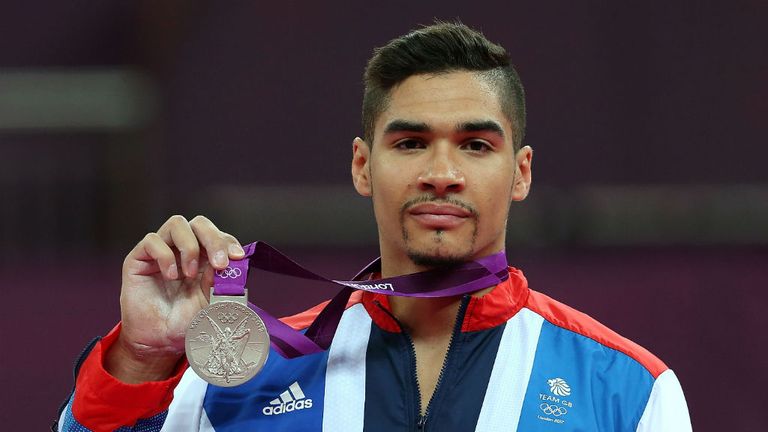
Britain's Louis Smith won the silver medal in the Olympic pommel horse event as team-mate Max Whitlock took a surprise bronze.
Happy with decision to go for a safer routine
British gymnast Louis Smith won the silver medal in the Olympic pommel horse event as team-mate Max Whitlock took a surprise bronze.
Pre-event favourite Smith was pipped to the gold by Hungary's Krisztian Berki in the North Greenwich Arena by the narrowest of margins.
Both routines received scores of 16.066 from the judges but Berki took the gold courtesy of a better execution score.
Smith, the bronze medallist in Beijing four years ago, had disappointment etched across his face after the result flashed up on the scoreboard having been the last man to perform.
But he was quick to congratulate the Hungarian champion and acknowledge the quality of his work.
Smith said: "It was very tough. Being a British athlete in a home games, it's very nerve-wracking, especially the build-up we've had over the last couple of years."
"I wasn't too focused about what anyone else was doing. My routine is hard enough let alone worrying about what other people are trying to do so I just try to stay focused, stay chilled, listen to my reggae music and keep calm."
After the result was announced, Smith went over to shake Berki's hand and the pair embraced on the podium. He added: "We're good friends. We're great rivals but we're good friends. If I was going to be beaten by anyone apart from Max then Krisztian Berki is that guy.
"He'll go down as one of the greatest pommel horse workers ever and the fact I came second to him is something to be proud of."
Held back
Smith admitted he held back on performing his toughest routine, which includes a triple rotation called the 'triple Russian', but is pleased to have come away from the Games with two medals despite missing out on gold.
"To do that routine under that type of pressure with two massive scores to beat, it was very nerve-wracking but I'm glad I'm still alive," Smith said.
"In training, my 17.1 wasn't going to plan, I kept making a few little errors, so my decision was to go for the easier routine.
"He [coach Paul Hall] didn't make it, I did, and afterwards he said: 'That was a good decision'.
"It's hard. The waiting game I call it. It's tough, especially when you put in a good performance like that. I knew straight away as soon as it came up that it was second place."
When asked if he regretted not going for his toughest routine with which he scored 16.325 at this year's British Championships, Smith said: "No, not at all. I could probably be standing here without a medal with tears down my face.
"I've got a silver medal, I've got my third Olympic medal and all those years ago I didn't think I would go to an Olympic Games and get three medals so I'm very happy right now."
Whitlock claimed third place with a score of 15.600.