
Constructive criticism
Wednesday 22 June 2011 14:30, UK
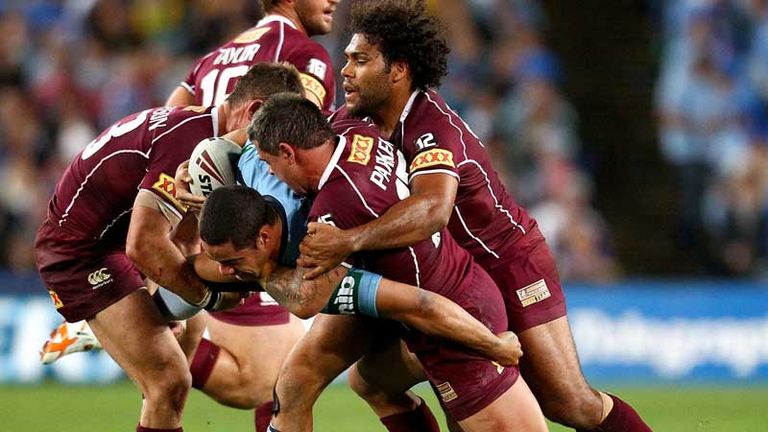
Phil Clarke asks if rugby union pundit Stuart Barnes has assessed the State of Origin fairly.
Are pace, power and skill enough asks Phil
People in rugby league say that we're not afraid of change. I've written it here quite recently. So for that reason I thought that it would be worthwhile to listen to the opinion of my colleague from the rugby union department. Stuart Barnes is the equivalent of Stevo in the 15-a-side game of rugby and I value his thoughts and opinions. Last week he attended a State of Origin match in Sydney and wrote about it in an article for a Sunday newspaper. It's worth saying, for those of you who don't know much about him, that he was a running stand-off in the days when kicking the ball increased your chances of being picked for England. He likes to see teams play rugby and can appreciate a good try in either code. To summarise his article, he said how impressed he was with the players. He felt that their athleticism and skill levels were superior to much of what he sees in rugby union and commented on the accuracy of the passing for both teams, but he felt bored by the predictability of much of the play. He accepted that the game went from end to end but regretted the fact that the players made very few decisions. He thought that the shape of the game was so predictable, even if it was played at an unrelenting pace. His point about there being very little 'dead time' is an interesting one. Most supporters of rugby league think that that leads to a good match, but maybe it doesn't? What do people who don't usually watch rugby league think is the best? The recent game played between England and the Exiles had the ball in play for just over 60 minutes, far greater than rugby union, but was it too predictable? Is it too fast?Think on your feet
Stuart Barnes believes that at the highest level, elite union eclipses the best league because players are forced to think more. He appreciates the decision making needed in the 15 man game. Everybody in rugby league has spent the last 20 years working out ways of making the game even quicker. Even when the ball rolls over the dead ball line, we have a race to see how quickly we can restart play. Is it too quick for some viewers? Barnes was magnanimous enough to accept that a great game of rugby union is quite rare, and he's sick of seeing teams constantly kicking the ball back to their opponents or out of play. Perhaps this gives the crowd a chance to have a chat. Is it the conversation during the game that they like? If predictability was his greatest complaint, does he have a fair point? Criticism sometimes hurts but we should use his feedback in a positive way and see what we can learn from it. I think that most of you would agree that five drives and a kick down field can seem quite monotonous. It's even worse if you throw two runs from acting half back in as well. Three passes and one kick in a minute's action doesn't seem a lot. The rules of the game for the last 30 years have taken away the majority of contests for the ball. Scrums are very rarely contested and the defending team can no longer strike for the ball at the play-the-ball. Until quite recently, kick offs were very predictable with the receiving team picking up possession and starting their march down field. So, what could we do to be less predictable? I haven't met a fan who doesn't like the 40/20 rule. It's like asking the team to gamble in the casino. The risk is that it won't find the sideline and by kicking earlier in the tackle count they'll have to do some extra tackling. The reward is a chance to attack your opponent's try line from close range. The problem is that they are too rare in my opinion. We've had 125 games in the Super League this season and only 27 40/20 kicks. I love to see teams contest the ball when it's kicked off and appreciate the challenge for possession. I believe that we need a little bit more of this in our game if we want to attract new people to it and would like to read your suggestions.Keeping our talent
I sometimes think that we've not been great as a sport in retaining some of the talent that comes up. I'm not just talking about players like Chris Ashton or coaches like Shaun Edwards, but other people who've been involved in rugby league and drifted away when the game chose to ignore them. Jon Finn is a qualified sports psychologist from Leeds. He did some work with Tony Smith in the past and yet was ignored by the Performance Department at the RFL. He's now doing some ground breaking work at a private school in Monmouth, helping the students with their mental resilience and performance under pressure, in both sporting and academic situations. It's only my opinion, but I feel that we could have a bigger impact on performance by investing in Sports Psychology. Every team has a fitness trainer, a gym, tracking equipment and yet most coaches talk about confidence, belief and aggression.Phil answers your emails...
Got a question for Phil? Email him at skysportsclub@bskyb.com or use the feedback form below...Pushing the limits
Hi Phil, Having watched the second state of origin match I can't help thinking we are a long way behind the Southern hemisphere. I do however think that the RFL is correct to try to push the boundaries of intensity with the exiles game, and long may it to continue to grow. I wonder if you think that it could be a good idea to have a two tier Super League both consisting of ten teams but all with equal salary cap monies. So that the bottom four sides of the super league now would play in the second tier with teams like Leigh, Halifax, Widnes, Toulouse etc., giving them an intense comp and the winners to be given the opportunity to join the first tier. The first tier would then likely to have better quality but with fewer games to keep players fresher but hopefully achieving close games week in week out keeping the interest of people who may not know our game. I know that this is not possible at the moment because of TV rights and monies but surely this would in the long run make our game stronger whilst not alienating some of the teams that have realistic ambitions of playing in the top flight like Halifax, Leigh and not at the cost of teams like Wakefield.John B PHIL REPLIES: Like you John, I thoroughly enjoyed the State of Origin game which came across as a great spectacle. I think that it was enhanced by the fact that they had over 80,000 people there to watch it, providing an unforgettable atmosphere for the ones who attended. It makes it easier for players to have a 'personal best' performance when put inside that environment. I thought that it was a pity that our game between England and the Exiles lacked such an atmosphere, but perhaps that will improve in time. The points that you make are very interesting but I don't see how you can get 20 clubs operating on the same salary cap. It sounds like a Communist run league in the U.S.S.R. of the 1970's! Some teams are bigger and more successful than others and it would be unfair, inappropriate and to the detriment of the sport in the longer term to restrict their growth and expansion. I'm not sure if you are a season ticket holder John, but would you be happy to see fewer games and still pay the same amount for your season ticket? The final point that you make would need some further investigation for me. There can be a difference between the words 'realistic' and 'ambitious' and I think that one sometimes puts the two together mistakenly.
Three-match series
Phil, surely a three game series against the Exiles needs to be established? I'm sure the England players would love to have another crack at the Exiles this season rather than wait a full year, as would the fans. To cope with a three match series mid-season and to prevent player burnout I'd suggest that England players be limited to playing 22 games for their respective clubs during the regular super league season, with the RFL making a contribution to their salary. This would help in keeping our elite players relatively fresh for the end of season international series' and also give clubs the chance to blood some younger, fringe players. Also the Exiles should be given the opportunity to play against the Aussies and Kiwis at the end of the season, which would produce some intriguing matches and generate a fair amount of interest down under I'd imagine.Ben Risley PHIL REPLIES: I have already written about the technical quality of the England v Exiles games. It was much higher than we usually see during a Super League game but it lacked a real atmosphere. That might be because it was its first year or because we only had one set of supporters in the ground. I'm not sure how we're ever going to get a great atmosphere as I can't see the Exiles ever building a fan base. There might be the odd Scot, Welshman or Irishman who turns up to see an English defeat, and you might get a few people from Down Under who are travelling around Europe and want to take in a good game, but how will we ever get for example, Castleford supporters cheering when Rangi Chase drops the ball, when they've got a Castleford shirt with his name on at home and he's their favourite player in Super League? How can they hate a player who they shout for most weeks? Other people have suggested a maximum number of club games and I think that it takes place in rugby union, but I can't see how you'd ever get it to happen in rugby league. The club game has so much more money than the International one that it's impractical. If your team needed to win their last Super League game in order to qualify for the play-offs, but your star player had already played 22 games, would you be happy to see him rested? There's no guarantee that he's going to get picked in the International team after all. I can't see supporters or clubs accepting it, and realistically why should players. They play to earn money; it's what they do to pay the bills etc. Who says that they're burnt out? Is a player burnt out at 35? Should he retire? Not if he wants to carry on playing a team still think that he's good enough. It's a myth that we lose in International matches because our players have played more games than theirs. With regards to your point about the Exiles playing against the Aussies and the Kiwis, or in fact entering the Four Nations in place of France or Wales, I can't really see why you'd do that. Who would pay to watch? What would it prove? It would be a bit like asking Lennox Lewis to box David Haye. Both great boxers but one's just older than the other. Viewers Down Under would just laugh if they saw some of the players who played Test matches and State of Origin five to 10 years ago playing in Representative games in the UK. It wouldn't be as interesting as you might think.
Paying the price
Hi Phil, I'm sure you get lots of mail asking you your opinion on the rules of the game and how they should be changed. One rule i think definitely should be looked at is the knock on rule by a defending player in the in goal area. If a defending player knocks on behind his own line, the rule is a drop out under the posts, which potentially could reach halfway line or even further. It could even result in the opposing side knocking on or the ball bouncing in play and then in touch, and resulting in a scrum to the original offending side. Alternatively if a player knocks on just in front of his own try line, the outcome is a scrum attack on the 10yrd line. Surely this cannot be fair as to knock in the in goal area you would think was more an offence than knocking on in the field of play. I think the ruling should be a scrum attack on the 10 yard line for both offences. I have sent this question in to Boots 'n' All several times but haven't been lucky enough to have read out and discussed, could you please give me your opinion please.Harold [aka ] Aspey PHIL REPLIES: I can't believe that I've been watching the game for so long and never considered your point before. It's brilliant. It seems blindingly obvious once you've thought about it and I laughed every time I watched a Goal Line Drop Out this week. The accuracy of the kickers this season and the difficulty with which they force the receiving team to gather possession means that we are going to see more occasions in which a team makes a Goal Line Drop Out and then gets the ball back. Players like Danny Brough will soon shoot the ball at the touchline quicker than Ronaldo hits a free kick. When this starts to happen, I think that your idea may gain some momentum. I will discuss your idea with the referees that I sometimes speak to before our games on Sky. They may have already considered it, but I will lobby for you and report back. Thanks for an enlightening suggestion that seems so obvious.
War of the Roses
Phil why can't we get the War of the Roses back on? All what you hear on Sky is 'state this and state of origin that'. Let's get ours back on then the British game can move on as well, plus the England camp will see all the player who are playing well and on form.Gary Grimes PHIL REPLIES: Well Gary please let me know how you build the game around the country if you just play representative matches between two counties. I'm not sure of the relevance of the War of the Roses these days. There isn't a professional rugby league team in Lancashire now. Warrington are in Cheshire, St Helens and Widnes and Wigan are in Merseyside and Greater Manchester, so how do you link in to a series of battles that took place between Royal families in Lancashire and Yorkshire over 500 years ago? If Harlequins had a player worthy of selection, who would he play for? How would you get people to take a keen interest in it if they lived in counties outside of Lancashire and Yorkshire? I appreciate the point that you make about the word Origin. I'm embarrassed by it and didn't feel it was necessary. It's important that we don't get carried away with the fact that the primary reason for the match was to help England prepare for the Four Nations. I hope that I see you at one of the games.