Skip to content

Half a century of glory

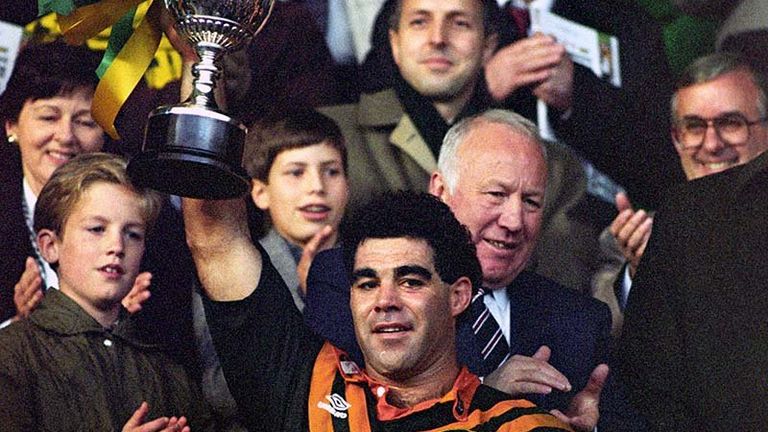
Image: Mal Meninga lifts the trophy in 1992

Jonathan Doidge takes a look back at the long and colourful history of the Rugby League World Cup.

The Rugby League World Cup can rightly claim to have been the first of its kind in either code of rugby, with the first competition being held in France in 1954, when Great Britain defeated the host nation in the final, staged in Paris. The competition moved to Australia in 1957, where the hosts won a league competition also involving Great Britain, New Zealand and France, to lift the title for the first of nine occasions. Great Britain staged the tournament for the first time in 1960 and regained the title with a 10-3 victory over the holders in front of 32, 773 at Bradford's Odsal Stadium. Wigan's Eric Ashton, the 'Prince of centres' had the honour of leading a star-studded line-up that included some of the all-time greats such as Alex Murphy, Billy Boston and Mick Sullivan. After France had struggled on a tour of Australia, they withdrew from staging the scheduled 1965 World Cup, meaning there was an eight-year gap by the time the next competition was organised for 1968. For the first time the tournament was held in two countries, with Sydney, Brisbane and Auckland staging the seven matches that it took to decide the winner. Over 62,000 were crammed into the Sydney Cricket Ground to see the Aussies defeat Great Britain 25-10 in the opener, and the co-hosts, led by the legendary Johnny Raper, enjoyed a similarly comfortable 20-2 success against France at the same venue in the final.

Sporadic

By now, the sporadic tournament was being held every two years, so after Great Britain had returned triumphant from their 1970 Ashes Tour of Australia, they were naturally the favourites to regain the World Cup on home soil. Nothing that happened in the group stages of the tournament changed any of that. Great Britain swept aside the Aussies, France and New Zealand in clinical fashion. Australia, meanwhile, lost two of their three pool matches and only reached the Headingley final on points difference. On the day they got it right though and despite a John Atkinson try on his home ground, Australia won a very tough battle 12-7 to regain some pride and the title. By 1972 the World Cup returned to France for the first time since 1954, but the host nation could not prevent Great Britain and Australia making the final once more. Despite a memorable length-of-the-field try by GB winger Clive Sullivan and another by current Sky Sports pundit Mike 'Stevo' Stephenson, the finalists could not be separated in the 80 minutes played out in the Lyon decider, drawing 10-10. Rather than extra time or a replay, the tournament rules said that the outcome of the pool game between the teams would decide the World Cup winner, so Great Britain, courtesy of their earlier 27-21 success against the Aussies, lifted the title. The dip in popularity of the international game in the 1970s was never better exemplified than by the attendance at that final, for even though the host nation was not involved, a miserly 4,500 spectators turned up to see the decider. Although Great Britain had always been the team to represent what was of course largely an English team in Test matches and World Cups, by 1975 the Rugby Football League took the decision to split the GB side into England and Wales, so making it into a five-team tournament.

Format changed

As a result, and for by no means the last time, the format of the competition was changed. The nations competed against each other home and away between March and November of 1975, and there would only be a final if two teams were level on points at the end of the league matches. Despite not losing to Australia, England this time scuppered their chances by losing to Wales 12-7 in Brisbane and then drawing 17-17 with New Zealand in Auckland, leaving them runners up as the Aussies took a firm grip on the trophy that they have never subsequently relinquished. The Green and Golds, including the likes of Manly's Bob Fulton and brilliant goalkicker Mick Cronin in their line-up, held on to their trophy in the 1977 World Cup. The tournament reverted to four teams with England and Wales returning to form Great Britain. Having defeated GB 19-5 in a pool match at Brisbane, the joint hosts Australia were red hot favourites to retain their title. However, they still had to repeat the feat in the final. Great Britain could consider themselves very unlucky at the Sydney Cricket Ground, where Widnes winger Stuart Wright went the length of the field for an interception try but the referee called him back, awarded the visitors a penalty, and refused to play the advantage rule... the final score 13-12 to the old enemy. Despite a more promising turnout of over 32,000 for that final, the dominance of Australia in the international game away from World Cups meant that they were reluctant to get involved in any further tournaments of that name until the International Federation again changed the format and added a new team for a lengthy, sprawling competition that would take place over four seasons between 1985 and 1988. Papua New Guinea, where the game was made the national sport, made its World Cup debut and each team would play home and away with usually the last Test of a series being nominated as a World Cup qualifier, so as to maintain extra interest in each series.

Shock

The Kumuls of Papua created the shock of the qualifiers by defeating the big guns of New Zealand 24-22 in Port Moresby, costing the Kiwis the chance to top the table. Despite being 2-0 down in their Test series in Australia, Great Britain enjoyed their first Test win over the Kangaroos in 10 years when they won 26-12 in their Sydney qualifier, meaning a win in Christchurch against New Zealand a week later would have put them in the final. However, atrocious conditions saw the Kiwis sneak home 12-10 and go into the Eden Park final with home advantage against the expectant Aussies. Despite a great start, with tries from the Iro brothers Tony and Kevin, 46,000 adoring Kiwis could not lift their team to victory and two tries from scrum-half Allan Langer plus four goals from Michael O'Connor were the features of a 25 - 12 success for the men in green-and-gold. The four-season format was retained for the 10th World Cup, which spanned seasons 1989 to 1992, and with the resurgence of Great Britain as an international force under first Maurice Bamford and then Malcolm Reilly, the crowds returned. Australia, showcasing some of the greatest teams ever to set foot on a rugby league field, dominated the qualifiers, winning all their eight matches and conceding only 68 points in the process. With France and Papua New Guinea battling to avoid the wooden spoon again, it was left to GB and New Zealand to fight for a place in the final. Having beaten the Kiwis at Wigan, Garry Schofield's GB side then lost in Christchurch in a match that will forever be remembered for Martin Offiah's premature celebration which saw him lose the ball and cost his country a try and the match by 21-18.

Record

Even so, Reilly's men scraped through on points difference and on October 24th 1992, 73,631 - a record crowd for an international - were present at Wembley to see the tightest of matches decided by centre Steve Renouf's try, helping the Aussies home by 10-6 with the legendary Mal Meninga proudly lifting the cup. Despite the success of the four-year format, the influence of Maurice Lindsay, by now the top dog at RFL headquarters, and the promise of a Super League future, meant that we would revert to a month-long tournament format.In 1995, in their most ambitious attempt yet at giving the World Cup a global feel, the international federation gave debuts at this level to Fiji, South Africa, Tonga and Western Samoa. With England and Wales again playing separately, plus France, Australia and New Zealand, the number of nations competing had doubled to 10. Despite almost being embarrassed by Tonga, New Zealand made it to the semi-final against Australia, who won one of the most dramatic games of all time by 30-20 after extra time. It was left to England to see off a Jonathan Davies-inspired Wales in the other semi, before 66,540 travelled to Wembley for the final.

Firm grip

Rod Wishart and Tim Brasher touched down for the holders and Paul Newlove's sole try for England was not enough, the Aussies maintaining a firm grip on the world title with a 16-8 victory. Buoyed by the success of the tournament, Rugby League reached for the stars with its hugely ambitious and unrealistic attempt at staging a 16-team World Cup played in all four home nations, plus France, in 2000. While the Cook Islands, Russia and the Lebanon can all rightly claim to host their own domestic rugby league competitions they could not hope to compete with the big guns, giving a number of scores, such as Australia's 110-4 demolition of Russia, a lopsided look. A terribly wet autumn, plus the geographical spread of the competition did not lend itself to big crowds. Fewer than 5,000 people turned up for the opening game in Belfast, not exactly a rugby league hotbed, and a poorly staged curtain-raiser. For the first time there were enough teams to have knock-out quarter finals, and the same four teams made the semis as had done so five years earlier.

Pulverised

This time, however, England were pulverised at the Reebok Stadium 49-6 by a Richie Barnett-inspired New Zealand, and despite a brilliant individual effort from Lee Briers which saw Wales lead with 20 minutes to go, the Aussies eventually got home by 46-22 in the other semi in Huddersfield. With no home presence in the final except for referee Stuart Cummings, 44, 329 dug deep in their pockets for the trip to Old Trafford, where in spite of the rain that had dogged the tournament Wendell Sailor crossed for two of the seven Australian tries that saw them hit overdrive in the final quarter to beat the Kiwis 40-12, giving Brad Fittler's green-and-golds the trophy for sixth succesive time and their ninth in total.