Team principal Christian Horner is confident Red Bull will conquer their KERS problems sooner rather than later.
Horner reckons pacesetters will resolve power boost problems
Team principal Christian Horner is confident Red Bull will conquer their KERS problems sooner rather than later.
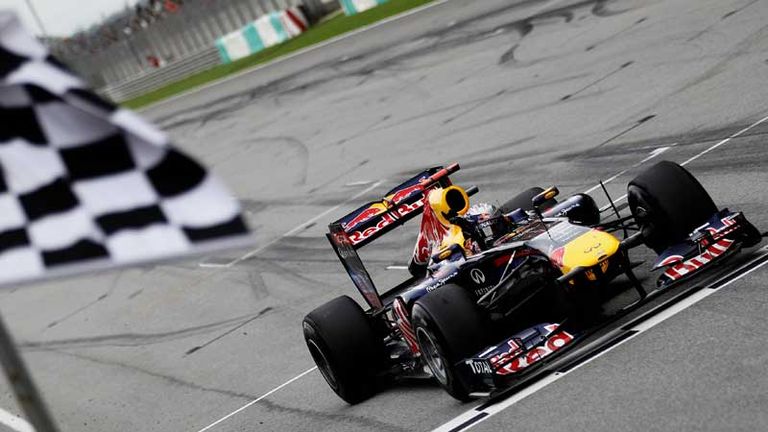
The constructors' champions have made a flying start to the 2011 season, with world champion Sebastian Vettel taking the chequered flag in both Australia and Malaysia.
However, Red Bull's pace has largely come without the additional power boost afforded by KERS.
Reliability fears meant they did not use it at all in Melbourne, while it worked only intermittently at Sepang.
Although Red Bull use Renault engines, they have elected to develop their own version of the French manufacturer's KERS system.
Horner labelled it "immature", particularly in comparison to those used by McLaren and Ferrari, who both previously used KERS in 2009.
But with Red Bull leading the pack ahead of this weekend's Chinese Grand Prix, Horner reckons they can close the gap as far as KERS is concerned.
"We've gathered a huge amount of data, so we will only learn more this week, and we plan to build on the experience we've had," he said.
"With a system that is quite immature compared to some of our rivals, we just didn't want to take too many risks in arguably one of the harshest environments for it (Malaysia), so we became a bit conservative in our usage."
Ebb and flow
Asked whether Red Bull's battle to make KERS reliable has become their main focus, Horner replied: "No, no, no. McLaren and Ferrari are our chief concern.
"You can see that performance can ebb and flow. Ferrari looked to be having a very strong race (in Malaysia).
"We just need to focus on optimising our own performance, and we've managed to win the two opening grands prix of the season, which is a tremendous start. And we'll look to build on this form as we head to China."
Although Vettel had to stop using KERS during the Malaysian Grand Prix, he was still never under any real threat from the runner-up, McLaren's Jenson Button.
Team-mate Mark Webber, meanwhile, lost his KERS system immediately prior to Sunday's race, worsening a poor getaway at the lights.
The Australian recovered to finish fourth, though, after making four pit stops in a race dominated by tyre wear.
Horner believes it is the new, fast-fading Pirelli rubber that is providing the biggest difference in race pace rather than KERS.
"In the end the tyres were the biggest performance differentiator, as we saw," he said.
Something that also helped Red Bull and Vettel in Malaysia was one of his tyre stops being timed at 2.7 seconds.
Thrill
Horner maintains it is the pursuit of these fractions, together with the glory of winning, which is keeping motivation high.
"Within this team it's very simple. You can see the thrill and enjoyment the team get out of winning," he added.
"You can see it in the expression of every team members' face, they never take it for granted.
"You can see it when they've completed a good pit stop, a good qualifying, all those factors.
"The work ethic is tremendous at the moment, not just with the guys at the track, but also behind the scenes within the less glamorous departments, the electronics guys, the inspection guys.
"They're all just going that extra yard and it's paying dividends."