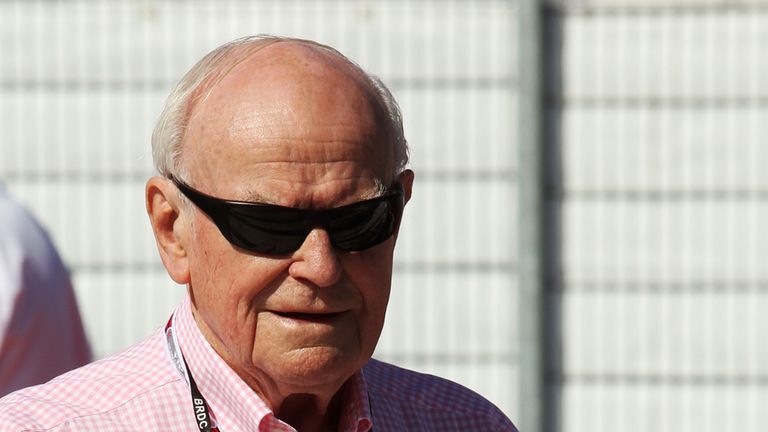
British Professor Sid Watkins, who tended to Ayrton Senna after the Brazilian's fatal crash at Imola in 1994, has died aged 84.
Tributes paid to doctor who oversaw safety improvements
British Professor Sid Watkins, who tended to Ayrton Senna after the Brazilian's fatal crash at Imola in 1994, has died aged 84.
Watkins served as Formula 1's doctor and medical chief between 1978 and 2004 - a period which brought much-improved levels of safety in the sport.
He oversaw enhanced medical intervention in that time and helped many drivers. However, Watkins was best known as being the doctor on the scene when Senna crashed in the San Marino Grand Prix 18 years ago.
"Motor sport has lost a true visionary and character with death of Prof Sid Watkins. Great man, funny too.Saved my left foot being amputated," said Sky Sports F1's Martin Brundle. "Sid was the 'go to' man for health in Motorsport. He helped, saved, or made more comfortable, numerous people who never sat in a racing car."
"Really sad news that Prof Sid Watkins passed. My heart goes out to his family and friends. Will miss your great sense of humour. R.I.P," added Johnny Herbert.
The current generation of F1 drivers, including McLaren pair Jenson Button and Lewis Hamilton, have also paid tribute.
"Rest in Peace Sid Watkins...Motorsport wouldn't be what it is today without you. Thank you for all you've done, we as drivers are so grateful," tweeted Button before quoting Albert Einstein reflecting: "Only a life lived for others is a life worthwhile."
Born in Liverpool, Watkins graduated as a Doctor of Medicine at the city's University in 1956 and attended his first motorsport event in a medical capacity five years later.
Watkins was often required to bring his own equipment to races, which reflected prevailing attitudes towards safety at the time. Little had changed by the time Bernie Ecclestone, then Brabham team owner and head of the Formula One Constructors' Association, asked him to start attending Grands Prix in 1978.
Watkins, who at the time was Head of Neurosurgery at the London Hospital, later recalled that the medical facilities for the first race he attended were located in a tent.
He demanded change as a result of Ronnie Peterson's death at that year's Italian Grand Prix. Watkins' attempts to reach the injured driver were halted by police, whilst there was also an ambulance delay.
A medical helicopter, car and anaesthetist were secured, although drivers continued to lose their lives. One day before Senna was killed at the 1994 San Marino GP, the Austrian driver Roland Ratzenberger also succumbed in a qualifying accident at Imola.
In his book 'Life at the Limit: Triumph and Tragedy in Formula One', Watkins recalls asking Senna to walk away from the sport on the day of the race.
Senna's death brought a new impetus in the drive towards improving safety, with Watkins appointed President of the FIA Institute for Motor Sport Safety in 2004.
Awarded an OBE in 2002, Watkins was married with four sons and two daughters.
A tribute to Professor Sid Watkins will be shown during Friday's edition of The F1 Show at 8pm.