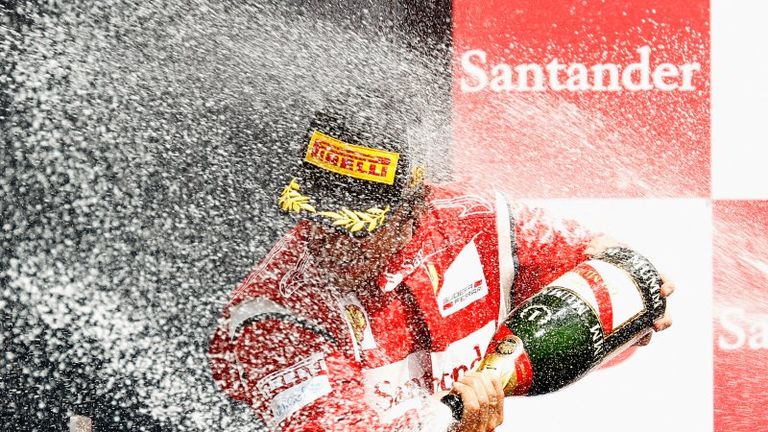
Say all you want about other teams such as Red Bull and McLaren making mistakes, there's no taking away from Fernando Alonso's win...
Red Bull Clanger Or Not, Ferrari Had The Pace To Win
The overriding emotion at Ferrari in the wake of Fernando Alonso's fine victory at Silverstone will have been relief rather than pleasure. Such is the way of life in Italy and the pressurised domestic strife the country's national F1 team is forced to live with. Congratulations never last long - if at all - because Ferrari are supposed to win. The headlined summary for the reaction of Ferrari president Luca di Montezemolo will have spoken for most Italians. The big story is always not when Ferrari win but when they are not winning.
Yet once the relief has been gulped down along with the champagne, even the team itself might start to expect plenty more victories to come. They were seriously fast at Silverstone - much, much quicker than McLaren, and, when it really mattered, much quicker than Red Bull.
It wasn't obvious at first because of the British summer's wet ingredient, but when the track dried out and all the moisture evaporated, Ferrari were just mighty.
The fun for the watching public was that the rain meant Alonso had to claim his victory the long way. With a little over a third of the race run, Ferrari were only the third-fastest car on track, with the Red Bulls a speck on the horizon and Lewis Hamilton zipping his McLaren around Alonso's Ferrari to loud acclaim on lap 15.
Yet at that stage the track was still damp. Once it reached full dry status, Alonso was untouchable. Though it was a shame that Sebastian Vettel's calamitous pit-stop donated the lead of the race to Alonso without the Spaniard having to grab it for himself, that donation should not distract from the speed advantage the Spaniard had just unfurled to re-pass Hamilton and close within five seconds of Vettel before his wheel-nut calamity. All of a sudden, the Ferrari was in a league of its absolute own. For lap after lap, all the way into double figures, Alonso was a second faster than Hamilton and the boxed-up Vettel. No doubt the Red Bull was being slowed by the McLaren, but maybe not substantially - after undercutting Hamilton at his third stop, Vettel made no inroads into the lead Alonso had built up. Nobody can know for certain (and we'll have a quick discussion about the matter in a moment), but the numbers suggest that even without the pit-stop blunder, Alonso's pace would have trumped Vettel.
By hook or by crook, because of their own upgrades or this tedious diffuser business, Ferrari are back with a vengeance. Both Championships are probably still out of their reach - even in defeat, Vettel
extended his lead of the Drivers' Championship - but at least we have a chase. And in Italy, the F1 world is back in its right order.
Red Bull's Hot Vulnerability Is Obvious In Hindsight
Another interesting development - and one which might have a huge bearing on the destiny of the remaining chunk of the season - was the curious performance of Vettel's tyres.
Noted in race commentary, Sebastian repeatedly left the dry line that emerged to cool his tyres by deliberately running them through the few remaining puddles still on the circuit. Hitherto this season, Vettel has, with decent justification, earned credit for being kind on his tyres, but what we learnt on Sunday is that keeping your tyres in trim is easy when you're out in front and enjoying the clean air of open road. Yet as soon as Vettel was baulked by Hamilton, he began to struggle and lose performance. His tyres over-heated and he shed them within ten laps, meaning he had to finish on a long stint which in turn resulted in the World Champion being reeled in by his team-mate to controversial effect. In short, he was severely weakened.
Such has been the regularity of his lights-to-flag dominance this season, Vettel has only very rarely suffered the inconvenience of being stuck in another car's hot air this season, so it was a bit of a shock see his previously-near-perfect Red Bull suffering so adversely. Then again, there was a clue obvious in hindsight. The reason why Vettel is so dominant in qualifying and so fast out of the blocks at the start of races is because the Red Bull is so adept at putting heat into it tyres compared to its rivals. So perhaps we should have long suspected it would be especially vulnerable to overheating when stuck in the hot air of another.
Interesting though.
Silverstone Still Lacking Key Ingredient
Another short reflection: All the time he was stuck behind the relatively-slow Hamilton, Vettel never once looked like he was about to pass the McLaren, which reflects well on Lewis' defence but less so on Sebastian and also offer a disconcerting reminder that his race-craft remains largely unproven and untested. It can't go unremarked either that whereas Vettel failed to find a way past Hamilton and quickly gave up on the task, Fernando took just a lap to surge past the McLaren once his Ferrari had dried out to become the race's quickest package.
Yet Vettel's struggle also underlined that Silverstone, for all its glorious sweeps, is a darn difficult place to overtake. As stated, Alonso had the pace to beat Vettel in a straight fight even without the World Champion's pit-stop calamity. But at some stage, to win in a straight fight, Alonso would have had to actually overtake for victory. Easier typed than done, and the likelihood is that any such overtake would have come with the instruction of 'box to pass' .
Silverstone, by all accounts from those in attendance, is improving towards being a great venue. On track, however, its old fault still remains in place and until it features an overtaking venue it will continue to fall short of being a truly great track.
McLaren Are Nuts
For a company that operates with an attention to detail that would impress NASA, and a cleanliness that would shame the NHS, McLaren's penchant for stupidity is a modern-day sporting phenomenon. The seriousness is that it is scarcely believable that a company that essentially exists to drive two racing vehicles on twenty occasions a year can continue to make so many cock-ups, and the only consolation is that at least they make their business appear rather more difficult than it sounds.
This weekend's particular idiocy began in the early stages of qualifying when, with rain falling into pouring, they sent both their drivers out on soft tyres to waste valuable tread. Goodness knows why. It continued onto race day when they miscalculated their fuel load by a massive margin - Hamilton claims he was first told to slow 21 laps from home. No other team struggled with their fuel estimate, never mind erred to such incredible extent.*
And then, most obviously, there was the Button shambles, which was just plain embarrassing. Not such since McLaren left a bung on his car in Monaco has the team provided such cringe.
A little farce makes for entertaining viewing but McLaren have become the joke that isn't funny any more.
Webber Was Right To Argue, Wrong To Ignore
To appreciate the fairness of Red Bull's request to Mark Webber not to pass Seb Vettel - reputedly made "four or five times" over the pit-to-car radio, which begs the question of why the television audience only heard one of those delayed transmissions until the penultimate corner - all that needs doing is to envisage the scenario which Christian Horner was intent on avoiding: a collision that put one or both Red Bulls out of the race. In other words, just remember Istanbul last year or take another look at the damage caused in the final corners when Felipe Massa grappled with Lewis Hamilton and lost most of his front wing in the doing.
In an ideal world, Horner would have let Webber race on. Yet F1 is too complex for ideals. First and foremost, it's a team sport run as big business. Nor was Horner's demand for restraint unreasonable viewed in an entirely sporting sphere. Webber had raced Vettel for the previous 45 laps. Only at the very end of the race, when the points were all but won for Red Bull, and Ferrari had shouted out their return to the front, did Horner plead pragmatism. Fair enough. There was nothing to gain, and plenty of value to lose.
Fair enough, too, for Webber to argue that he should be allowed to race. That's what a racer should do. The crux of this tangled matter is whether he was right to ignore it. Webber might race under his own name, but he does so as a paid employee and as a team member of Red Bull Racing. The question is not whether he was right or wrong in demanding to race. The question is whether he had any right to have his say, let alone ignore the spoken instruction of his team's boss.
"Of course I ignored the team because I wanted to try and get a place", he maintained afterwards. Yet respect for the chain of command was worth more than a place he couldn't achieve anyway.
Next week's chat about his contract should be lively.
The British Make An Odd Fuss About The British GP
One of the strange things about the British GP is that the British media make such a fuss about it. At a rough approximate, the airtime and print copy devoted to the nation's annual GP is 75% higher than it is for any other race other than Monaco. The obvious retort is that that's because it's the British GP, stupid. Yet the thing is, the British GP is not particularly British. Unless you're one of the 175,000 paying spectators in attendance - and that number represents less than one per cent of the British population - Silverstone could be in Mongolia for all the difference it makes.
Frankly, the blanket coverage devoted to Silverstone amounts to media self-serving. It's just a way of gaining an all-expenses-paid day out at an event that, for the most of the time, they have very little interest in. For the average Formula One fan in Britain, the British GP is still what all the other races are: a spectacle to be enjoyed from the comfort of their favourite armchair.
* Apparently, the team under-fuelled Hamilton because they expected him to spend the start of the race in traffic because he was tenth on the grid. Perhaps they hadn't heard about Hamilton's skill in the wet or realised that he was only tenth because of their bungling.