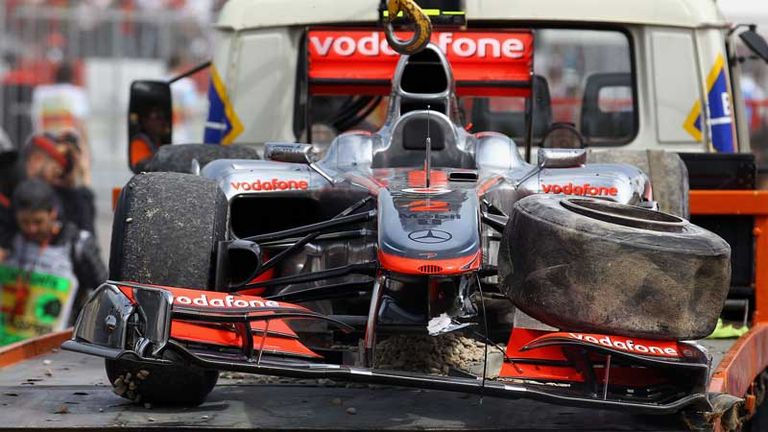
McLaren are yet to get to the bottom of Lewis Hamilton's tyre-rim failure, but investigations suggest it was caused by "human error".
Human error probably to blame for rim failure
McLaren are yet to get to the bottom of Lewis Hamilton's tyre-rim failure during Sunday's Spanish Grand Prix, but initial investigations suggest it was caused by "a human error".
Hamilton was cruising to a second-place finish in Barcelona when his left-front tyre suddenly deflated and sent him into the barriers on the penultimate lap.
After inspecting the tyre along with officials from tyre manufacturer Bridgestone, team boss Martin Whitmarsh confirmed that they are yet to find out what caused the problem.
"The analysis of the part came back yesterday [Monday], we had Bridgestone here," he said during a Vodafone teleconference.
"As we said at the time, we did not believe that the deflation was caused by a puncture or a tyre failure in that all the evidence told us that the rim failed, which caused the deflation.
"The rim failure is being investigated. It could be debris-related, it could be that a lack of tightness of the wheelnut allowed some flexing. What we know is that the rim failed, probably a human error somewhere in the process to cause it, and that led to deflation and the accident.
Problems
Hamilton wasn't the only one who encountered problems in Spain as his team-mate Jenson Button, who finished fifth behind Michael Schumacher, had issues with his steering wheel.
"In Jenson's case there was a failure in the steering wheel which took out his dash," Whitmarsh said. "The functionality of the knobs and switches on the wheel was fine. That happened quite early.
"We checked from the system that all the systems on the car were working as they should, but obviously you rob the driver of the means of being told when to shift and obviously other information. Also when you're behind another car, as he was subsequently, your shift points change when you're in a tow, and you then don't have the lights telling you that you have to adjust.
"What it meant at the pitstop - which caused Jenson to drop behind Schumacher - was no display through the pitstop sequence, including revs. The car was then sat at too high revs. That causes a little clutch drag and spinning of the rear wheels. He did a very good job to cope with that. The stop was delayed through no fault of the driver or the pit crew. In light of that he'd have been ahead of Schumacher in that part."