
Pit stop Q&A
Wednesday 19 March 2008 12:57, UK
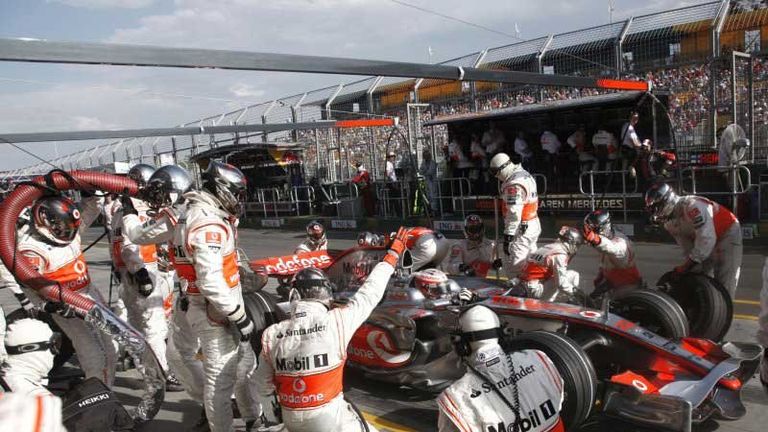
McLaren give us the lowdown on how they hone their pit stop skills.
With levels of competitiveness in Formula One now such that tenths of a second can be difference between winning and losing, it's vital that pit stops are executed as efficiently as possible. Since the re-introduction of fuel stops in 1994, they have also become an inherent part of each team's tactical approach to a race, with the combination of a car's tyres and fuel level used to try and gain speed - and hopefully places in the running order of a grand prix. Thus, as each team gears up for the start of the new season by fine tuning their latest cars during testing, they also use these outings to provide mechanics with the chance to hone their pit stop skills. One such opportunity recently occurred during a test at Barcelona's Circuit de Catalunya, where skysports.com was able to ask Steve Hallam, Head of Race Operations for the Vodafone McLaren Mercedes team about the ins and outs of life in the pit lane. How many mechanics are allowed to work on a car during a stop? (Presumably there's a limit in place.) Vodafone McLaren Mercedes has a crew of 29 people working on each car, to refuel and to change four wheels and tyres. There is no limit in the rules. What changes can/cannot be made to a car during a pit stop? In a normal pit stop only the tyres would be changed and fuel added. However there are no regulations limiting what can be changed on the car once the race has started. What role does each mechanic play? 1. A front jack - used to lift the car clear of the ground to enable the wheels/tyres to be replaced. 2. A 'Lollipop' man - usually the Chief Mechanic who controls the release of the car once the mechanics have finished working on the car and guides the driver into the correct pit box. 3. Three mechanics for each wheel to change the wheels and tyres. The central position is always taken by a mechanic with an airgun for fast removal and relocation of the wheel nut. The outer mechanics help remove and replace the wheel. 4. A mechanic with a spare jump start battery in the event the car stalls during the pit stop and who also clears debris from the radiator. 5. A mechanic with a spare scissor jack to lift the car in the event either the nose or rear lifting point are badly damaged or missing. 6. A rear jack - used to lift the car clear of the ground to enable the wheels/tyres to be replaced. 7. An engineer who co-ordinates information and instructions from Senior Engineers/Tacticians on the pit wall gantry. 8. Refuelling mechanics - two are required; one to hold and take the weight of the fuel pipe; the other to connect the refuelling nozzle to the car. 9. A mechanic to clear debris from the radiator and to clear the driver's visor if necessary. What jobs do they perform for the team apart from taking part in pit stops? The pit stop crew is made up of the team members and each one has an individual role throughout the weekend. The role they have in the team does not necessarily bear any reflection on their role in the pit stop. Can anyone who travels as part of the McLaren team to each race 'audition' as it were? Or is a certain level of experience required? Every year as part of the training process before the start of the new season every position in the pit stop is reviewed and every mechanic gets the opportunity to try each position. This means everyone has experience in each role and is able to step in should one member not be available one weekend. At what rate is fuel pumped into a car during a stop? The cars can be refuelled with Mobil 1 at a rate of 12 litres per second. How much does the fuel rig weigh? The Mobil 1 fuel rig weighs approximately 250kg with hose when empty. Will the changes to the 2008 qualifying procedure alter the pit stop procedure itself in any way? (Both in qualifying and in the race.) No. What's the quickest stop for fuel and tyres the team has ever performed We do not keep a record of this, as no one pit stop is the same and there are many variables that take place during a stop which effect the time it may take. Is there a rivalry between teams with regard to their ability to get a car in and out as quickly as possible? Pit stops are an integral part of the race and as a result the aim is to complete them in as fast a time as possible. The mechanics themselves take great pride in completing the stops as swiftly and efficiently as possible and see it as them contributing to the outcome of the race. It must get hot wearing your protective gear at, say, the Malaysian Grand Prix. Do you get the chance to shed some of the layers between pit stops? Or do you have to stay covered up in case of an unplanned stop? Mechanics remain in their fireproof gear throughout the race to ensure that they are ready to immediately respond to a strategy change or an incident on track. At races such as Malaysia measures are taken such as installing fans in the garage where the mechanics sit between pit stops and also maintaining hydration levels. How often are pit stops practiced? (both pre-season and during the season) Vodafone McLaren Mercedes conducts approximately 1,260 practice pit-stops throughout the course of the Formula One season. Do some teams spend more time practicing stops than others? We can only comment on our own procedures. Are there any exercises mechanics do to help their performance? Vodafone McLaren Mercedes has developed the McLaren Lab Training Programme which is a framework within which we can measure the health and physical and mental fitness of the team, and develop its overall physiological performance. Although the drivers are key people, the role of engineers, mechanics and other team members is so important that in order to build a winning team, they must also be fit and committed.