
Changes for 2011
Sunday 20 March 2011 16:37, UK
skysports.com takes a look at some of the rule changes to be seen in Formula One this season.
skysports.com looks at changes to the F1 rulebook this season
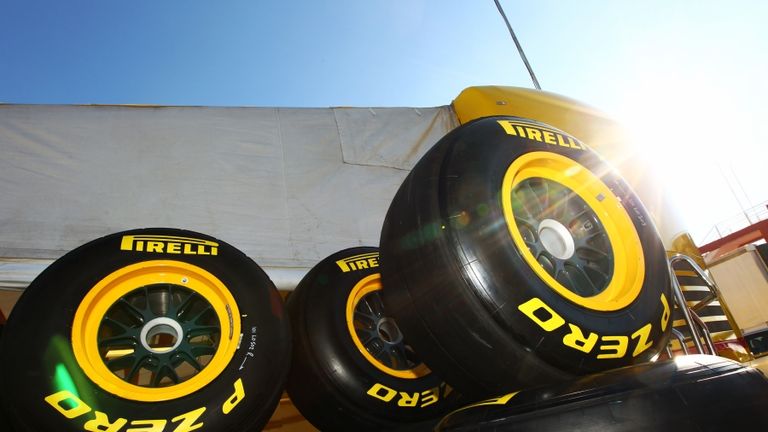
While not of the magnitude seen, for example, ahead of the 2005 and 2009 seasons, there are a number of rule changes - mainly technical but also sporting - to be seen in Formula One this coming season. Tyres Potentially the most important change (although not a rule change as such) is the return of Italian manufacturer Pirelli to F1 for the first time in 20 years as its sole supplier following the departure of Bridgestone. Handed the task of trying to inject more unpredictability into races, Pirelli have responded with the PZero - the degradation levels of which have generated much talk pre-season. Most of it has concentrated on the impact on pit stops and the knock-on effect on race strategies. Whereas one (mandatory) pit stop was the norm last year, between two and four stops will be on the agenda in 2011. Also, the performance differential between the harder 'prime' and softer 'option' compounds of dry-weather tyres is set to be more pronounced than before. Differing levels of degradation might improve the prospects of overtaking, while the ability of a driver to look after his tyres, as well as decide when a change is needed, will be more of an asset. Also in 2011, each driver may now use three sets of dry-weather tyres (two 'prime' and one 'option') during Friday's two practice sessions. Eight further sets (four of each compound) will then be allocated for the remainder of the weekend. Six different types of tyre will be used during the season and each will have its own colour coding: Wet - orangeIntermediate - light blue
Supersoft - red
Soft - yellow
Medium - white
Hard - silver Two compounds of dry-weather tyre (i.e. the bottom four on the list) will be taken to each race. 'Double diffuser' ban New rules mean the gap at the front of the diffuser that created the loophole Brawn GP exploited to such effect two years ago has now been closed. As a result, diffusers will be smaller and generate less downforce. Teams are responding by placing devices called Gurney flaps on the trailing edge of the diffuser, in order to increase airflow from within it and thus improve the downforce effect. Another potential gain (which Williams are looking for) stems from the fact that the smaller diffuser will not encroach on the gearbox which, together with the differential, can be made lower. This creates an easier airflow to the rear beam wing and also lowers the centre of gravity. But the driveshafts and, particularly, the CV joints will be worked harder. Blown diffusers One of the main innovations seen in F1 last season, this is where exhaust gases are blown over the top of or through the diffuser to improve its performance on the throttle. It's still allowed, although the closing of the loophole that brought the double diffuser also limits what can be done to blow exhaust gas through it. Blowing through the hole allowed to reach the starter motor is still allowed, and openings are still allowed in the outer 5cm of where the floor meets the diffuser. Blowing exhaust gas over the diffuser is less effective than through it, but the use of a Gurney flap helps again by pulling gas from underneath. One big innovation for 2011 is the use of the forward exhaust, pioneered by Renault (and being looked at by other teams) in which the gases are blown on to the leading edge of the floor (by the fronts of the sidepods). The theory is that this improves downforce by boosting the flow of air under the car towards the diffuser - but further up the line. KERS Kinetic energy recovery systems return this year after teams voluntarily agreed to drop them for the 2010 season as a cost measure. The energy that is recovered comes from braking. It amounts to around 400 kilojoules per lap and can be used by the driver to deliver an extra 60kW (equivalent to approximately 80 horsepower) over a period of 6.6 seconds per lap. The driver can press the button for a single boost or eke it out over the whole lap. It can also give a significant edge in getting off the starting line. With the minimum weight of the car also increasing this season, KERS will be easier to package without hindering set-up. This also means that taller, heavier drivers will not be penalised as they were in 2009. At the start of the season, all teams bar Team Lotus, Virgin Racing and Hispania Racing are expected to use KERS. DRS This stands for Drag Reduction System and is the acronym that has been given to the moveable rear wing, which replaces the moveable front wing (part of the last attempt to try and improve overtaking possibilities in F1). The idea is to open up a slot gap in the wing (e.g by pivoting a hinge at its trailing edge) from 10-15mm to up to 50mm. This will reduce drag and increase speed by around 12km/h. The gap is closed automatically when the driver hits the brakes. A driver has free rein to operate the wing in practice and qualifying. However, options are limited in the race itself. During the race, the wing cannot be adjusted for the first two laps. After that, a driver will be able to operate the DRS at a designated point on the track (e.g. the longest straight) but only if one second or less behind another car. Time will tell if DRS produces more overtaking. It could be that differences in tyre wear brought by the new Pirelli rubber provide more of the speed differential needed. F-ducts Another innovation seen last year, these devices, which the driver used to control air flow to the rear wing in order to reduce drag and increase straightline speed, have been outlawed - although the introduction of the DRS effectively made them irrelevant. Weight and distribution In conjunction with the reintroduction of KERS (see above), minimum car weight (including driver) has been increased by 20kg to 640kg. The weight distribution is now mandatory too, with a minimum 291kg on the front axle and 342kg on the rear. Gearbox Gearboxes must now last for five races rather than four, with a five-place grid penalty imposed if a replacement is needed. However, this does not apply the first time a replacement is needed (unless it is at the final race). In this instance, the gearbox need only be used for the race in question. Bodywork The 'shark-fin' design on engine covers which has sprung up in recent seasons is now prevented from touching the rear wing. Front wings will likely prove more flexible this season as those of frontrunners Red Bull and Ferrari flexed last year while still meeting FIA tests. There is now a ban on blade roll structures, as used by Mercedes GP last season and which increased airflow to the rear wing, for safety reasons with a minimum cross section now mandated. Wheel tethers Following a number of incidents, the FIA have decreed each wheel must now be attached to a car with four tethers rather than two, thus hopefully further reducing the possibility of a wheel flying off. Team orders The ban on team orders has been lifted following last year's controversial German Grand Prix, when Ferrari ordered Felipe Massa to relinquish the lead to team-mate Fernando Alonso. The rule in question, article 39.1 of the sporting regulations, has been deleted after the FIA decided it was, in effect, unenforceable. However, the governing body says it will still punish any team whose actions it decides are bringing the sport into disrepute. Driver conduct Formal driving standards have now been written into the rules rather than a simple 'gentleman's agreement' and standards of behaviour when being lapped have also been tightened up. The rules now explicitly forbid: more than one change of direction, crowding another car off the circuit and abnormal changes of direction. Qualifying If a car laps more than 107 per cent slower than the fastest time set in Q1 then it will not be allowed to start the race. However, stewards might agree the car can start if, for example, it has lapped at sufficient speed during practice. Safety car When the safety car is deployed, cars now have two laps (rather than one last year) to lap the track at a mandatory reduced pace (about 40 per cent less than the lap time) before forming a line. Furthermore, to prevent cars potentially gaining an advantage, they will not now be able to enter the pits under safety car conditions for any reason other than changing tyres. Also, the pit exit light, which previously turned red when the safety car led cars past the pitlane exit, will now remain green throughout. Pit lane safety The pit lane can now be closed for safety reasons during the race. In this situation (at Monza last year, for example, a mechanic was injured in the pit lane) cars may only enter the pits for "essential and entirely evident" repairs. Cars queued at the pit lane exit must now form up in a single line and leave in the order they arrived, unless another car is unduly delayed. Stewards Race stewards have been granted further powers which means they can impose a range of penalties that now includes disqualification from a grand prix and even suspension for a subsequent race.