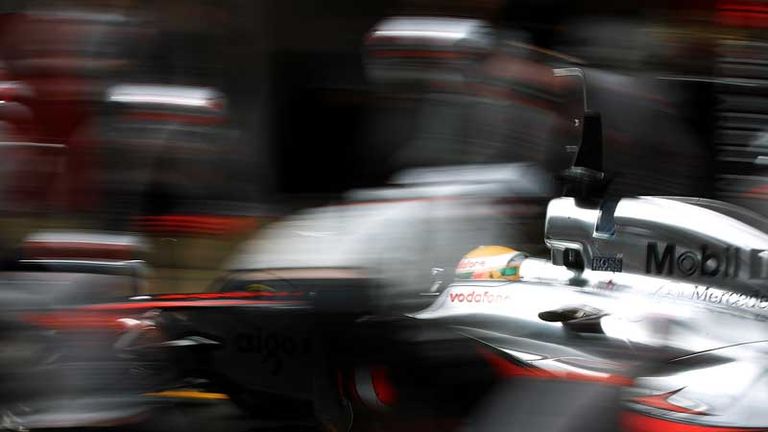
skysports.com gets vexed by its inability to change the wheel of a Formula One car fast enough.
skysports.com gets vexed by its inability to change the wheel of an F1 car fast enough
Pit stops have long been an essential part of the drama of Formula One. Indeed it could be argued that, over the course of the last 20 years or so, the practice of bringing drivers in for fuel and/or tyres has injected a good measure of drama into many races where little was actually fermenting on the track itself.
Until the early 1980s, a visit to the pits was seen as something best avoided if at all possible. However, since the Brabham team first exploited the use of running lighter fuel loads and softer tyres in 1982, the potential for strategic gain has pushed this aspect of the sport on to a whole different level - one occupied by frighteningly intelligent people crunching numbers and applying game theory in the hope that their man will get the jump on the opposition. For a very few - Ross Brawn springs to mind - the ability to make the right call at the right time seems to elevate the exercise beyond mere practice.
And yet such fanciful theorising isn't worth a damn unless the bottom line is in place and doing its thing. I'm speaking, of course, of the pit crews: the guys who take it upon themselves to spend the duration of a Sunday afternoon doing not very much at all before springing to life and going to work as though their lives depend on it.
It's an impressive sight when all goes to plan, but when it doesn't it suddenly seems as if Busby Berkeley got himself lumbered with the Keystone Cops. Watch footage of Felipe Massa's pit stop in Singapore back in 2008 (one which was to prove very costly given the way that season's world championship panned out) if you want to be reminded of how quickly the best-laid plans can go horribly awry.
It's all too easy to sit on a sofa and laugh at people in flameproof suits rolling around on their backsides, which is why when McLaren invited me to their Woking HQ to have a go myself, I knew I had to rise to the challenge. It was "a bit of fun" they said, and they were quite right in that regard.
And yet, with the 'pit stop challenge' taking place around about lunchtime - and with me and my colleagues now rolling on
our backsides in full view of McLaren staff passing by on their way to the canteen - I couldn't help but wonder who was having the most fun of all. Was that laughing I could hear?
The actual process of changing a wheel is easy enough: plonk the gun on to the wheel nut, press the trigger and unscrew. The 'wheel off' guy then does his thing before the 'wheel on' man does his. Then, having pressed a button to change the direction of the gun, plonk the gun (plus nut) back onto the thread and pull the trigger to tighten. I was told that during the practice sessions McLaren hold during the off-season (any team personnel travelling to races can 'audition' by the way) they look to complete this task in under three seconds.
Suffice to say, I got nowhere near that target but with McLaren team members Giles and Sam acting as my 'wheel off' and 'wheel on' accomplices, it wasn't as though I had anyone else to blame. The errors were as basic as the task: if I wasn't failing to unscrew the nut all the way off the thread, then I was unscrewing it with such enthusiasm that the bloody thing would fly out of the gun and bounce over the floor.
In fact, I then proceeded to break the gun itself by jamming it on to the nut with such ham-fistedness that a split ring sheared off. "Don't worry, it happens all the time," soothed Giles, before placing some spare protective gloves on the floor when I complained that my knees hurt. Was I being a wuss, I asked? "No, not at all," he replied diplomatically.
I can't remember exactly how well I did because it all passed in a blur, but I think my best time was about five-point something seconds. I do remember taking part in a combined effort of 3.56s but by that stage I had relegated myself out of harm's way and taken the 'wheel off' role.
One fellow journalist did get down to about 3.4s, which impressed us all at the time. However, a vicious rumour later spread that he was, in fact, holding the gun right next to the nut when the timing started, rather than its agreed starting position on the ground. Bending a rule to breaking point? Such is the way in F1, although my own ponderousness with the gun was such that protesting the result seemed a bit pointless.
A simple task, then, changing a tyre; it's the time pressure that quickly reveals one's deficiencies. They can be worked on, of course, but only up to a point. In F1, the difference between winning and losing can actually be the difference between sub-three seconds and five-plus seconds.
And that's before we've extrapolated "a bit of fun" to the chaos of the pitlane: to stewing in your overalls in the tropical heat of Malaysia; of having to deal with wheels and tyres built to operate in temperatures measured at several hundreds of degrees Celsius; of using wheel guns twice the size of those entrusted to us which possess wrist-breaking torque.
The pressure was increased last season when refuelling (hitherto the slowest part of the stop) was banned and looks set to be ratcheted still higher in 2011 because the new Pirelli tyres introduced to F1 will be far less durable than their Bridgestone predecessors. Pit stops only last a few seconds, require a formidable combination of calmness and dexterity - and let's not forget either that the potential for danger is never far away.
Having gained a little insight into what's needed and found myself a long way short of 'the right stuff', I'll certainly give them the benefit of the doubt the next time I spot a stray wheel bouncing down the pitlane.