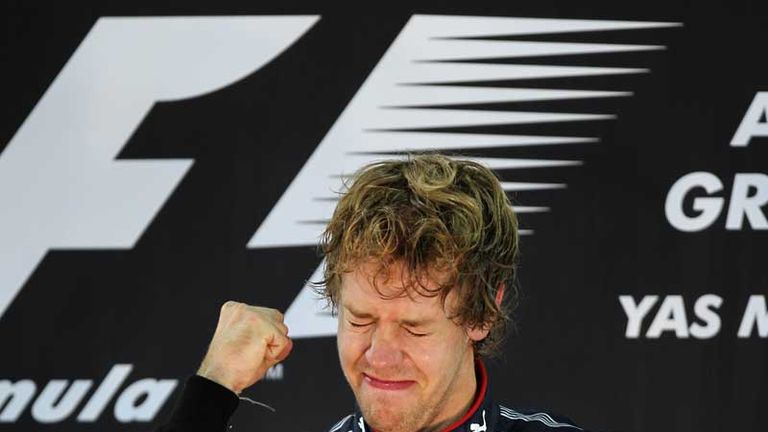
Sebastian Vettel became the sport's youngest world champion at the end of a wide-open season.
skysports.com picks out the highlights of the Formula One season
Did the 2010 Formula One season live up to its billing? Yes, on the whole, although fans of the returning Michael Schumacher might not agree.
Nor, perhaps, followers of Lewis Hamilton and Jenson Button - McLaren's British 'dream team' the other main talking point at the start of the year. Both, however, will have to wait a little while longer if they are to taste title success again.
Instead, we got a new world champion. At the age of just 23, Sebastian Vettel became the sport's youngest at the end of a wide-open season that saw as many as four drivers - Vettel, Hamilton, Fernando Alonso and Mark Webber - still in contention at the final race.
The year might have been competitive in the extreme but Red Bull still ended it with a clean sweep, having also scooped the constructors' title with their Renault-powered RB6.
Vettel's success means there'll be a record-equalling five world champions on the grid next year. At the end of a season defined more than anything else by the inability of any of its main protagonists to steal a march, perhaps it's too much to ask for more of the same in 2011?
Driver of the season - Sebastian Vettel
Speaking as someone who will always plump for the underdog if he can help it, Vettel wasn't my favourite driver from within his own
team, let alone on the grid. But sentiment should not be the overriding factor when making a big decision and the biggest at the start of 2010 - who is actually going to win? - saw me backing the German. Why? The logic flowed as follows: that Red Bull would build a car even quicker and more reliable than last year's rocketship, while its young pilot would this year marry greater experience (and therefore judgement) to his speed.
The team certainly kept their half of the bargain, although you were made to wonder at the start of the season in Bahrain and Melbourne - Vettel suffering through no fault of his own after dominating both weekends. Make no mistake though, he certainly made Red Bull suffer as spring gave way to summer as failures in first Turkey, Hungary and then Belgium made you wonder whether he actually had any judgement left. Impetuous and immature were the adjectives being bandied about as his squabble with Mark Webber took hold and as the season entered its closing stages, you wondered whether it might really be a case of too much, too soon.
Vettel did make more mistakes than last year but with each title contender suffering hiccups along the way, it didn't matter in the end. Remember also that he was the youngest of the title-chasing quartet: youthful indiscretions are always easier to forgive, right? Despite the third part of the Vettel-Red Bull-Renault axis threatening to ruin everything in Korea, subsequent wins in Japan, Brazil and Abu Dhabi allowed him to leap to the top of the standings for the first time all year - in the nick of time. Phew. I just wish I'd put my money where my mouth was.
Team of the season - Red Bull
When Christian Horner was installed as boss of what was the former Jaguar team in January 2005, his first task was to help take down decorations and clean up the remnants of a Christmas party. Not that the act was symbolic of a new chapter: Red Bull were quick to label themselves the party team of the paddock - a smokescreen that arguably served them well as they set about putting a title-winning package together. There have been setbacks along the way: a Ferrari engine deal lasted just a year before it was transferred to 'junior' team Toro Rosso, who then pipped Red Bull Racing to a first grand prix win - rubbing it in somewhat by using an identical chassis. The last two years have seen them come on in leaps and bounds though, and this year's double title success was ultimately an assured one - despite the inevitable fallout from managing the title aspirations of two drivers.

Although the hiring of Red Bull-backed Vettel was more an inevitability than a masterstroke, the hiring of Adrian Newey could certainly be described as such and it's the presence of the former March, Williams and McLaren designer that underpins the team's rise. They became contenders last year, when Newey's RB5 challenged but ultimately could not catch the Brawn, and despite the odd reliability glitch here and there (for so long Red Bull's bugbear) the final step was duly taken. Their rise might lack the 'back from the brink' romance of last year's winners but to take a team which finished seventh in the 2004 constructors' championship (252 points behind winners Ferrari) and turn them into winners - all the while without manufacturer backing - in six seasons is no mean feat.
Most entertaining drivers - Lewis Hamilton and Kamui Kobayashi
Of all the sport's leading lights, more often than not it's the 2008 world champion who is seen to be actually
having a go. Hamilton had no choice at the start of the year when poor qualifying results forced him to come through the field more often than he would have wished, while Monza and Singapore both demonstrated the inevitable downside of such a pleasingly aggressive approach. Not that Hamilton said he would change in the aftermath of his back-to-back crashes and why should he? After all, it's an attitude that also creates opportunities.
Kobayashi does not yet enjoy Hamilton's success yet and perhaps never will but what he shares with the McLaren star is an uncanny ability to catch the eye. He certainly did as much at the tail end of the 2009 season and yet that promise appeared more a flash in the pan early this year - the combination of his own inexperience and a team struggling to get a handle on their new car hardly ideal. But with James Key taking over as Sauber's technical boss, they turned the corner and Kobayashi suddenly found himself running third in Valencia before also forcing his way past Fernando Alonso late in the race. The Japanese driver finished regularly in the points in the second half of the season and was arguably the star of his home race, finishing fourth after an all-action, wheelbanging display. Perhaps there is a reason for all that zeal: before joining Sauber - and seemingly hung out to dry following Toyota's unexpected exit - Kobayashi claimed his only alternative employment should the F1 not work out is at his father's sushi delivery business.
Unluckiest driver - Nico Hulkenberg
Only a month younger than Sebastian Vettel, his countryman has enjoyed a similarly effortless rise to the top, the Hulk's emergence albeit lacking quite such a startling assault on the record books. Of course, Vettel was helped in that regard by the faith of both Red Bull and BMW - friends in high places indeed. Not that Hulkenberg lacks clout: Michael Schumacher's manager Willi Weber is also his and has overseen an ascent that has taken in A1GP, F3 Euroseries and then GP2 titles. A role as Williams test driver further eased his path but after ending the season four places behind team-mate Rubens Barrichello in the standings, Hulkenberg was released. The reason has nothing to do with the driver's ability and everything to do with money - Sir Frank Williams made the point of labelling Hulkenberg a future world champion - and he even conjured up that little bit of stardust all future champs need late in the year by claiming pole position in Brazil. It goes without saying that Hulkenberg deserves another shot. If not, then it would be hard to remember another driver being so let down by the system.
Race of the season - Korea
The rain in Australia and China helped relieve the boredom of Bahrain; Turkey, Great Britain, Belgium, Italy and Singapore all brought incident; Canada, meanwhile, brought tyre troubles aplenty. But Korea had it all: bad weather, incident
and car trouble. That the race would take place at all had only been confirmed the previous week and if there were any doubts about the readiness of the facilities in Yeongam, they were soon allayed. Indeed, much as a hastily-arranged party can often prove the best sort, it seemed as though the last-minute rush to get the show on the road actually helped rather than hindered. What followed was almost three hours' worth of drama and implications: a red flag, a big spin (from which Webber's season never really recovered), an engine failure (from which Vettel's most emphatically did) and a third win in four races for Alonso. Fortunes had changed once more; they would so again.
Controversy/scandal - Hockenheim
It must be said that F1 sets the bar pretty high in this regard and in the absence of any spying controversies or drivers deliberately crashing this year, then the fallout of Ferrari's decision to issue coded 'team orders' is, alas, the best we can manage. Depending on your point of view, there might appear nothing controversial whatsoever about the Scuderia asking Felipe Massa to understand that 'Fernando is faster than you' several times before handing his team-mate the German Grand Prix on a plate. After all, haven't team orders always been a part of the sport? Well, yes, they were - but only until 2002, when they were outlawed by the FIA. The governing body therefore found Ferrari guilty, despite their defence that the decision was Massa's alone and that their main consideration was to avoid the sort of collision suffered by Red Bull's drivers in Turkey. And yet the FIA also admitted that the rule in question (Article 39.1 of the Sporting Regulations, which states simply that "Team orders which interfere with a race result are prohibited") was nigh on impossible to police. Ferrari might have been clod-hoppingly inept in their attempts to shuffle the order on this occasion, but there have been more subtle cases in recent years that have also begged the team orders question. When is a team order not a team order?
The FIA eventually decided to drop the rule earlier this month. Yet in pointing out that any blatant order shuffling could still leave teams facing a charge of bringing the sport into disrepute, it's an issue that's bound to cause still more controversy in years to come.
Moment that summed up 2010 - the slow death of Fernando Alonso's title hopes
It's fitting that, at the end of a season which brought the most open battle in the sport's history, the prize should go to the driver who hadn't actually led the world championship until the very last race. Not that Vettel appeared from nowhere in Abu Dhabi, of course; far from it: he scored five wins and 10 pole positions during the year. Taken alone, the latter figure suggests a dominant season for Vettel but place both numbers side by side and you get an inkling of the ups and downs experienced by all the main protagonists. For Vettel, the problem was an inability to turn raw speed into world championship points on race day; Alonso, meanwhile, was blighted by his own mistakes, bad luck and a poor performing car until Ferrari turned their season around - some might say back to front - at Hockenheim. As his rivals each struggled to build title-winning momentum during the season run-in, Alonso's own appeared ominous. And yet there was to prove a final twist: as Vettel matched his rival's late-season record by racing to a third win in four races, the Spaniard's own hopes suffered a slow strangulation as he spent 40 laps struggling without success to get past Vitaly Petrov's Renault.
Rule changes - For better, for worse?
Very much for the worse was the cry after the season-opener in Bahrain, when all the expectation - and there was an awful lot about at the start of the year - quickly dissipated to be replaced by F1's favourite 'b' word. With fuel stops having been banned, only one mandatory tyre stop remained and it was said the decision of teams to play it safe with strategy as they adjusted to the new rules was a factor in the snooze-a-thon that transpired. Any talk of a knee-jerk response - two mandatory stops was a suggestion - quickly disappeared though as Australia, Malaysia all China all put the show back on the road. Time and again, rain or a safety car - or both - intervened to liven things up, with the combination of tyres and larger fuel tanks also a factor (particularly in Montreal). So timely were some of the interventions, indeed, that you wondered whether the sport might be pushing its luck.
All in all, then, while banning fuel stops did remove a variable from the tactical equation, across 19 races the change did little to detriment 'the show'. Formula One's fundamental problem still exists - a fact borne out when you consider that this year's Bahrain Grand Prix contained the same number of overtaking manoeuvres (14) as the previous year's. Overtaking in the pits is one thing; overtaking on track is something else.
Also, there was a new points system introduced and while - with 25 points now available for a win instead of 10 - it seemed as though it added to the game of snakes and ladders, the effect was, in truth, illusory. Under the old system, the same four contenders would all have arrived in Abu Dhabi in pretty much the same situation. Indeed Hamilton, who came into the final race 24 points behind Alonso, would have been just seven points down under the old system and therefore in a slightly better place.
Year to forget for - Michael Schumacher
The seven-times world champion's highly anticipated comeback turned into the most disappointing this side of Tiger Woods' own return - golf's
ubermensch out for months rather than years admittedly. The 14-times major winner morphed from blandest of the bland to tabloid staple around the same time as Schumacher's own return was announced and while Woods' all-too human frailties were a factor in the sometimes dreadful displays that were to follow, Schumacher's own woes were not really the sort that were ever going make the back page, let alone the front. A lack of front-end grip on his Mercedes W01 was never going to set a tabloid editor's pulse racing, was it? But that was the reason given for his eventual position of ninth in the drivers' championship and it will be interesting to see whether the soon-to-be 42-year-old is able to tease more out of a new chassis and Pirelli tyres next year.
A hugely disappointing year, then. Yet although the close encounter with Rubens Barrichello in Hungary suggested that old habits die hard, what redeemed Schumacher was his dignified public response to what must have been an immense private disappointment. Even during the retirement years, Schumacher's frequent appearances at grands prix, not to mention his continued tests for Ferrari, suggested a man who had not really 'got it out of his system' and now he is competing once more, the impression remains of someone who genuinely loves Formula One. That might well be the case, but Schumacher also loves winning: if there's little prospect of a 97th career victory on the horizon, can we assume he'll be on his way once more next year?
Gone but not forgotten? - F-ducts
Pioneered by McLaren, the aerodynamic device which, with the help of the driver, reduced rear wing drag and therefore boosted top speed, is being outlawed in 2011 to be replaced by an FIA-mandated moveable rear wing. The new device will, alas, be operated via the steering wheel meaning that, much like the kid at school who would ride his bull-handlebar bike down the middle of the street with his hands in his pockets, we will no longer have the chance to see drivers do their thing one or even none-handed. Having said that, with KERS also back next season - and also controlled using a button mounted on the steering wheel - drivers might be forgiven for thinking they'll need more than two hands to actually drive the car.