
2013 Korean Grand Prix analysis: Where Sunday's race was won and lost
How did Nico Hulkenberg do it? How much time did Lewis Hamilton lose? How lucky did Kimi Raikkonen get with the Safety Car?
Tuesday 8 October 2013 16:24, UK
So why then, with the W04 losing laptime and grip hand over fist, did Mercedes keep their increasingly agitated driver out on track for so long? Well, as Ross Brawn explained after the race: "An extra stop at lap 22 would have committed us to a much slower three-stop strategy, or we could leave Lewis in clean air to tough it out and try and reach the target lap to make our two-stop strategy work." It was a painful watch but in the cold light of day Hamilton himself admitted afterwards: "We couldn't have done thirty-five laps on the tyres."
However, Mercedes did suffer a rather unfortunate additional slice of bad luck as they executed this strategy. As the radio message delivered to Hamilton on lap 29 implied, Mercedes would have called the Briton into the pitlane at the end of the previous lap had Rosberg's sparking car not required more urgent attention. That extra 5.6km tour, and the resultant loss of several more seconds, meant Hamilton ultimately exited his pitstop right behind, rather than just in front, of the flying Raikkonen, losing him his best chance of clinging onto a podium position.
Would Kimi Raikkonen have finished second without the Safety Car?
Somewhat amazingly, the Korean GP represented the fifth time in Kimi Raikkonen and Romain Grosjean's two seasons as team-mates at Lotus that the pair have finished second and third respectively on the podium - with all but one of those GPs being won by Sebastian Vettel, incidentally. The majority of those races have also followed a set pattern: Grosjean runs as the lead Lotus through the first half of the race only for his World Champion stable-mate, via superior speed or strategy or both, to eventually overhaul him for the runner-up position. Sunday's race may have finished with that same two-three order but how it came about proved a different matter entirely. Having outqualified the sister car by six places on Saturday, Grosjean's advantage over Raikkonen on the track was 25 seconds when the Finn, at the time running in seventh place, made his second and final pitstop at the end of relatively early juncture of lap 25. Raikkonen's initial gains up the order on his return to the track were all hard-earned as a quick out-lap and then immediate new race fastest lap on his fresh medium rubber saw him jump four cars - Nico Hulkenberg, Fernando Alonso and the ailing Mercedes pair - when they all made their respective stops over the next couple of laps. However, while now up to third, Raikkonen would have been able to do nothing about Grosjean had the first Safety Car not intervened on lap 31. With his team-mate's large advantage over him having therefore been completely wiped out, Raikkonen was perfectly placed to pounce on the sister Lotus's wide moment out of Turn 15 on lap 37 and nail him into the first corner on the next lap. Grosjean's slightly superior pace thereafter underlined why he had been Lotus's lead runner all weekend but, as a wily old campaigner like Raikkonen knows only too well, you often make your own luck in this game and as the Frenchman himself ruefully reflected afterwards: "I should have avoided that Astroturf in turn 15 and it would have been the end of the conversation." How perfect was Sebastian Vettel's weekend?
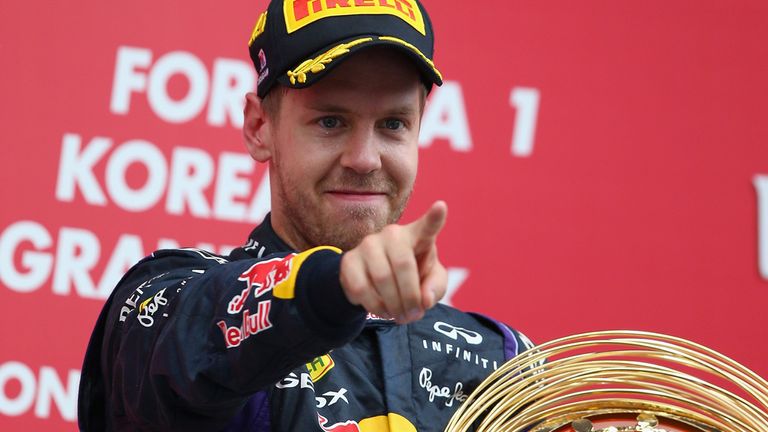
He may play down the significance of the records he continues to collect, but it's blindly obvious that Sebastian Vettel takes great pride - and satisfaction - from ticking off as many 'boxes' during a race weekend as he possibly can. Indeed, for the second race weekend in a row - and the seventh time in his career - the World Champion chalked up the hat-trick of pole, win and fastest lap in Korea, making sure of the final leg of that on lap 53 of 55 when he banged in a 1:41.380 time which was six tenths of a second faster than his previous lap and half a second quicker than anyone else managed all race. Even more impressive than that, however, was that Vettel added another even more coveted, and rare, 'Grand Chelem' to his collection by once again leading every lap in Yeongam. Given only 22 drivers in history have ever notched up this rather special race weekend quadruple, and only half of them more than once. So the fact that Vettel also managed it in Singapore really does underline Christian Horner's view that his driver is currently operating at an "unbelievable" performance level. Vettel now has four such Grand Chelems to his name in his career (India 2011 and Japan 2012 being the others) which is already just one fewer than Michael Schumacher managed and half way to Jim Clark's overall record.
Somewhat amazingly, the Korean GP represented the fifth time in Kimi Raikkonen and Romain Grosjean's two seasons as team-mates at Lotus that the pair have finished second and third respectively on the podium - with all but one of those GPs being won by Sebastian Vettel, incidentally. The majority of those races have also followed a set pattern: Grosjean runs as the lead Lotus through the first half of the race only for his World Champion stable-mate, via superior speed or strategy or both, to eventually overhaul him for the runner-up position. Sunday's race may have finished with that same two-three order but how it came about proved a different matter entirely. Having outqualified the sister car by six places on Saturday, Grosjean's advantage over Raikkonen on the track was 25 seconds when the Finn, at the time running in seventh place, made his second and final pitstop at the end of relatively early juncture of lap 25. Raikkonen's initial gains up the order on his return to the track were all hard-earned as a quick out-lap and then immediate new race fastest lap on his fresh medium rubber saw him jump four cars - Nico Hulkenberg, Fernando Alonso and the ailing Mercedes pair - when they all made their respective stops over the next couple of laps. However, while now up to third, Raikkonen would have been able to do nothing about Grosjean had the first Safety Car not intervened on lap 31. With his team-mate's large advantage over him having therefore been completely wiped out, Raikkonen was perfectly placed to pounce on the sister Lotus's wide moment out of Turn 15 on lap 37 and nail him into the first corner on the next lap. Grosjean's slightly superior pace thereafter underlined why he had been Lotus's lead runner all weekend but, as a wily old campaigner like Raikkonen knows only too well, you often make your own luck in this game and as the Frenchman himself ruefully reflected afterwards: "I should have avoided that Astroturf in turn 15 and it would have been the end of the conversation." How perfect was Sebastian Vettel's weekend?
He may play down the significance of the records he continues to collect, but it's blindly obvious that Sebastian Vettel takes great pride - and satisfaction - from ticking off as many 'boxes' during a race weekend as he possibly can. Indeed, for the second race weekend in a row - and the seventh time in his career - the World Champion chalked up the hat-trick of pole, win and fastest lap in Korea, making sure of the final leg of that on lap 53 of 55 when he banged in a 1:41.380 time which was six tenths of a second faster than his previous lap and half a second quicker than anyone else managed all race. Even more impressive than that, however, was that Vettel added another even more coveted, and rare, 'Grand Chelem' to his collection by once again leading every lap in Yeongam. Given only 22 drivers in history have ever notched up this rather special race weekend quadruple, and only half of them more than once. So the fact that Vettel also managed it in Singapore really does underline Christian Horner's view that his driver is currently operating at an "unbelievable" performance level. Vettel now has four such Grand Chelems to his name in his career (India 2011 and Japan 2012 being the others) which is already just one fewer than Michael Schumacher managed and half way to Jim Clark's overall record.