
Getting a grip: McLaren's Sochi improvement and the positive signs for 2015
Was McLaren's best performance since Melbourne purely Sochi-specific or more fundamental than that? Mark Hughes explains...
Tuesday 28 April 2015 12:09, UK
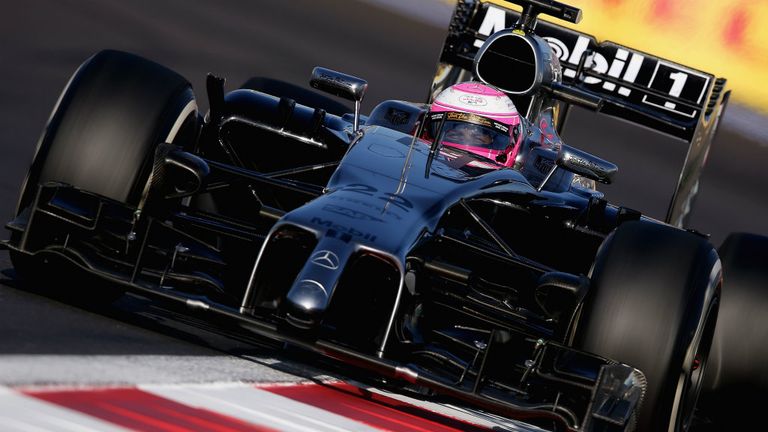
Jenson Button was postponing judgement on McLaren’s much-improved form in Sochi. “We’re not sure yet if it’s genuine improvement or if it’s just track characteristics that worked in our favour,” he said after heading team mate Kevin Magnussen home in a four-five finish.
As in qualifying, Button was beaten only by the two Mercedes and Valtteri Bottas’s Williams and comfortably headed the Ferraris and Red Bulls. Although the car’s naturally good traction around a circuit that favoured its Mercedes engine over the Ferrari and Renault power units even more than usual worked heavily in its favour at Sochi, improvements to the car have been bearing fruit recently – and point the way ahead for next year.
A revised front-wing in Russia addressed the car’s main shortcoming – its lack of front end grip because of difficulties in generating the optimum vortices (circles of swirling air that speed up the airflow) between the wing and the sidepods. The team admits this has been its main battleground all year, the key limiting factor to the car’s performance. Because of the way the nose, bulkhead and front suspension interact aerodynamically, it seems there is a built-in limitation to the car’s architecture.
Since this has been understood, it has allowed the team to tweak the wing design to partly compensate. But of more significance is how this understanding can benefit the 2015 car – which is said already to be showing much better aero figures in simulation than the current car.

As a piece on Sky F1 to be shown at a forthcoming race will show, creating the vortices behind the wing and ahead of the sidepods and getting them to work together in pulling the airflow over the front wing harder (thereby increasing the downforce produced by the wing) is more important than ever under the current regulations. These vortices also increase the speed of flow going back over the rear bodywork and brake ducts and so getting them to interact properly is crucial.
The damp air in one of the practice sessions at Austin last year made these vortices briefly visible on Mark Webber’s Red Bull, but the narrower front wings regulated for 2014 has made generating the vortices and placing them in the right area of the car much more difficult. The vortices are formed by the interaction of airflow from two or more surfaces, which cause the air to spin very fast in a circular motion. One of these vortices is formed by the two edges of the regulation ‘neutral’ centre section of the wing. Another is formed by the flow around the tyre and suspension. They each form between the tyre and sidepod. Get these two vortices forming sufficiently close to each other - one clockwise, the other anti-clockwise – and they accelerate each other and downforce increases dramatically.
On the McLaren the relatively big gap between the central section of the wing and the nose’s underside helps with providing a lot of airflow to the underbody and diffuser at the rear, but makes it difficult to generate a sufficiently powerful vortex to help the front of the car. The geometry of the bulkhead and nose and where the suspension legs attach to the MP4-29 have made this a difficult problem to solve.
The new wing used in Sochi featured subtly tweaked endplates that evidently helped with the interaction of the two key vortices behind the wheels and suddenly the car had an improved front end that more nearly matched its aerodynamically-powerful rear end. But it’s a fair assumption that the MP4-30 of 2015 will look very different to the current car at the front – and this just might be the key to a dramatic improvement in form for the team.
MH