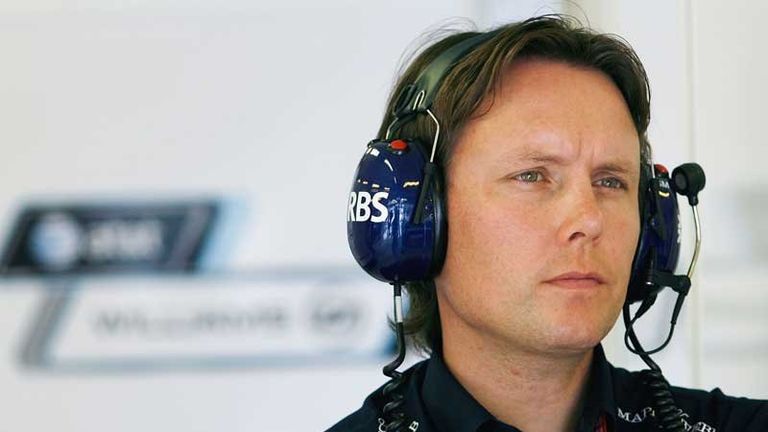
Williams technical director Sam Michael is hopeful that F1's new regulation changes can help propel them back to the front of the grid.
Michael wants extra effort on FW31 to pay dividends
Williams technical director Sam Michael is hopeful that Formula One's new regulation changes can help propel the once dominant team back to the front of the grid.
The team launched their Toyota-powered FW31 car at the Algarve Motor Park near Portimao, Portugal, on Tuesday.
Without a win since the 2004 Brazilian Grand Prix, the past four seasons have seen Williams by and large struggle.
Their eighth-place finish in last season's Constructors' Championship equalled their second worst since Sir Frank Williams and Patrick Head founded the team in 1977.
But Michael thinks the team's efforts to exploit this season's new rules changes governing aerodynamics - efforts which saw them concentrate on 2009 rather than develop last year's car - can start them back on the road to the glory days of the 1980s and 90s.
"We probably started work on this car at the same time as others, working in the wind tunnel in December of '07 and drawing many of the parts six weeks before that," Michael said.
"But the difference is, going into 2008 we increased our resource significantly throughout last season, which is why we took quite a big penalty on the old car.
"Hopefully that will pay off now with a more competitive 2009 car."
Without the resources available to manufacturer-backed teams such as Ferrari, McLaren Mercedes or BMW Sauber, Michael is guardedly hopeful Williams can nevertheless improve by playing to their strengths.
He added: "Our target is always to get back to the front.
"We've been a winning team before and we want to get back there again, but how far we go is still relative.
"If all the teams have done the same job as us, plus a bit more, then we will stay where we are.
"F1 is a relative game, but our aspirations are to make sure we're respectable in the current climate.
"We're a privately-owned team and we have to make sure we do things efficiently and try to gain on other people using efficiencies they can't achieve. That's what we try to do all the time.
"So in terms of a target finishing position, we don't sit here and have a target. We just try to do the best job we can.
"We don't go in feeling confident about anything. The Williams way is to be pessimistic and make sure we cover all bases.
"Under-expect and over-deliver is the best way."
Intrigued
Michael enthused about the rule changes - F1 cars in 2009 having larger front wings and smaller rear wings in an effort to promote overtaking.
He was also intrigued to see how they have been interpreted by rivals McLaren, Toyota and Renault - the other three new models taking part in the first test of the year.
"There is more of a level playing field going into this season than there has been for many a year," he assessed.
"The rules are so different aerodynamically, and that is really exciting. That's why I'm in Formula One, to be honest.
"If you look at periods like this, from an engineering point of view it's fascinating to see people come up with different concepts.
"It's really exciting to see which ones are good and which ones are not, and there'll be a massive fever of development during the year because of that.
"There are some big differences across the cars at the moment, and that's the great thing about Formula One."
Another big change in 2009 is the introduction of Kinetic Energy Recovery Systems (KERS), with Williams taking the route of a flywheel device.
They are also looking at a battery option, the route all their rivals have chosen, but have yet to decide whether they will begin the season with either on the car.
However, Michael's enthusiasm was somewhat dampened when reserve driver Nico Hulkenberg aquaplaned off the wet circuit after completing 17 laps, damaging the front nose.
Under a black tarpaulin, the car returned to the garage on the back of a flat-bed truck for repairs.
Secure
Meanwhile, team chief executive Adam Parr has confirmed they are financially secure for the next two years.
One of Williams' chief backers is beleaguered bank RBS, whose share price has plummeted amidst fears they are to announce losses of £28 billion - the biggest such in British corporate history.
However, RBS are tied into a contract for the next two years with Williams, who have also been buoyed by the decisions of other sponsors, including Phillips, to extend deals.
And with the FIA agreeing a range of cost-cutting measures with the Formula One Teams' Association (FOTA), Williams' short-term prospects appear strong.
Parr said: "We are very grateful for the loyalty and steadiness of purpose of our partners.
"We never take anything for granted, but our 2009 and 2010 budgets are in place thanks to the support of our partners, as well as the increased revenues from Formula One Management and the work being done by FOTA and the FIA to reduce costs.
"It is now our responsibility to make sure that our partners and the many other people who support the team enjoy a return on that investment."