
Red Bull Q&A
Wednesday 28 January 2009 15:38, UK
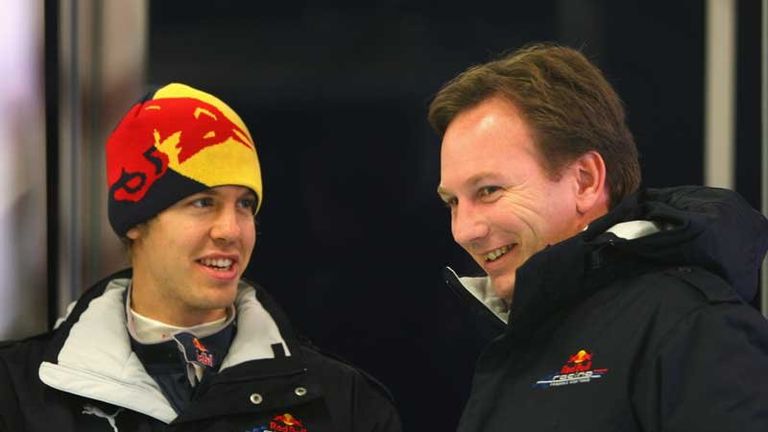
Team principal Christian Horner spoke to skysports.com ahead of the 2009 Formula One season.
With two months to go before the start of the new Formula One season, Red Bull's Christian Horner spoke to skysports.com about his hopes for 2009, the team's new wunderkind Sebastian Vettel and how this year's rule changes might affect the sport... Are we reading too much into the fact that Red Bull's launch date (February 9) is almost a month after those of your principal rivals? "Basically, with the significant changes in the regulations, we strategically opted to take full advantage of running in the wind tunnel before launching our 2009 contender. The bad weather teams experienced in the Algarve test last week - I don't think we missed anything particularly track time-wise. But strategically it was always part of our plan to go for a slightly later launch just to maximise our time available, taking into consideration the new regulations." Sebastian Vettel: is he the 'final piece in the Red Bull jigsaw puzzle'? "He's an important piece. He's obviously progressed through the Red Bull junior programme, he's done an excellent job for Toro Rosso - he's worked closely with the group anyway, belonging to the same family - and he's a very exciting prospect. I think he and Mark Webber make a strong team line-up and I'm sure Sebastian will only continue to improve." There seems almost an embarrassment of riches in terms of young drivers in the sport right now. What does Vettel have that might separate him from his rivals? "I think what he's demonstrated over the past 18 months. He's got considerable ability, he's an intelligent driver - he seems to have spare capacity whilst driving the car. And whenever there have been adverse conditions he's taken advantage, whether it be in China in 2007 (where Vettel finished fourth), whether it be Monza 2008 (a race he won). Both were held in difficult conditions - which is always the trait of an excellent driver." Has the broken leg suffered by Mark Webber hampered your preparations to any great degree? "In all honesty no, because obviously with running slightly later it's given Mark the maximum recovery time: I think it'll be 11 or 12 weeks by the time he'll be with us down in Jerez. His recuperation has gone extremely well - he's ahead of schedule with his recuperation at the moment. He's had some excellent treatment, some excellent advice, he's in good spirits and he's making progress with every day." What will David Coulthard's role with the team be in 2009? "David is retained by the team as a consultant. We will be looking to draw on his 15 years of grand prix experience, working in the team in different areas: with the drivers, with the marketing aspect and I'm sure the engineers will look to draw upon his experience on occasion. He'll be at every grand prix anyway as a TV commentator and with testing now abolished in season it's obviously unlikely he's going to get occasion to drive the car. He's contributed a great deal in the initial years of Red Bull Racing; it's absolutely relevant he continues to make a contribution." Was Toro Rosso's emergence during the course of last season something that was difficult to deal with at Red Bull Racing? "Not at all. Red Bull Technology, which is housed here in Milton Keynes, supplies equal equipment to both teams and Red Bull Racing enjoyed a very strong first half of the year, while Toro Rosso enjoyed a very strong second half of the year. Sebastian really emerged during the season and we took huge heart that the design group here produced such a good car in 2008 that Toro took advantage of to win the Italian Grand Prix. So whilst there is a healthy rivalry between the two teams, they belong to the same family. Sebastian has obviously stepped up into the senior team for 2009 and we expect the teams to be closely matched again in 2009 as they will have the same equipment at their disposal." Apparently the difference between the two of you was that they enjoyed a performance advantage using Ferrari engines. Renault (who supply RBR) have been given a special dispensation to improve the performance of theirs this year. What are they allowed to do? "There was a difference between the engines and one of the downsides of a freeze is that we potentially freeze in an advantage or disadvantage. And in Renault's case it was unfortunately the latter. However, the FIA have access to all the information, all the engine data and they permitted Renault to make some changes over the winter to equalise the engine or create a more equal powerbase - which is very positive news for Red Bull Racing, and indeed for Renault." Have Red Bull Racing any definite objectives for the coming season, such as a first race victory? "I think we just want to go to every race and be better - just continue to improve. We enjoyed a very strong first half to last season, scoring 24 points in the first seven or eight races. We arrived at Silverstone at the halfway point of the year fourth in the Constructors' Championship and qualified on the front row. From that point onwards, we had a fairly miserable second half of the year and what we're determined to do this year is to see the performance continue throughout the season. Obviously the new regulations are a massive challenge for everybody: different aero rules, slick tyres and obviously the much talked-about KERS system. So it's impossible to make any predictions at the moment because I don't think any team genuinely knows where they stand." Did it take Honda's announcement at the start of December to concentrate minds and for the cost-cutting deal to be agreed, or was such a landmark agreement on the cards anyway? "Obviously there's been a great deal of discussion during the past seven months since FOTA (Formula One Teams' Association) was created last summer. There've been some initiatives regarding cost saving but what the Honda situation did was focus the minds somewhat. But well before that measures were already in place to significantly reduce costs, be it by extending engine life or reducing testing. I think FOTA and the FIA are acting responsibly to reduce the costs in Formula One - it's obviously a critical economic time the world's currently enduring."Was any serious thought given to the idea of a budget cap? "I think the principle of it is very simple to grasp; as with all these things the devil is in the detail. The policing of such a budget cap would be fraught with problems and issues. Especially more so for teams that are sub-divisions of manufacturers: how do you police the R&D element? How do you monitor the activities within an organisation? Whilst the principle, I think, is interesting, like with all these things the devil is very much in the detail and the ability for it to be policed and regulated." There are significant rule changes in 2009, which manufacturer-backed teams might perhaps be best-placed to benefit from. However, there are also cost-cutting rule changes which, on the face of it, benefit independent teams. What might a well-resourced independent team, such as Red Bull, stand to gain? "I think that for an independent team such as ourselves or Williams it creates very much a more equal and level playing field. I think Formula One costs - and R&D costs in particular - have spiralled out of control in recent years and I think recent measures look to control and curtail those kinds of activities. So I think it is positive for the independent teams; it does create a level playing field that will allow the independents to compete - if they're well run, well disciplined and show ingenuity with the bigger manufacturer-backed teams." Do you think KERS will make a significant difference to the racing? "I think that KERS is an extremely interesting technical challenge. It's quite immature, I think, for all teams in its development at the moment. I think its impact with the amount of power output will be limited, but I think every team on the grid is in a position where it can't afford to ignore KERS because of the potential advantage it can give in, for example, a safety car restart. So, it will be very interesting to see how KERS is integrated between the different teams and who has it on their car for the first race in Melbourne. It's a complicated system - it comes with other issues, in terms of putting a high voltage battery into the car...and obviously the health and safety issues that go with that. So I think it's a challenge for every grand prix team and we'll see who's on the grid in Melbourne with the system."