skysports.com asks whether this year's shake-up in the F1 rulebook was in fact successful.
skysports.com takes a look at the biggest shake-up in the Formula One rulebook in 25 years and asks whether it has achieved its stated aim
This year's Brazilian Grand Prix summed up everything that is great about Formula One. The race itself saw Jenson Button clinch the World Championship after coming through the field, pulling off a series of dashing overtaking manoeuvres along the way. Admittedly, his path was eased by a number of crashes on the opening lap but these too characterised the danger and excitement inherent within the sport. Pull the strands together and you were left with a thrilling piece of sporting theatre.
And yet Formula One has a problem, one on which casual viewers are always quick to pounce and one for whom those more committed have almost come to accept with a shrug of the shoulders. Namely: the cars don't actually overtake each other that often do they?
Button did it when it really mattered at Interlagos, but the number of passes he made in the race - four - equalled the sum total of all manoeuvres made by all 20 runners during the Singapore Grand Prix three weeks earlier. That night race perhaps sums up Formula One's problem: as a spectacle it was breathtaking. However, the red lights then went out and the race got underway.
With his mania for races to be held in places like Manhattan and Eurodisney, the sport's commercial rights controller, Bernie Ecclestone, doesn't give the impression of a man altogether concerned with the need for great racing; presumably as long as the TV companies and race promoters continue to cough up then everything else will take care of itself. But what of us lot at the bottom of the pyramid? Although this year's Turkish Grand Prix was notable for its empty grandstands we still keep turning out in our droves, happy to pay good money in difficult times for a product that can be frustratingly indifferent. The ability of sport to keep an irrational grip on otherwise rational people never ceases to amaze.
Ecclestone and the FIA sometimes appear joined at the hip but the governing body has at least recognised and tried to tackle the problem. Formed at the start of 2007, its Overtaking Working Group (OWG), a collective of senior engineers from leading teams, was handed the task of identifying why current F1 cars find it so difficult to pass each other and, more importantly, to try and come up with a solution.
So what is it that prevents these phenomenally skilled sportsmen doing what most people assume is the fundamental point of the exercise? In short, the cars have increasingly relied on sophisticated aerodynamics to generate the majority of their grip. However, when one car is shaping up to pass another, the air disturbance created by the one in front causes that behind to lose grip - meaning the driver has to back off. A side effect of this is a reduction in braking distances - a modern F1 car can decelerate from 200km/h to zero within 65 feet - which hardly helps matters.
Solution
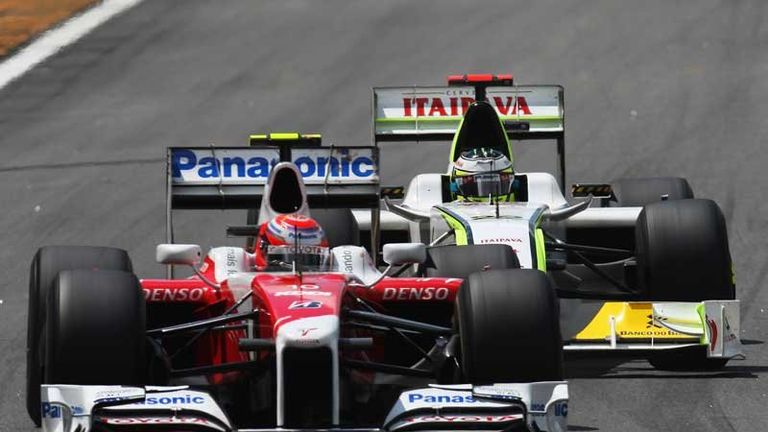
The OWG's solution was to cut aerodynamic grip for the 2009 season, with 50 per cent the reduction initially hoped for. (A figure of 90 per cent was first suggested but quickly shelved so as not to make Formula One cars slower than those in junior formulae.) To do this, the FIA mandated a lower, wider front wing with an adjustable element (in order for the driver to try and improve grip when moving to pass another car), as well as a smaller, higher rear wing (to lessen the trailing air disturbance). Appendages like bargeboards and chimneys, which have spread like a cancer in recent seasons, were also banned while rear diffusers were also made smaller to reduce their effectiveness. The 'push to pass' system afforded by KERS was billed as another plus, potentially helping a car exiting a corner to gain on a competitor on the following straight.

Factor in the return of slick tyres to boost mechanical grip and what resulted were, let's face it, a bunch of rather ungainly looking machines (BMW and Toyota surely being the worst culprits). But if they do the job to a noticeable degree then surely an awkward appearance would be a small price to pay?
Unfortunately, it appeared pretty much straight from the off that those wanting real change had been ripped off. A stern test came in May's Spanish Grand Prix, held on a circuit - Barcelona's Circuit de Catalunya - where there were two whole overtaking manoeuvres during the 2008 race. Fast forward 12 months and there were...four. Of course, you could argue that represents a 100 per cent improvement but for quite a few of us it still represented a good hour-and-a-half of our lives spent watching not very much.
So why has the improvement been, at best, only slight? The most obvious answer lies in the ability of Formula One engineers to take whatever rule changes the FIA throws their way and finagle a way around them. Such an example came at the start of the season when Brawn GP's interpretation of the new rules resulted in a "double decker" diffuser which offered them (as well as Williams and Toyota) a head start grip-wise and a kick-start to their successful World Championship bid. The reality is that such craftiness meant a downforce reduction of 50 per cent was always going to be unachievable - a reduction of between 15 and 25 per cent a more likely estimate for cars at the start of the season, with that figure eaten away still further as updates were introduced.
Then there's the tracks themselves. Speaking at July's German Grand Prix, one of Formula One's top finaglers, Red Bull designer Adrian Newey, said: "I think fundamentally the circuits are probably the biggest influence. Everybody seems to conveniently forget about that as it is deemed to be easier to change the cars than change the circuits." And yet the circuits have changed in recent years, with new purpose-built tracks in China, Bahrain, Turkey and now Abu Dhabi appearing alongside classics such as Monza, Silverstone and Spa. Much like the changes to the cars, though, the effect appears to have been imperceptible.
Rose-tinted
Speaking of perception, Newey also said the notion of a bygone age when "overtaking used to be fantastic", used by some to knock modern Formula One, was "rose-tinted". However, McLaren managing director Jonathan Neale points out the paradox which appears central to the problem: that overtaking has diminished as the field has grown more competitive. "People talk quite fondly and with dewy eyes about motor racing during the 1970s and even earlier and they forget that in those days the difference between first and second could be up to a second," Neale told
skysports.com. "Some of the grid never qualified. So when you have cars that are that far apart, cars coming through from the back, mistakes being made...that produced a lot of overtaking. This year, front to back of the grid, on some occasions if you look at the race paces from recent races, it's probably only a second and a half. And when you've got that level of closeness between the cars it is more difficult, more challenging."
Former grand prix driver John Watson agrees. With a Formula One career spanning 12 seasons between 1973 and 1985, the Ulsterman is perfectly placed to make eyes moist with tales of derring do from a time when the sport was an altogether different proposition for those taking part. He also knows a thing or two about overtaking: two of his five grand prix victories came at Detroit in 1982 and Long Beach the following year, where he took the chequered flag having started respectively 17th and 21st on the grid. Then there's the undeniable truth that, besides being one of its more notable exponents, 'Wattie' - a self-confessed motor racing "anorak" - is passionate about the subject matter.
"In many ways I'm from a generation of grand prix drivers where we had overtaking. Or maybe my memory tricks me into thinking we had," he told
skysports.com before saying: "I think that there was (more overtaking) partly because there was a bigger disparity between the front and the back of the grid - at different points. At some points it was close but Formula One right now is exceptionally close."
Watson's thoughts on Formula One's overtaking problem and its causes are nothing if not perceptive. He marvels at the ability of engineers to exploit the rules ("I think it's wonderful because it's human nature at its most innovative") whilst explaining how they use the power of lateral thought to outfox the rule makers ("the rule makers think in a linear way and the engineers think in a lateral way"). Then there's the notion that the racing has declined as money has been pumped into the sport. "Manufacturer investment has not produced better motor racing," Watson states. "All it's done has produced a fantastic show; I'm talking about the stage of Formula One not the racing."
There's also an argument that contemporary Formula One relies too heavily mandatory fuel stops to shuffle the order, where once drivers relied solely on overtaking. The stops, introduced in 1994 but to be removed next season as a cost-cutting measure, may have satisfied the need of some for more tactical variables and also give more of a chance to see cars are their absolute quickest but others, including Watson, have argued that the sport has suffered as a result.
"Part of the skill and art of being a grand prix driver is not just doing sprints between pit stops," he insists. "Having a car that's full of fuel, which is what they will be next year and having a single set of tyres, which my generation had, and balancing the car from the point of view of running from empty tanks to full tanks and being able to look after the tyre that you've got - without pit stops - now that's what Formula One used to be and that's what generated good motor racing as a consequence. Bear in mind we're still wearing the rose-tinted glasses." Tyre stops are still mandatory next year, so it remains to be seen whether there'll be much of a change.
Radical
Watson suggests a radical solution, albeit one he knows will never happen - the purist within him no doubt heaving a huge sigh of relief. In short, he thinks that Formula One can only guarantee more overtaking by following NASCAR's lead and effectively becoming a one-make formula. Much as NASCAR has used its 'Car Of Tomorrow' to provide a standard shell in which Ford, Chevrolet, Dodge and Toyota house their wares, he thinks the only real solution available is for the FIA to introduce a standard car including drive train, suspension, brakes, aero package and tyres that are "exceptionally hard by the standard of tyres they run today" - leaving teams to decide what engine to run.
He explains: "It's only by making draconian steps that you will get back longer braking zones and a lot less cornering power than we currently have. But that almost goes against what is Formula One. I would hate to see that actually because Formula One to me has always been about the ultimate in terms of whatever element it is: tyres, aerodynamics, chassis design, engines, whichever. But to the detriment it becomes a very...I have to say 'boring' is not correct but it isn't fulfilling the expectation."
Maybe expectations are simply too high? Much as football has the 0-0 draw and cricket can deliver the Test match washout, then Formula One is all too capable of staging a procession. Perhaps the new formats introduced by the summer game can offer a pointer? Here's a suggestion: using Test matches and the Twenty20 format as a loose analogy, grand prix motor racing in its current guise could settle the constructors' title and the drivers' crown could be decided in a new spec. car (called, say, GP1). That way, the appetite for the sport at its purest - but not necessarily its most exciting - can be maintained, together with a greater guarantee of thrills and spills over an additional 40-lap race. Plus, the extended weekend would offer fans much-needed value for money.
According to Watson, any such radical proposals would cause teams and manufacturers to "throw their hands up in horror" in much the same way they did when former FIA president Max Mosley tried to introduce a budget cap earlier this year. What it apparently boils down to is a cycle of self-interest: "The teams are utterly and totally reluctant to accept any change that is retrospective or retrograde in their opinion because the purpose for them to be in (Formula One) is to go out and generate the money to enable them to spend the money to gain the advantage...to earn the money to spend the money to gain the advantage." Presumably then, the cost-cutting changes they did agree to during the summer, which are intended to take spending back to "early 1990s levels" within two years are not sufficiently retrograde.
It seems as though changes labelled as the most radical in 25 years were not radical enough to produce much of a change on track and yet the sport itself will not allow the sorts of changes that might make a real difference. However, as Watson's own dilemma amply demonstrates, resistance also comes from those who love Formula One and who cannot bear the thought of its 'best of breed' ethos being diluted any more than necessary. And so, for now, F1 continues upon its merry way, with the £800 million Yas Marina circuit serving up pretty average fare in the sport's first ever twilight race. Still, it was comforting to know that Naomi Campbell enjoyed herself.