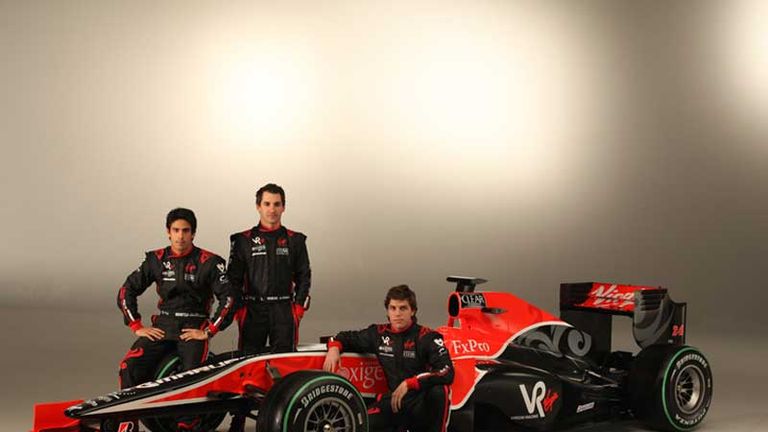
Virgin Racing have become the first of Formula One's new teams to unveil their car.
"Immensely proud" moment for team boss as first car appears
Virgin Racing have become the first of Formula One's new teams to unveil their car.
The Cosworth-powered VR-01 chassis, which was launched on Wednesday, was designed using digital techniques with the team wholly relying on computational fluid dynamics (CFD) technology rather than the more usual process of building scale models to test in a wind tunnel.
Driver Timo Glock will begin a two-day shakedown test of the car at Silverstone on Thursday before Virgin join other F1 teams for a group test at Jerez next week.
"The first reaction... is that it's a really nice car," Glock said. "I think we have some good ideas on the car. For me, it's a solid base to start for us to go testing. The design is already pretty good and now we have to sort out the speed.
"The real unique stuff will come in the season or later on in the year, but now for us it is important that the car is here and ready.
"That's where the team did just a great job. The mechanics have been working 24 hours the last couple of days."
Team-mate Lucas Di Grassi added: "The car just looks amazing."
Team principal John Booth, whose Manor Grand Prix outfit secured a place on the 2010 grid last year prior to their partnership with Sir Richard Branson's Virgin Group said the unveiling was "the culmination of a very emotional journey.
"I am immensely proud... I am blown away. When it rolled out of the workshop yesterday in all its glory, it was a very special moment."
Epic
Technical director Nick Wirth said designing and building the car in a relatively short space of time had been an "epic task".
"The other fantastic thing, which isn't obvious today, is that when we unloaded the truck yesterday, I had a telephone call with the news that we had passed our final major crash test so the car is now completely homologated and ready to go," he said.
"So it's just an amazing job that everyone has done to get it to this point, on time and on budget."
Wirth said he hoped the team's unique approaching to designing their car might "demonstrate that this could be the way for the future of F1."
Unlike the majority of cars launched so far, the VR-01 does not feature a 'dorsal fin' engine cover supporting the rear wing. However, the nose follows the trend of being more raised.
Wirth added that the team would introduce constant updates throughout the year but stressed that getting the car to run reliably first was a must.
"We are a serious racing team with serious ambitions, so we aren't going to try to run before we can walk," he said.
"We fully expect to encounter issues along the way. CFD is an approximation as is scale model testing. In both cases, it is only when you hit the track that you can really appreciate the effect of factors that are tricky to model with any technology."
Virgin Racing decided to enter F1 in light of the sport's recognition of the need for cost cutting and claim to have the lowest budget of all 13 teams - around £40 million.