Tour de France route guide
We take a closer look at the biggest race in cycling - the Tour de France.
Last Updated: 11/07/12 3:54pm
The most prestigious race in cycling, and one of the most famous sporting events in the world, is gearing up for one of its most intriguing editions in 2012.
Not since 2007 has so much emphasis been placed on time trialling, meaning the contenders for overall victory may approach the event in a very different way from recent years.
There will, as ever, be opportunities for the climbers to make up time in the mountains but those who count riding against the clock as their strong suit have been given a golden chance to secure victory.
With a start in Belgium being followed by the traditional sprint stages and trips over the Alps and Pyrenees, the showpiece of cycling will put on a typically spectacular show. Here's what the riders will face:
Stages
Saturday 30 June: Prologue - Liege - 6.4km (ITT)
The Tour returns to a prologue start rather than the road stage that kicked off last year's race. For the fourth time in six years the Tour will start outside France, with the Grand Depart this time heading to the Belgian city of Liege. The short time trial takes place in the centre of the city and is a flat out-and-back affair, with the course running alongside itself in opposite directions at certain points. The fight to win the first yellow jersey of the race will be a fierce one, and is likely to favour the power riders that traditionally excel in such short efforts.
Sunday 1 July: Stage one - Liege to Seraing - 198km
The opening road stage heads through the Ardennes in the south of the country before looping back up to finish in Seraing, a municipality on the outskirts of Liege. The majority of the course will not pose many problems, with four category four climbs likely serving only to identify the first mountain jersey recipient. However, the end of the stage features a 2.4km ascent with an average gradient of 4.7%, meaning the punchier all-rounders rather than the pure sprinters should fight it out for victory.
Monday 2 July: Stage two - Vise to Tournai - 207.5km
The second stage takes the peloton west from the province of Liege to Tournai, right on the border with France. The long, flat second half of the stage is perfect for the sprinters' teams to reel in any break and set up the first genuine bunch finish of the race. There may also be extra motivation to catch the break before the intermediate sprint at 54.5km to go as there are increased points on offer at such points this year.
Tuesday 3 July: Stage three - Orchies to Boulogne-sur-Mer - 197km
A short hop across the border between stages brings the race into France for the first time, with stage three taking the peloton to Boulogne-sur-Mer on the north coast of the country. Although the stage is mainly flat, the majority of the six categorised climbs are packed into the latter stages of the route. Starting at 17 km to go, the riders will have to tackle three short climbs within 10km, with the ascent to the category three Cote du Mont Lambert the hardest. There is also an uphill finish to contend with, meaning the punchy climbers will have another chance to fight for a stage win.
Wednesday 4 July: Stage four - Abbeville to Rouen - 214.5km
The longest stage of the race so far does not look very threatening on paper but is one that the general classification contenders will be wary of. For the first 140km, the peloton could well be buffeted by strong crosswinds coming in from the English Channel as they race along the coast. The riders will finally make a left turn with 75km to go and head south towards Rouen, where a bunch finish should await them if the peloton has stayed intact after the first part of the day.
Thursday 5 July: Stage five - Rouen to Saint-Quentin - 196.5km
An near pan-flat stage that heads back west across the north of France will almost certainly be one that sees a sprinter claim the win from a bunch finish. The intermediate sprint point comes shortly after the halfway mark, and after that it is a flat blast into the finish. The finish of the stage kicks up slightly but should not be enough to trouble the sprinters, who will be keen to sink their teeth into this stage after the mixed terrain of the first week so far.
Friday 6 July: Stage six - Epernay to Metz - 207.5km
The sprinters have a second straight day suited to their capabilities as another flat run takes the peloton from Epernay to Metz. And with this potentially being the last stage for over a week to end in bunch sprint, the speed specialists are unlikely to let this opportunity be taken away from them. After going through an intermediate sprint point and over an easy category four climb, there is long, flat run-in to Metz.
Saturday 7 July: Stage seven - Tomblaine to La Planche des Belles Filles - 199km
Stage seven gives the overall contenders their first real chance to make a significant move. The peloton will travel over undulating terrain until the finishing climb of La Planche des Belles Filles, situated in the Vosges mountain range. The 5.9km ascent averages a gradient of over 8% and has stretches in excess of 13%. The middle part of the climb hovers around the 10% mark for 2.5km, a stretch of gradient which is rarely seen in climbs at the Tour. Although it is only a short ascent, it marks one of the main opportunities for the climbing specialists to gain time.
Sunday 8 July: Stage eight - Belfort to Porrentruy - 157.5km
A tough day in the saddle through the Jura Mountains takes the riders into Switzerland over seven categorised climbs, including five rated second category or above. There are virtually no flat stretches of road at all between the 20km mark and the final part of the stage and the final climb is the first category Col de la Croix, which is less than 4km long but averages over 9% with sections that are tougher than that. With the summit situated 16km from the finish the big favourites may choose to sit tight, but the stage winner will need to be an accomplished climber.
Monday 9 July: Stage nine - Arc-et-Senans to Besancon - 41.5km (ITT)
For the first time since 2008 the riders have to tackle a long individual time trial outside the final week of the race. The 41.5km route is mainly flat and will provide a perfect opportunity for the time trial specialists to gain a large amount of time. The stage could provide the biggest shake-up of the overall standings yet, with pure climbers set to be put on the back foot heading into the mountains.Wednesday 11 July: Stage ten - Macon to Bellegarde-sur-Valserine - 194.5km
After the first rest day of the Tour the peloton heads back into the Jura Mountains for one of the most intriguing stages of the race. The focal point of the stage is the hors category Col du Grand Colombier, which is included in the Tour de France for the first time. The climb is hardest at the bottom, with long stretches around 10%, while the 17.4km as a whole averages 7.1%. Another climb, the Col de Richemond, follows before the descent into the finish. Despite the fact it crests 43km from the end of the stage, the Grand Colombier may be hard enough to cause decisive gaps.
Thursday 12 July: Stage 11 - Albertville to La Toussuire Les Sybelles - 148km
The race heads into the Alps with a brutal stage over two hors category climbs before we even get to the finish. The Col de Madeleine should whittle down the field early on, before the Col de la Croix de Fer and final first cat climb of La Toussuire, with the second category Col du Mollard in between, provide the main action of the day. Due to its steep middle section, the Croix de Fer is the tougher of the two climbs but the 18km drag to La Toussuire will punish tired legs. There are almost no flat stretches at all from the 70km mark until the finish which, combined with the short length of the stage, could encourage long-range attacks.
Friday 13 July: Stage 12 - Saint-Jean-de-Maurienne to Annonay Davezieux - 226km
The second and final day in the Alps features two first category climbs but should not shake-up the general classification given that they are both situated within the opening 80km of the longest stage of the Tour. The second of those ascents - the Col du Granier - is one of the toughest climbs in the race, averaging almost 10% for the last 5km. With another third category climb placed shortly before the finish, this stage is likely to see a breakaway stay clear to the end.
Saturday 14 July: Stage 13 - Saint-Paul-Trois-Chateaux to Le Cap d'Agde - 217km
On stage seven the race continues to head south out of the mountains to the seaside resort of Le Cap d'Agde. After their suffering in the mountains, the stage is likely to be one for the sprinters with only a single third category climb on the menu. As the final 30km of the stage takes place alongside the Mediterranean coast the overall contenders will have to be wary of crosswinds, especially as the pace is sure to be high at his point in the race.
Sunday 15 July: Stage 14 - Limoux to Foix - 191km
A short transfer inland leads the riders into their first taste of the Pyrenees, with two first category climbs to be taken in before the finish in Foix. The Port de Lers leads straight into the Mur de Peguere, the final 3km of which has the potential to create big gaps. The last part of the climb has an average gradient of well over 10% and parts that are as high as 18%. The steep slopes could cause major damage but with the summit of the climb coming almost 40km from the finish, there could also be a regrouping before the end.
Monday 16 July: Stage 15 - Samatan to Pau - 158.5km
At the start of the final week the race heads back out of the Pyrenees for a relatively flat trip from Samatan to Pau, which will host a Tour stage for the 65th time. Some rolling terrain may discourage sprinters who are feeling the effects of the previous day's climbing, but if the peloton is motivated enough a bunch finish is likely.
Wednesday 18 July: Stage 16 - Pau to Bagneres-de-Luchon - 197km
The riders stay in Pau for a rest day before they prepare to tackle four of the most famous peaks in the history of the race - heading over the Aubisque, Tourmalet, Aspin and Peyresourde. The first two climbs are on paper the hardest and should reduce the peloton as it passes through the highest point of the race at the top of the Tourmalet. The subsequent descent leads straight into the shorter ascents of the Aspin and Peyresourde, where attacks are anticipated as the climbing specialists are likely to be aggressive with the final time trial quickly closing in.
Thursday 19 July: Stage 17 - Bagneres-de-Luchon to Peyragudes - 143.5km
Stage 17 should be a dramatic affair, offering the last chance for climbers to gain time before the test against the clock two days later. The fireworks are set to start with the Port de Bales, which is 11.7km long at a gradient of 7.7%. The riders will then ascend the Col de Peyresourde for the second time in as many days, albeit from the opposite side to the previous stage. After the summit there is a short descent before another kick up to a new finish at the Peyragudes ski resort. But as the final ramp is just 4km long, the overall contenders will likely have to attack earlier to gain any meaningful time.
Friday 20 July: Stage 18 - Blagnac to Brive-la-Gaillarde - 222.5km
With the mountains over the riders begin their journey back towards Paris with a flat stage starting in Blagnac, situated just outside Toulouse. If the sprinters' teams are willing to ride after two heavy days in the Pyrenees then a bunch finish is likely, with a category four climb 10km from the finish the only obstacle for the fast men. If the sprinters are still resting their tired legs, then a breakaway should stay clear.
Saturday 21 July: Stage 19 - Bonneval to Chartres - 53.5km (ITT)
After a long transfer to Bonneval, the riders will face the final and all-important test in the fight for overall victory. Apart from a small rise at the start, the route is almost completely flat and will be for the strong time triallists to really relish. Those who struggle against the clock will likely suffer on the long, straight roads and the 53.5km distance means there will be large gaps among the GC riders by the finish. After three weeks of hard racing, a rider's ability to recover will also be crucial in determining both the stage winner and the rider who effectively seals overall Tour de France victory.
Sunday 22 July: Stage 20 - Rambouillet to Paris Champs-Elysees - 120km
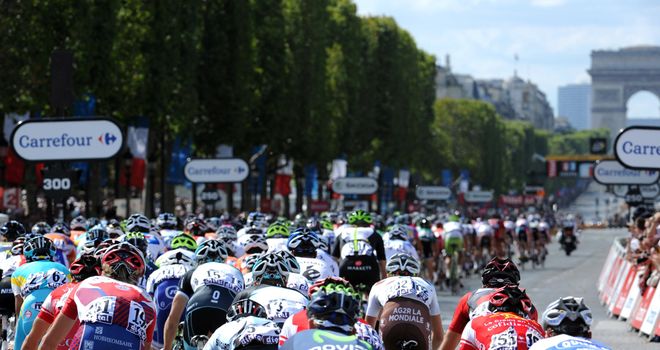
The shortest road stage of the race is saved for last as the peloton take the largely-ceremonial trip into Paris for the iconic finish on the Champs-Elysees. As ever the action will start in earnest when the riders reach the centre of the French capital, but any late attacks should be reeled in before the finish, where the sprinters will fight it out for victory. The rest of the peloton should roll in close behind to complete the ultimate test of sporting endurance, with the 2012 winner crowned.
Team Sky history
This is Team Sky's third appearance at the Tour de France. Edvald Boasson Hagen claimed the team's first stage victories with wins on stage six and 17 last year. Thomas Lofkvist's 16th-place finish in 2010 is the best GC result, while Rigoberto Uran and Geraint Thomas placed 24th and 31st respectively last year after stints in the white jersey.